

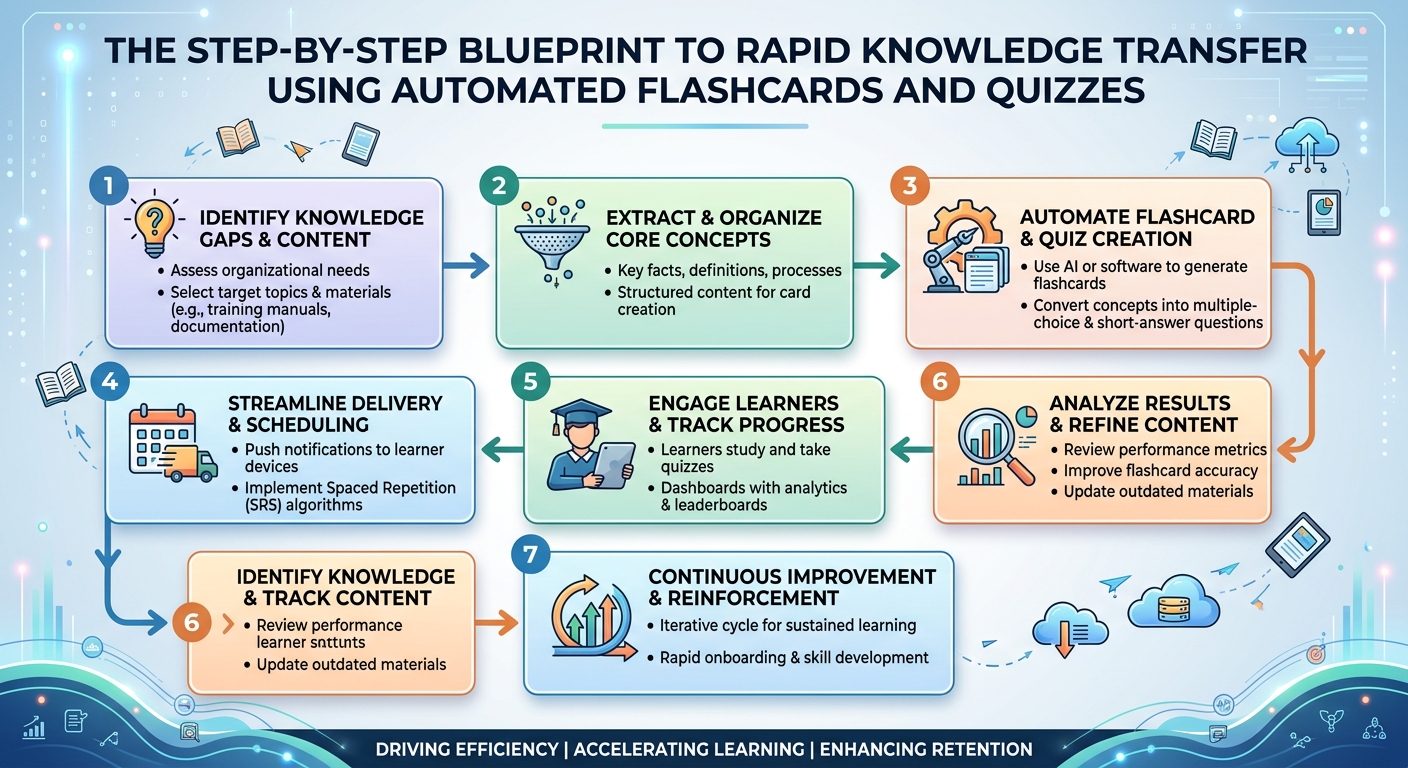
The Step-by-Step Blueprint to Rapid Knowledge Transfer Using Automated Flashcards and Quizzes
In today's fast-paced corporate environment, the ability to rapidly transfer and embed critical knowledge is not just an advantage—it's a necessity. For L&D Vice Presidents, Directors, Senior Managers, and Managers, the challenge lies in moving beyond traditional training methods that often yield slow retention rates and inconsistent application. Whether in compliance, sales, banking, finance, insurance, retail, pharma, health care, hospitality, oil and gas, or mining, the demand for agile, effective learning solutions is escalating.
This article outlines a pragmatic, step-by-step blueprint leveraging the power of automated flashcards and quizzes within a modern Microlearning LMS. This approach promises not only to accelerate knowledge transfer but also to dramatically improve retention, engagement, and measurable impact across your enterprise learning management initiatives.
Why Rapid Knowledge Transfer is Your Strategic Imperative
The stakes are high. In sectors like compliance and finance, slow knowledge uptake can lead to significant regulatory breaches and financial penalties. For sales teams, delayed understanding of new products or market shifts translates directly into lost revenue. Healthcare requires immediate mastery of new protocols, while oil and gas demands rigorous safety knowledge transfer. Traditional, lengthy courses often fall short, struggling with the forgetting curve and failing to provide sustained reinforcement.
Enter a modern learning management system that harnesses automation and intelligent design. By embracing a systematic approach to knowledge reinforcement, L&D leaders can transform their training from a periodic event into a continuous, impactful process.
The Blueprint: Six Steps to Accelerated Learning
Step 1: Define Precise Learning Objectives and Segment Content
The foundation of rapid knowledge transfer begins with precision. Break down complex subjects into atomic, digestible pieces, aligning each with a specific, measurable learning objective. This is where the principles of microlearning shine. Instead of lengthy modules, create focused learning chunks—each suitable for a flashcard or a short quiz question. For instance, in banking, a complex regulation can be dissected into several key clauses, each becoming a distinct knowledge point.
- Identify critical concepts, facts, and procedures that learners absolutely must know.
- Segment content into "knowledge nuggets" that can be grasped quickly.
- Ensure each segment addresses a clear learning outcome.
Step 2: Leverage an Intelligent Content Creation Engine
Creating thousands of flashcards and quiz questions manually is daunting. This is where innovation comes into play. An AI Powered Authoring Tool can dramatically accelerate content development. These tools can analyze existing training materials, extract key information, and automatically generate relevant flashcards and quiz questions, often with multiple-choice options or short answer formats. This not only saves immense time but also ensures consistency and quality across your learning content management system.
- Utilize machine learning to auto-generate questions and answers from source material.
- Focus human effort on refining AI-generated content and adding nuanced questions.
- Ensure diverse question types (true/false, multiple-choice, matching) for comprehensive assessment.
Step 3: Implement Spaced Repetition and Adaptive Learning Algorithms
The core mechanism for robust retention is spaced repetition. This scientific method optimizes learning by presenting information at increasing intervals, right before the learner is about to forget it. Integrated into a modern Adaptive Learning platform, flashcards and quizzes automatically adjust to each individual's performance.
- Learners who answer correctly see the item again less frequently.
- Items answered incorrectly reappear sooner, reinforcing weak areas.
- This personalized learning path ensures efficient study time and maximizes long-term recall.
Step 4: Integrate Gamification for Enhanced Engagement
Learning doesn't have to be a chore. A Gamified LMS transforms the experience by introducing elements like points, badges, leaderboards, and challenges. For instance, a sales team can compete on leaderboards for mastering new product features, or compliance officers can earn badges for completing all mandatory quizzes within a certain timeframe. This not only motivates learners but also fosters a sense of achievement and healthy competition, driving consistent engagement with the learning management software.
- Award points for correct answers and completion of quiz sets.
- Offer badges for mastering specific topics or achieving milestones.
- Create leaderboards to encourage friendly competition and visibility.
Step 5: Ensure Robust Analytics and Reporting
What gets measured gets managed. A sophisticated learning management system provides detailed analytics on learner performance. L&D leaders can monitor progress, identify common knowledge gaps, and track completion rates. This data is invaluable for:
- Pinpointing areas where content might need clarification or improvement.
- Identifying individuals or teams struggling with specific topics for targeted intervention.
- Demonstrating the ROI of your training initiatives by showcasing improved knowledge retention.
These insights allow for a data-driven approach to continuous improvement of your learning management solutions.
Step 6: Cultivate a Culture of Continuous Learning and Application
Rapid knowledge transfer isn't a one-off event; it's an ongoing process. Automated flashcards and quizzes facilitate continuous learning by making reinforcement accessible and engaging. This continuous loop of learning, recall, and application is crucial, especially for Risk-focused Training in industries like compliance and insurance.
- Integrate flashcard and quiz challenges into daily or weekly routines.
- Connect learning directly to real-world scenarios and job tasks.
- Promote peer-to-peer learning and discussion around quiz challenges.
Strategic Insights for Enhanced Learning
Question: How can learning platforms dynamically adjust content to individual learner needs and preferences for maximal engagement?
Modern platforms leverage sophisticated algorithms to analyze a learner's performance, past interactions, and even their stated preferences. This allows the system to present information in the most effective format and at the optimal pace, ensuring a highly personalized and effective learning journey. Imagine a learning content management system that automatically knows when to introduce a new concept or revisit a challenging topic for each employee.
Question: In a globally distributed enterprise, how can we ensure learning content is universally relevant and easily accessible, regardless of location or local nuances?
By utilizing a cloud based learning management system, organizations can host and deliver training modules that are accessible from anywhere, on any device. Advanced systems also offer multi-language support and localization features, ensuring that the learning experience resonates with diverse regional contexts while maintaining core messaging and compliance standards. This makes enterprise learning management truly global.
Question: What advanced capabilities do today's learning technologies offer to predict knowledge gaps and proactively recommend relevant training?
Today's cutting-edge learning management software incorporates predictive analytics and machine learning. This enables the platform to identify patterns in learner behavior and performance, foreseeing potential areas of weakness before they impact performance. It can then automatically suggest targeted microlearning modules or quizzes, turning a reactive training approach into a proactive one, significantly boosting knowledge retention and application. This is a core benefit of a smart LMS.
Conclusion
The blueprint for rapid knowledge transfer using automated flashcards and quizzes offers a powerful solution for L&D leaders grappling with the complexities of modern corporate training. By methodically defining objectives, leveraging intelligent authoring tools, implementing spaced repetition and adaptive learning, integrating gamification, and utilizing robust analytics, you can build a highly effective learning ecosystem.
This systematic approach within a robust LMS not only accelerates knowledge acquisition but also ensures long-term retention and practical application across all critical industries. Explore how a comprehensive learning management system like MaxLearn LMS can empower your organization to achieve unparalleled learning outcomes and drive measurable business growth.
.jpg)


