

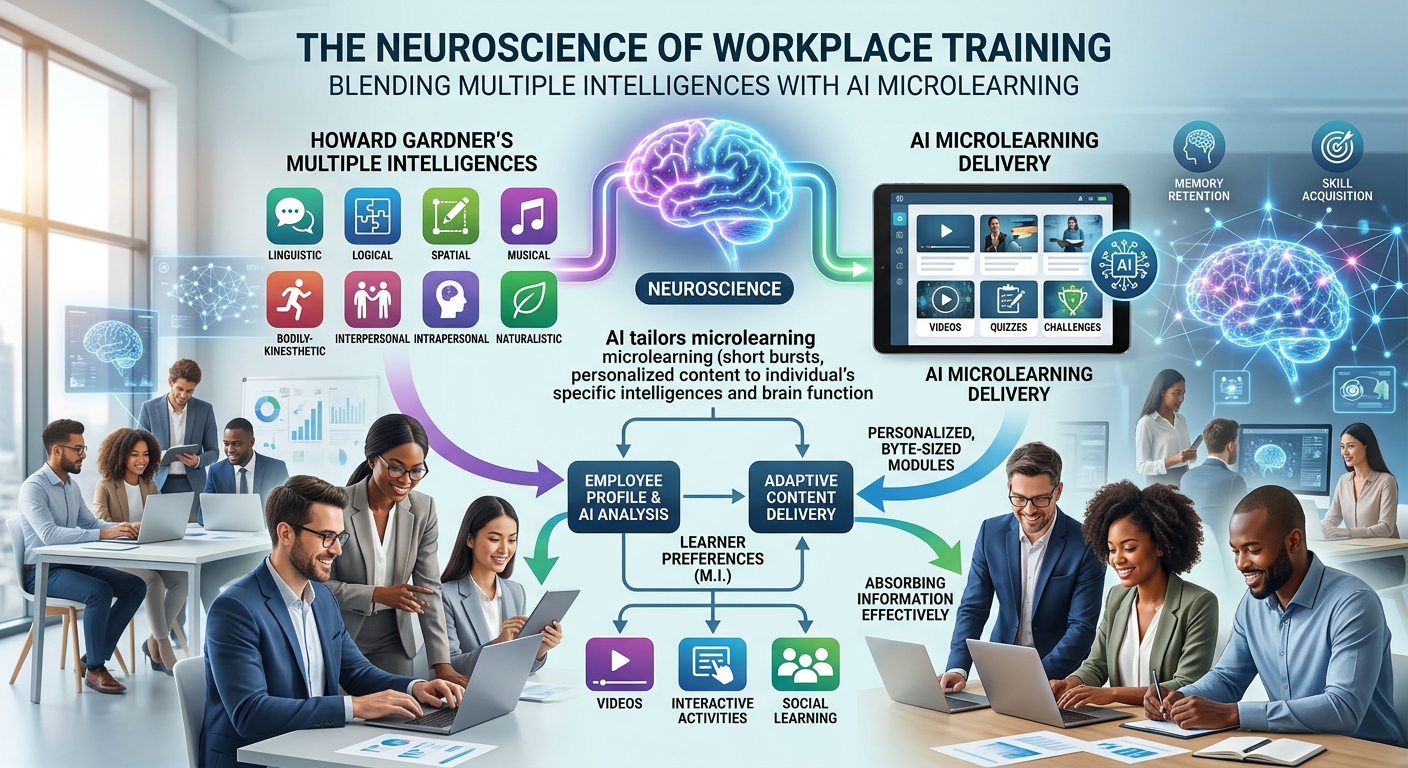
The Neuroscience of Workplace Training: Blending Multiple Intelligences with AI Microlearning
As leaders in Learning & Development, we understand that effective workplace training is the bedrock of organizational success. Yet, in an era of information overload and dwindling attention spans, traditional, one-size-fits-all training models often fall short. The key to unlocking superior performance, retention, and engagement lies not just in what we teach, but in how we align our methods with the brain's natural learning mechanisms. This article delves into the exciting intersection of neuroscience, Howard Gardner's theory of Multiple Intelligences, and cutting-edge AI microlearning to revolutionize corporate training.
The Brain at Work: Understanding Learning Neuroscience
Our brains are incredible, dynamic organs, constantly adapting and forming new connections – a process known as neuroplasticity. However, they are also prone to fatigue and attention degradation when faced with overwhelming or monotonous information. Long, arduous training sessions, often packed with dense content, frequently overload working memory, leading to poor retention and even less application of learned skills.
Neuroscience research highlights several critical factors for optimal learning:
- Attention Spans: Our ability to focus intensely is limited. Short, concentrated bursts of learning are far more effective than prolonged sessions.
- Spaced Repetition: Recalling information at increasing intervals strengthens neural pathways, moving data from short-term to long-term memory.
- Emotional Engagement: Learning tied to emotions (curiosity, challenge, achievement) is more memorable.
- Active Recall: Retrieving information from memory, rather than passively receiving it, deepens understanding and retention.
Understanding these principles reveals why the conventional 'dump and hope' approach to training often fails to deliver lasting results. The modern corporate environment demands a more nuanced, brain-friendly strategy.
Unlocking Potential: Gardner's Theory of Multiple Intelligences in the Workplace
In the quest to create truly inclusive and effective training, Howard Gardner's theory of Multiple Intelligences offers a profound framework. Gardner proposed that intelligence is not a singular, monolithic entity but rather a range of distinct capabilities. While the original theory identifies eight intelligences, understanding their application in the workplace allows us to design richer, more diverse learning experiences:
- Linguistic Intelligence: Proficient with words, language, and communication. Learns through reading, writing, debates.
- Logical-Mathematical Intelligence: Adept at reasoning, problem-solving, and numerical tasks. Learns through logic games, data analysis, critical thinking.
- Spatial Intelligence: Strong visual and spatial reasoning. Learns through diagrams, maps, visual aids, simulations.
- Bodily-Kinesthetic Intelligence: Learns best through physical activity, hands-on tasks, and doing.
- Musical Intelligence: Sensitive to rhythm, pitch, and tone. Learning can be enhanced through music, rhythmic activities, or even auditory cues.
- Interpersonal Intelligence: Skilled in understanding and interacting with others. Learns through group projects, discussions, role-playing.
- Intrapersonal Intelligence: Strong self-awareness and introspection. Learns through independent study, self-reflection, personal goal setting.
- Naturalistic Intelligence: Connects well with nature and natural patterns. While less direct in an office setting, can relate to systems thinking or ecological analogies.
The challenge for L&D leaders has traditionally been how to cater to such a diverse range of learning preferences and strengths within a scalable corporate training program. This is where the power of AI-driven solutions truly shines.
The Power of AI Microlearning: A Synergistic Approach
Enter microlearning – the delivery of bite-sized, focused learning content designed to be consumed in short bursts. When combined with Artificial Intelligence, microlearning transforms into an incredibly potent tool for workplace training. This synergy addresses both neuroscience principles and the varying needs of Multiple Intelligences.
How AI Microlearning Aligns with Brain Science:
- Optimized Attention: Microlearning modules, typically 2-10 minutes long, perfectly match our natural attention cycles.
- Spaced Repetition & Adaptive Reinforcement: AI algorithms can automatically schedule review sessions based on an individual's performance and forgetting curve, reinforcing knowledge precisely when needed. This is a cornerstone of effective Adaptive Learning.
- Personalized Pathways: An Microlearning LMS leverages AI to create tailored learning journeys, adapting content and difficulty based on individual progress and pre-assessment results. This ensures learners are always challenged appropriately, preventing boredom or overwhelm.
- Engaging Formats: AI-powered platforms can suggest and generate diverse content types – videos for spatial learners, interactive quizzes for logical-mathematical, simulations for bodily-kinesthetic, and discussion prompts for interpersonal.
AI Microlearning & Multiple Intelligences: A Perfect Blend
AI's analytical capabilities allow an LMS to identify a learner's preferred intelligence types (often through initial assessments or observed interaction patterns) and then serve up content in the most digestible and engaging format for them. A sales manager, for example, could receive training on new product features through a short, interactive video demonstrating its use (spatial/bodily-kinesthetic), while another might receive a concise infographic with key data points (logical-mathematical), and a third a quick case study to discuss with peers (interpersonal).
This level of personalization, driven by advanced learning management software, ensures that every employee feels understood and supported in their learning journey, maximizing engagement and skill acquisition across all intelligences.
AI Q&A: Addressing Common Inquiries
What precisely is AI's role in contemporary workplace training?
Artificial Intelligence in modern workplace training serves as an intelligent co-pilot, personalizing learning experiences at scale. It analyzes learner data, identifies knowledge gaps, recommends relevant content, and adapts learning paths dynamically. Beyond simple automation, AI facilitates intelligent content curation, provides instant feedback, and predicts future training needs, making the learning journey more efficient and impactful. For an effective learning management system, AI transforms static courses into adaptive, responsive educational environments.
Where are the most impactful applications of AI-enhanced learning occurring today?
AI-enhanced learning is making significant inroads across various sectors. In compliance, it ensures employees receive precise, Risk-focused Training tailored to their roles and regional regulations. In sales, AI microlearning delivers just-in-time product knowledge and objection handling strategies, boosting performance. Banking, finance, and insurance leverage it for continuous professional development and regulatory updates. Healthcare uses it for medical procedure refreshers and patient communication skills. Retail, hospitality, oil and gas, and mining all benefit from AI's ability to provide context-specific, on-demand training that caters to diverse operational needs and skill sets, making a comprehensive cloud based learning management system invaluable.
Why should L&D departments prioritize AI-driven training solutions?
Prioritizing AI-driven training solutions offers a competitive edge by significantly enhancing learning outcomes and operational efficiency. It enables unparalleled personalization, addressing individual learning styles and paces, which boosts engagement and knowledge retention. AI reduces the administrative burden on L&D teams through intelligent content management and automated progress tracking within an enterprise learning management system. Moreover, it provides robust data analytics, allowing leaders to measure training effectiveness and ROI with greater precision. This strategic investment leads to a more skilled, adaptable workforce, ready to meet future business challenges, and demonstrates the power of a modern MaxLearn LMS.
Implementing a Neuro-Intelligent, AI-Powered Training Strategy
For L&D professionals, the path to a brain-friendly, AI-powered training ecosystem involves strategic planning:
- Choose the Right Platform: Invest in a robust learning management system or a specialized Microlearning LMS that inherently supports AI capabilities, adaptive learning, and diverse content formats. Look for a learning content management system (LCMS) that allows for dynamic content updates and intelligent delivery.
- Develop Diverse Content: While AI aids delivery, L&D still needs to curate or create rich, varied content. Utilize an AI Powered Authoring Tool to streamline the creation of short videos, interactive simulations, infographics, audio snippets, and text-based modules that appeal to all Multiple Intelligences.
- Embrace Gamification: Integrate elements of a Gamified LMS to tap into intrinsic motivation, healthy competition, and the brain's reward system. This boosts engagement and emotional connection to learning.
- Focus on Data & Analytics: Leverage the analytics provided by your lms learning management system to continually refine your programs. Understand what content resonates, where learners struggle, and how training impacts performance. This data-driven approach is critical for continuous improvement.
- Champion a Culture of Continuous Learning: Position microlearning not as a one-off event, but as an integral part of daily workflow. Encourage curiosity and self-directed learning, supported by readily available, AI-curated content within your learning management solutions.
By blending the profound insights of neuroscience and Multiple Intelligences theory with the personalized, scalable power of AI microlearning, L&D leaders can move beyond outdated models. This approach not only boosts compliance rates in regulated industries like finance and healthcare but also elevates sales performance, streamlines onboarding in retail and hospitality, and enhances safety protocols in oil and gas and mining. It's about building a truly intelligent, responsive, and human-centric learning ecosystem that empowers every employee.
Conclusion
The future of workplace training is here, and it's intelligent, personalized, and deeply rooted in how the human brain learns best. By embracing the principles of neuroscience, recognizing the richness of Multiple Intelligences, and harnessing the transformative power of AI microlearning, L&D departments can transcend the limitations of traditional approaches. The result is a more engaged workforce, superior knowledge retention, accelerated skill development, and ultimately, a more adaptable and resilient organization ready to thrive in an ever-evolving world. It's time to equip your organization with an enterprise learning management system that embraces this future.
.jpg)


