

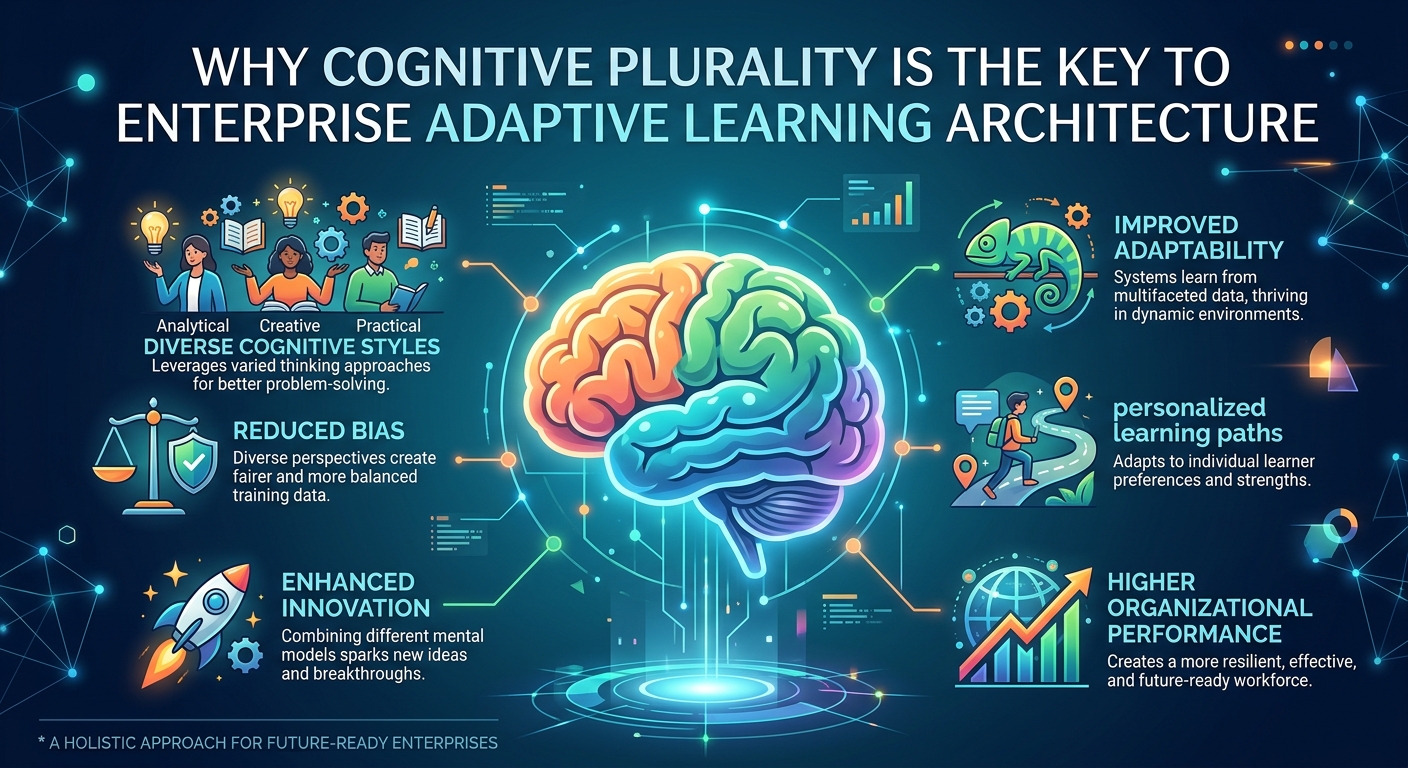
Why Cognitive Plurality Is the Key to Enterprise Adaptive Learning Architecture
In today's rapidly evolving business landscape, the ability of an enterprise to adapt, innovate, and thrive hinges critically on the continuous development of its workforce. Traditional, one-size-fits-all learning models are increasingly falling short, struggling to keep pace with dynamic market demands and the diverse needs of modern employees. This is where the concept of cognitive plurality, coupled with an intelligent adaptive learning architecture, becomes not just beneficial, but absolutely essential for any forward-thinking organization.
For L&D Vice Presidents, Directors, and Senior Managers, understanding and implementing an adaptive learning framework that embraces cognitive plurality is paramount. It’s about moving beyond generic training modules to create deeply personalized, effective, and engaging learning experiences that resonate with every individual across varied industries like Compliance, Sales, Banking, Finance, Insurance, Retail, Pharma, Healthcare, Hospitality, Oil and Gas, and Mining.
Understanding Cognitive Plurality in the Enterprise Context
Cognitive plurality refers to the inherent diversity in how individuals perceive, process, learn, and apply information. Within any enterprise, this translates into a rich tapestry of learning styles, problem-solving approaches, intellectual strengths, and experiential backgrounds. Some employees might be visual learners, others auditory, some thrive with hands-on kinesthetic experiences, while many prefer reading and writing.
Furthermore, cognitive plurality extends to varied levels of prior knowledge, different speeds of assimilation, and distinct motivational triggers. Ignoring this inherent diversity leads to inefficient training, disengaged learners, and ultimately, a workforce that isn't optimally equipped for the challenges ahead. A truly effective learning management system must acknowledge and cater to this rich mosaic of minds.
The Imperative for Adaptive Learning Architecture
An adaptive learning architecture is a sophisticated system designed to personalize the learning journey for each individual. Instead of a fixed curriculum, it dynamically adjusts content, pace, and instructional methods based on a learner's performance, preferences, and progress. It leverages data and analytics to provide relevant, timely, and impactful learning experiences.
The goal is to move away from static course catalogs towards a responsive ecosystem that ensures every employee receives the right training, at the right time, in the right format. This is critical for industries facing constant regulatory changes, new product launches, or evolving technological landscapes. A robust LMS is the backbone of such an architecture, enabling a comprehensive learning content management system.
Connecting Cognitive Plurality and Adaptive Learning
The true power emerges when cognitive plurality is at the core of your adaptive learning strategy. By recognizing and responding to individual cognitive differences, an adaptive system can:
- Tailor Content Delivery: Present information through preferred modalities (e.g., videos for visual learners, podcasts for auditory learners, interactive simulations for kinesthetic learners). A Microlearning LMS can be particularly effective here, breaking down complex topics into digestible, varied formats.
- Adjust Pace and Difficulty: Accelerate learning for those who grasp concepts quickly and provide additional support or alternative explanations for those who need more time or a different approach.
- Personalize Learning Paths: Create unique learning trajectories based on an employee's existing skills, job role, career aspirations, and identified knowledge gaps. This moves beyond generic learning management software to a truly individualized experience.
- Enhance Engagement: By offering relevant, personalized, and appropriately challenging content, learners stay more motivated and invested. This is further amplified by a Gamified LMS which can transform learning into an engaging experience.
Leveraging Technology for an Inclusive Learning Ecosystem
Implementing an adaptive learning architecture that caters to cognitive plurality requires sophisticated technology. A modern enterprise learning management system acts as the central hub. It’s not just about content delivery; it's about intelligent orchestration.
How can intelligent systems enhance learning pathways for individual employees?
Intelligent systems, often powered by advanced algorithms, analyze learner data – their interactions, assessment scores, time spent on modules, and even emotional responses to content. Based on this, they can:
- Recommend next steps, resources, or challenges that align with an individual's unique learning profile.
- Identify areas where a learner might struggle and proactively offer supplementary materials or alternative explanations.
- Optimize content sequence and presentation to maximize understanding and retention.
This dynamic personalization is the essence of effective Adaptive Learning.
How can data-driven insights from learning platforms inform global training strategies across diverse workforces?
A comprehensive learning management system (LMS) gathers vast amounts of data. When this data is analyzed intelligently, it provides invaluable insights into macro trends across different departments, regions, or even countries. For instance, it can reveal:
- Common skill gaps within a particular role globally.
- Effectiveness of specific training modules across diverse cultural backgrounds.
- Engagement levels with different content types in various geographical locations.
These insights empower L&D leaders to refine global training strategies, ensuring cultural relevance and universal effectiveness, making the lms learning management system a powerful strategic tool.
What role does advanced analytical processing play in identifying latent skill gaps and future training needs within an organization?
Beyond current performance, advanced analytical processing can predict future needs. By correlating learning data with job performance metrics, industry trends, and organizational objectives, these systems can:
- Identify skills that are becoming obsolete and proactively suggest new learning paths.
- Pinpoint emerging skill requirements based on strategic business goals.
- Detect patterns in learner behavior that indicate a potential struggle with certain competencies before it impacts performance.
This predictive capability, supported by an AI Powered Authoring Tool for content creation and a robust cloud based learning management system, allows organizations to stay ahead of the curve, preparing their workforce for tomorrow's challenges.
Building an Adaptive Learning Architecture for Plurality: Key Components
To successfully integrate cognitive plurality into an adaptive learning architecture, consider these essential components:
- Comprehensive Diagnostics: Initial assessments that go beyond simple knowledge checks to identify learning styles, cognitive preferences, and existing skill levels.
- Flexible Content Repository: A rich LCMS (Learning Content Management System) with a variety of content formats (video, audio, text, simulations, quizzes) that can be dynamically assembled. An AI Powered Authoring Tool can significantly streamline this content creation.
- Dynamic Recommendation Engine: The intelligence layer that processes learner data and recommends personalized learning paths, resources, and activities.
- Continuous Feedback Loops: Mechanisms for learners to provide feedback, allowing the system to refine its adaptations. This ensures the learning management solutions remain relevant.
- Robust Analytics and Reporting: Tools for L&D professionals to monitor individual and aggregate learning progress, identify trends, and measure the impact of training. This is crucial for optimizing Risk-focused Training and other critical areas.
The Payoff: Enhanced Performance and Resilience
Embracing cognitive plurality through an adaptive learning architecture delivers tangible benefits across all industries:
- For Compliance Training: Ensures every employee, regardless of their preferred learning style, fully grasps critical regulatory information, reducing risk.
- For Sales Training: Personalizes skill development, leading to more effective sales techniques and better client engagement.
- For Banking & Finance: Adapts to complex product knowledge and changing market conditions, building a more agile workforce.
- For Healthcare & Pharma: Customizes training for new drug protocols or medical procedures, critical for patient safety and innovation.
By investing in a modern LMS and developing an adaptive strategy, organizations not only improve learning outcomes but also foster a more engaged, skilled, and resilient workforce. This approach transforms learning from a one-time event into a continuous, personalized journey of growth.
Conclusion
Cognitive plurality is not a challenge to overcome, but a strategic asset to leverage. By designing an adaptive learning architecture that acknowledges and embraces the diverse ways people learn, enterprises can unlock the full potential of their workforce. This shift from a generic to a personalized approach, powered by intelligent MaxLearn LMS solutions, is the key to building an agile, knowledgeable, and future-proof organization. For L&D leaders, the time to champion cognitive plurality as the cornerstone of enterprise learning is now.
.jpg)


