

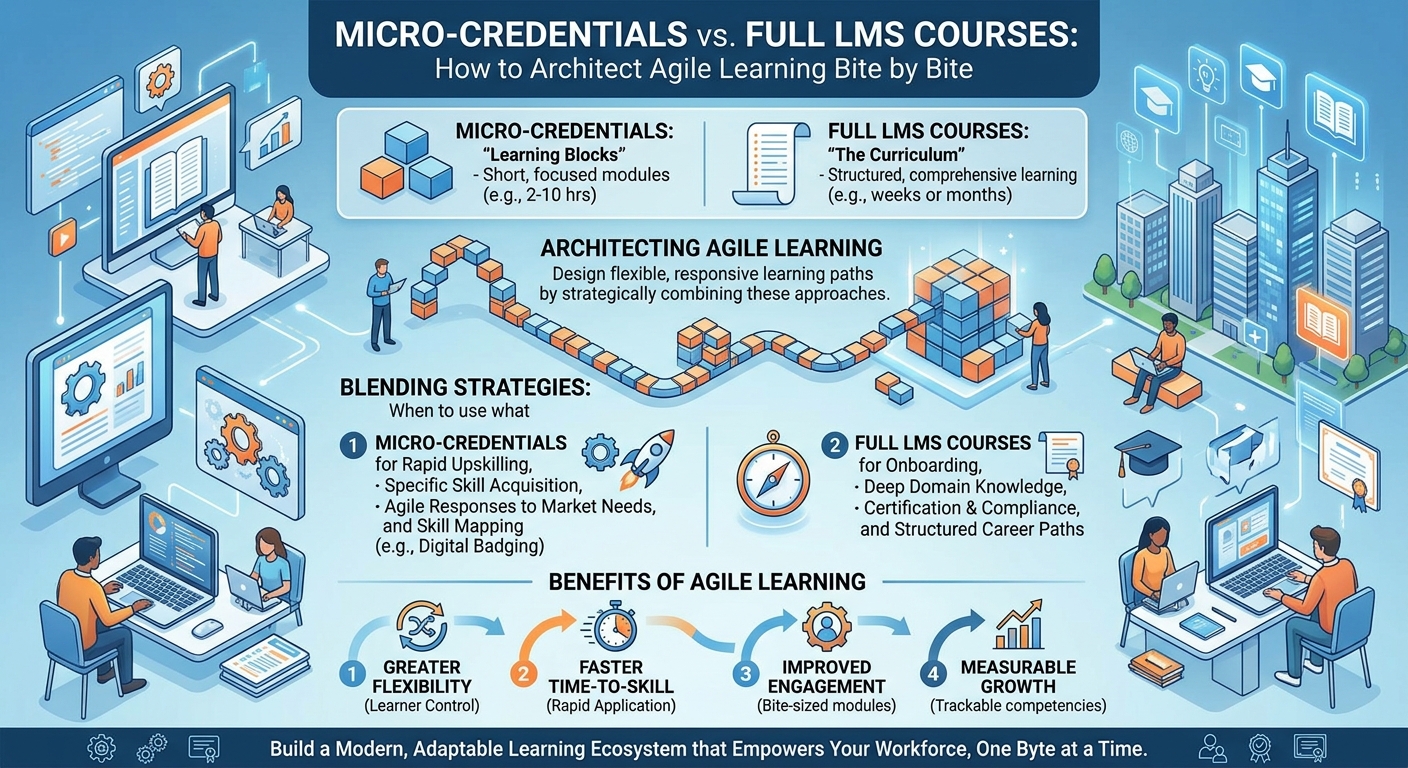
Micro-Credentials vs. Full LMS Courses: How to Architect Agile Learning Bite by Bite
In today's hyper-competitive and rapidly evolving business landscape, the mandate for Learning & Development (L&D) leaders is clear: foster continuous learning, drive skill acquisition, and ensure workforce readiness at an unprecedented pace. Vice Presidents, Directors, and Senior Managers in L&D across industries like Compliance, Sales, Banking, Finance, Insurance, Retail, Pharma, Healthcare, Hospitality, Oil and Gas, and Mining are constantly seeking the most effective and efficient ways to deliver impactful training.
The rise of digital learning solutions has presented a critical question: should we focus on bite-sized micro-credentials or comprehensive, full LMS courses? The answer, as with most strategic decisions, isn't an either/or but rather a thoughtful integration. This article explores the nuances of both approaches, demonstrating how to architect an agile learning ecosystem that leverages their respective strengths.
The Evolving L&D Landscape: Agility as the New Mandate
The traditional model of long, infrequent training sessions is increasingly inadequate. Modern work demands immediate application of knowledge, frequent reskilling, and personalized learning paths. Employees need just-in-time access to information to solve problems and master new tools or regulations. This shift places pressure on L&D to deliver learning content that is not only relevant but also consumable and impactful within the flow of work.
An effective learning management system (LMS) is no longer just a repository; it's a strategic platform for talent development. A robust learning content management system or learning management software needs to support diverse learning formats to cater to varied needs and learning styles. Whether it's an enterprise learning management solution or a cloud based learning management system, flexibility is key.
Demystifying Micro-Credentials: The Power of the Bite-Sized
Micro-credentials are short, focused learning experiences designed to teach a specific skill or concept. They are often digital, self-paced, and culminate in a verifiable digital badge or certificate. Think of them as concentrated doses of knowledge, perfect for addressing immediate skill gaps or updating specific competencies.
- Precision Skill Development: Micro-credentials target single skills, making learning highly relevant and immediately applicable. For instance, a finance professional might earn a micro-credential in "Advanced Excel for Data Analysis" or a healthcare worker in "New HIPAA Compliance Regulations."
- Flexibility and Accessibility: Their short duration (often 15-60 minutes) allows learners to integrate training into busy schedules, reducing time away from core duties. This makes them ideal for on-the-go learning, supported by a modern Microlearning LMS.
- Rapid Deployment: L&D teams can quickly develop and deploy micro-credentials in response to urgent business needs, market changes, or new regulatory requirements. This is particularly valuable for Risk-focused Training in banking and insurance, or for rapid product updates in retail and pharma.
- Enhanced Engagement: The achievement of frequent, small goals and immediate feedback can significantly boost learner motivation, especially when combined with a Gamified LMS.
The Enduring Value of Full LMS Courses: Comprehensive Mastery
Full LMS courses, conversely, are comprehensive programs designed to impart a broad base of knowledge, foundational skills, or deeper understanding of complex subjects. They typically involve multiple modules, assignments, and assessments, often leading to formal qualifications or professional certifications.
- Foundational Knowledge: These courses provide the extensive theoretical framework and practical application necessary for roles requiring deep expertise, such as a new manager in Oil and Gas or a software engineer in Banking.
- Career Pathways: Full courses are crucial for career development, fostering a holistic understanding that prepares employees for new roles or significant promotions. They build the "why" behind the "how."
- In-depth Exploration: When a subject requires significant context, nuanced understanding, or complex problem-solving skills, a full course provides the necessary depth. Think of training for complex financial instruments or intricate pharmaceutical development processes.
- Structured Learning Journey: They offer a guided, structured path that can be essential for complex compliance frameworks or the onboarding of new employees into highly regulated industries.
Architecting the Agile Learning Ecosystem: When to Choose Which (and How to Combine)
The key to architecting agile learning is to view micro-credentials and full courses not as competitors but as complementary components within a holistic learning management system (LMS) strategy. A truly effective LCMS supports both seamlessly.
Strategic Applications of Micro-Credentials:
- Compliance Updates: In Banking, Pharma, or Healthcare, annual compliance training can be broken into micro-credentials covering specific regulatory changes.
- Sales Training: A sales team can quickly learn about a new product feature or sales technique through a 15-minute micro-credential, rather than waiting for a full course. Leveraging an AI Powered Authoring Tool can expedite the creation of such targeted content.
- Upskilling Specific Tools/Software: If a new CRM module is implemented, micro-credentials can teach specific functionalities.
- Risk-focused Training: Specific risk scenarios or mitigation strategies in Finance or Oil and Gas can be addressed with targeted, rapid micro-content.
Foundational Learning with Full Courses:
- New Hire Onboarding: A comprehensive introduction to company culture, core values, and fundamental job responsibilities.
- Leadership Development: Programs that build soft skills, strategic thinking, and emotional intelligence over time.
- Industry Certifications: Preparing employees for certifications essential in Pharma, Healthcare, or Finance.
- Complex Operational Procedures: Detailed training for intricate processes in Manufacturing, Oil & Gas, or Hospitality management.
The optimal approach often involves a blended strategy. A full course might establish foundational knowledge, while micro-credentials provide ongoing updates, deep dives into specific topics, or reinforcement training. For example, a full course on "Project Management Fundamentals" could be followed by micro-credentials on "Agile Scrum Techniques" or "Risk Management in Projects."
The AI Revolution in Agile Learning: Smarter, Faster, More Personalized
Artificial intelligence is transforming how L&D architects learning, bridging the gap between micro-credentials and full courses with unprecedented efficiency and personalization.
How can intelligent systems optimize the delivery of learning content? AI can analyze learner performance, preferences, and job roles to recommend the most relevant micro-credentials or modules within a full course. This ensures that each learner receives a truly personalized learning path.
What's the impact of intelligent algorithms on personalized learning paths? Adaptive Learning powered by AI adjusts the content difficulty and sequence in real-time based on a learner's progress, ensuring optimal challenge and engagement. This dynamic tailoring, whether for a 10-minute micro-lesson or a multi-hour module, maximizes retention and efficiency.
Can smart tools assist in curating relevant learning content? Absolutely. An AI Powered Authoring Tool can significantly reduce the time and effort required to create and update learning materials. It can generate initial content drafts, identify knowledge gaps, and even suggest relevant media, making it easier to maintain an up-to-date learning management system (LMS) library. This is vital for industries with constantly changing regulations or product lines.
Key AI Applications in Agile Learning:
- Personalized Recommendations: AI algorithms suggest specific micro-credentials or sections of full courses based on individual skill gaps and career goals.
- Content Curation and Generation: AI assists in identifying, creating, and updating learning resources, ensuring their relevance and quality.
- Performance Analytics: Intelligent systems track learner progress, identify areas of struggle, and provide insights for L&D teams to refine their programs.
- Virtual Tutors and Chatbots: Provide on-demand support and answer learner questions, freeing up human instructors for more complex tasks.
The Future of Learning: MaxLearn's Vision for Enterprise Agility
Building an agile learning ecosystem requires a sophisticated learning management system (LMS) that can seamlessly integrate micro-credentials with comprehensive courses, adapt to individual needs, and leverage the power of AI. A platform like MaxLearn LMS is designed precisely for this purpose. It offers the flexibility to deliver bite-sized learning, robust tools for managing extensive course libraries, and AI-driven features for personalization and efficiency.
From a learning management software perspective, embracing both micro-credentials and full courses means providing a versatile toolkit for L&D professionals. It enables them to respond to dynamic business needs, whether it's rapid compliance training in Banking or deep technical expertise in Oil and Gas, ensuring that every employee has access to the right learning, at the right time, in the right format. By strategically combining these approaches, L&D leaders can architect a learning strategy that is truly agile, scalable, and impactful across any industry.
In conclusion, the debate between micro-credentials and full LMS courses is best reframed as an opportunity for integration. By thoughtfully blending these powerful learning modalities within a modern, AI-enhanced learning management system (LMS), L&D leaders can build an agile learning architecture that not only addresses immediate skill needs but also cultivates deep, lasting expertise, empowering their organizations to thrive in an ever-changing world.
.jpg)


