

How Does Spaced Repetition Beat the Ebbinghaus Forgetting Curve in Corporate Training?
In the high-stakes world of corporate learning and development, the battle against forgotten knowledge is perennial. L&D leaders, VPs, and Directors across industries like Compliance, Sales, Banking, Finance, Insurance, Retail, Pharma, Healthcare, Hospitality, Oil and Gas, and Mining constantly seek strategies to ensure that training investments translate into lasting proficiency and performance. The challenge? Hermann Ebbinghaus’s Forgetting Curve – a stark reminder that without reinforcement, most learned information rapidly fades from memory. However, a scientifically proven methodology, Spaced Repetition, offers a powerful antidote, transforming how organizations approach knowledge retention.
This article delves into how Spaced Repetition systematically dismantles the Forgetting Curve, ensuring that critical skills and information, from compliance regulations to complex product details, stick with your workforce long-term, powered by advanced eLearning solutions.
Understanding the Ebbinghaus Forgetting Curve
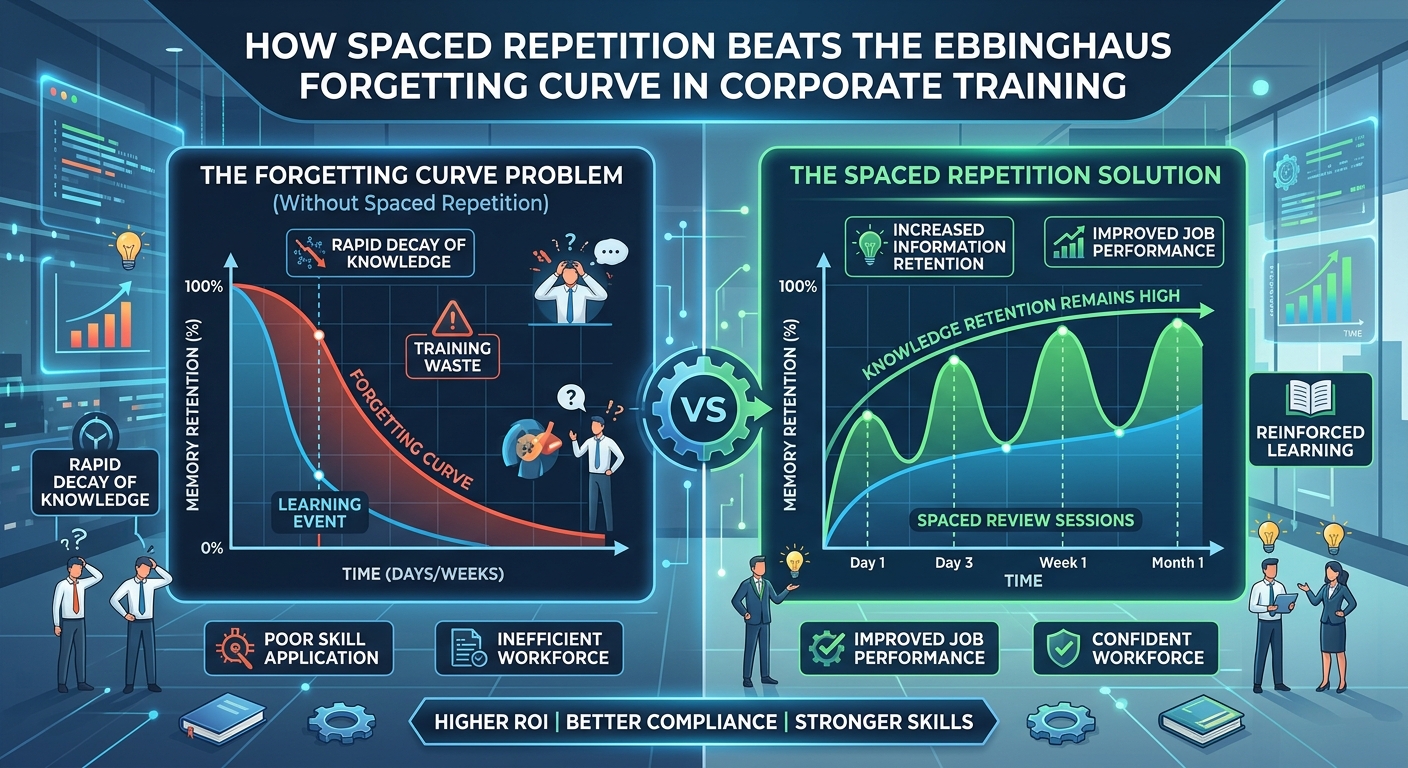
Hermann Ebbinghaus, a German psychologist, pioneered the study of memory and forgetting in the late 19th century. His groundbreaking research revealed that without active recall or reinforcement, people forget approximately 50% of newly learned information within an hour, and an astounding 70% within 24 hours. This rapid decline in retention, visualized as the Forgetting Curve, is a fundamental hurdle for any corporate training program.
For L&D professionals, this means that even the most brilliantly designed workshops or engaging online modules can be largely ineffective if learners aren't given structured opportunities to revisit and recall the material. Imagine the lost potential for a sales team forgetting key product features, or a compliance department struggling with lapsed regulatory knowledge. The financial implications, from re-training costs to potential errors and missed opportunities, are significant.
The Spaced Repetition Solution: Reinforcing Memory Effectively
Spaced Repetition is an evidence-based learning technique that strategically schedules reviews of previously learned material at increasing intervals. Instead of rote memorization or random review, it leverages the science of memory to present information precisely when a learner is about to forget it. This method strengthens memory traces, moving knowledge from short-term to long-term retention.
At its core, Spaced Repetition works by:
- Presenting new information.
- Scheduling the first review shortly after the initial learning.
- Increasing the time interval between subsequent reviews, assuming successful recall.
- Shortening the interval if the learner struggles to recall the information, adapting to individual performance.
This dynamic adjustment ensures that learners are challenged just enough to retrieve the information, reinforcing the memory without unnecessary repetition that can lead to boredom or inefficiency.
How Spaced Repetition Works in Corporate Training
Integrating Spaced Repetition into corporate training isn't merely about more quizzes; it's about smart, strategic reinforcement, often facilitated by a sophisticated Microlearning LMS. Consider a scenario where employees complete an initial training module on a new software application.
A common inquiry among learning professionals is: "When is the most effective moment for learners to revisit new information?" With Spaced Repetition, instead of a one-time assessment, the system might:
- Day 1: Initial Learning. Employees complete the training module.
- Day 2-3: First Review. A quick, targeted quiz or micro-activity covering key concepts is delivered.
- Day 7: Second Review. Another short review session is prompted.
- Day 30: Third Review. A more comprehensive review activity might be scheduled.
- Ongoing: Adaptive Reviews. Future review intervals are adjusted based on individual learner performance, ensuring challenging topics are revisited more frequently until mastery is achieved.
This iterative process embeds knowledge deeply, making it readily accessible when needed. For instance, in an industry like banking or finance, where regulatory compliance is paramount, Adaptive Learning paths can ensure that complex legal frameworks are revisited strategically, drastically reducing the risk of non-compliance due to forgotten details. An effective learning management system makes managing these intervals seamless across an entire workforce.
Benefits for Corporate Training Programs
Enhanced Knowledge Retention and Application
The primary benefit of Spaced Repetition is its unparalleled ability to combat the Forgetting Curve. By systematically reinforcing learning, it ensures that employees not only remember information but can also apply it effectively in real-world scenarios. This is crucial for sectors like healthcare, where precise knowledge application can be life-saving, or sales, where retaining intricate product knowledge directly impacts closing deals.
Improved Performance and Productivity
When employees consistently retain information, they perform better. Less time is spent searching for forgotten facts or re-learning procedures. This leads to increased efficiency, higher quality work, and greater overall productivity across the organization. Imagine a hospitality team flawlessly recalling service protocols or an oil and gas crew remembering critical safety procedures – the impact is immediate and measurable.
Cost-Effectiveness and ROI
By preventing knowledge decay, Spaced Repetition reduces the need for frequent, full-scale retraining sessions. This translates into significant cost savings on training development, delivery, and lost employee productivity during lengthy courses. It maximizes the return on investment for every dollar spent on L&D initiatives, providing a clearer value proposition for enterprise learning management.
Compliance and Risk Mitigation
Many L&D leaders ask: "How can we ensure critical compliance knowledge sticks for employees across all global operations?" For industries with stringent regulations such as Pharma, Banking, and Insurance, Risk-focused Training amplified by Spaced Repetition is indispensable. It ensures that crucial policies, ethical guidelines, and legal requirements are consistently remembered and adhered to, significantly mitigating the risk of non-compliance, penalties, and reputational damage. A robust Microlearning LMS can automate these critical reminders.
Increased Employee Engagement
Modern Spaced Repetition systems often incorporate elements of Gamified LMS designs, turning review sessions into engaging challenges rather than tedious tasks. Short, frequent interactions prevent cognitive overload and maintain learner interest. This continuous engagement fosters a culture of learning and continuous improvement, a key differentiator for attracting and retaining talent.
Integrating Spaced Repetition with Modern eLearning Solutions
The true power of Spaced Repetition is unleashed when combined with cutting-edge eLearning technologies. A comprehensive learning management system (LMS) or learning content management system (LCMS) serves as the backbone for delivering these intelligent learning experiences.
For example, a modern Microlearning LMS can automatically track individual learner performance, identifying knowledge gaps and dynamically scheduling personalized review content. This allows for truly personalized learning paths, catering to the unique needs of each employee.
Consider the query: "What methods can swiftly equip a sales team with complex product knowledge that truly lasts?" Leveraging an AI Powered Authoring Tool within a Microlearning LMS for sales training allows L&D teams to rapidly create bite-sized content modules. These modules can then be deployed through a spaced repetition schedule, ensuring that sales professionals not only grasp new product features quickly but also retain them for client interactions. Such an approach transforms a standard learning management software into a strategic asset.
Furthermore, cloud based learning management system solutions offer the scalability and accessibility required for global workforces, ensuring that everyone, from retail associates to mining engineers, benefits from consistent, effective reinforcement. The best learning management solutions, such as MaxLearn LMS, integrate these functionalities seamlessly, providing a powerful platform for enterprise learning management.
AI-Driven Insights for Optimal Learning
In today's data-rich environment, "What strategies can boost employee knowledge retention effectively across diverse skill sets and roles?" is a question many L&D professionals are pondering. Artificial intelligence plays a pivotal role in optimizing Spaced Repetition. AI algorithms can analyze vast amounts of learner data to predict when an individual is likely to forget a particular piece of information, tailoring the review schedule with unprecedented precision. This goes beyond simple fixed intervals, creating a truly Adaptive Learning experience.
Consider another common challenge: "How can technology personalize learning experiences for diverse global teams, especially for critical compliance or safety training?" An advanced learning management system, coupled with AI, can dynamically adjust content delivery and review timing based on an individual's prior knowledge, learning style, and even cultural context. This level of personalization makes learning more relevant and effective for a heterogeneous workforce, as seen in industries like hospitality or large-scale retail.
Conclusion
The Ebbinghaus Forgetting Curve presents a formidable challenge to corporate training, but it is not an insurmountable one. Spaced Repetition, when strategically implemented with modern eLearning technologies like a sophisticated Microlearning LMS, provides a scientifically validated method to beat memory decay. For Vice Presidents, Directors, and Managers of L&D, adopting Spaced Repetition isn't just about improving learning outcomes; it's about making smarter investments in human capital, enhancing operational efficiency, mitigating risks, and ultimately, driving sustained business growth across all segments – from compliance to sales, banking to healthcare.
By embracing this powerful methodology, organizations can transform their training programs from fleeting knowledge acquisition into a foundation of enduring expertise and peak performance.
.jpg)


