

How Do Spaced Repetition Algorithms Interact with Different Learning Styles?
As leaders in Learning & Development, you are constantly seeking innovative strategies to maximize knowledge retention, enhance skill acquisition, and ensure compliance across your organization. In an era where information overload is common, and the demands for continuous learning are escalating across industries like Compliance, Sales, Banking, Finance, Insurance, Retail, Pharma, Healthcare, Hospitality, Oil and Gas, and Mining, the effectiveness of training methodologies is paramount. One powerful technique gaining significant traction is spaced repetition, a scientifically-backed method for optimizing long-term memory.
However, the modern workforce is not monolithic. Learners bring diverse cognitive preferences, often categorized into various learning styles. The critical question for L&D professionals then becomes: How can spaced repetition, a seemingly rigid algorithmic approach, effectively cater to and enhance learning for individuals with different learning styles? This article delves into that synergy, exploring how you can leverage advanced learning management system technologies to create more adaptive and impactful learning experiences.
Understanding the Power of Spaced Repetition
At its core, spaced repetition is an evidence-based learning technique that involves reviewing previously learned material at increasing intervals over time. Instead of cramming, this method strategically resurfaces information just as you're about to forget it, pushing it back into long-term memory. This approach is rooted in cognitive science, specifically the 'forgetting curve' phenomenon identified by Hermann Ebbinghaus, which illustrates how information loss is rapid at first and then gradually slows down.
Modern LMS platforms integrate sophisticated spaced repetition algorithms that dynamically adjust review schedules based on individual performance and recall strength. This personalized approach is far more efficient than traditional review methods, leading to significantly improved retention rates and a deeper understanding of complex topics, whether it's understanding new financial regulations in Banking or mastering sales techniques in Retail.
Exploring Diverse Learning Styles in the Workplace
While the concept of distinct learning styles has been debated, acknowledging that individuals absorb and process information differently remains crucial for effective instructional design. For L&D leaders, understanding these preferences allows for the creation of more inclusive and engaging training programs. Commonly recognized styles include:
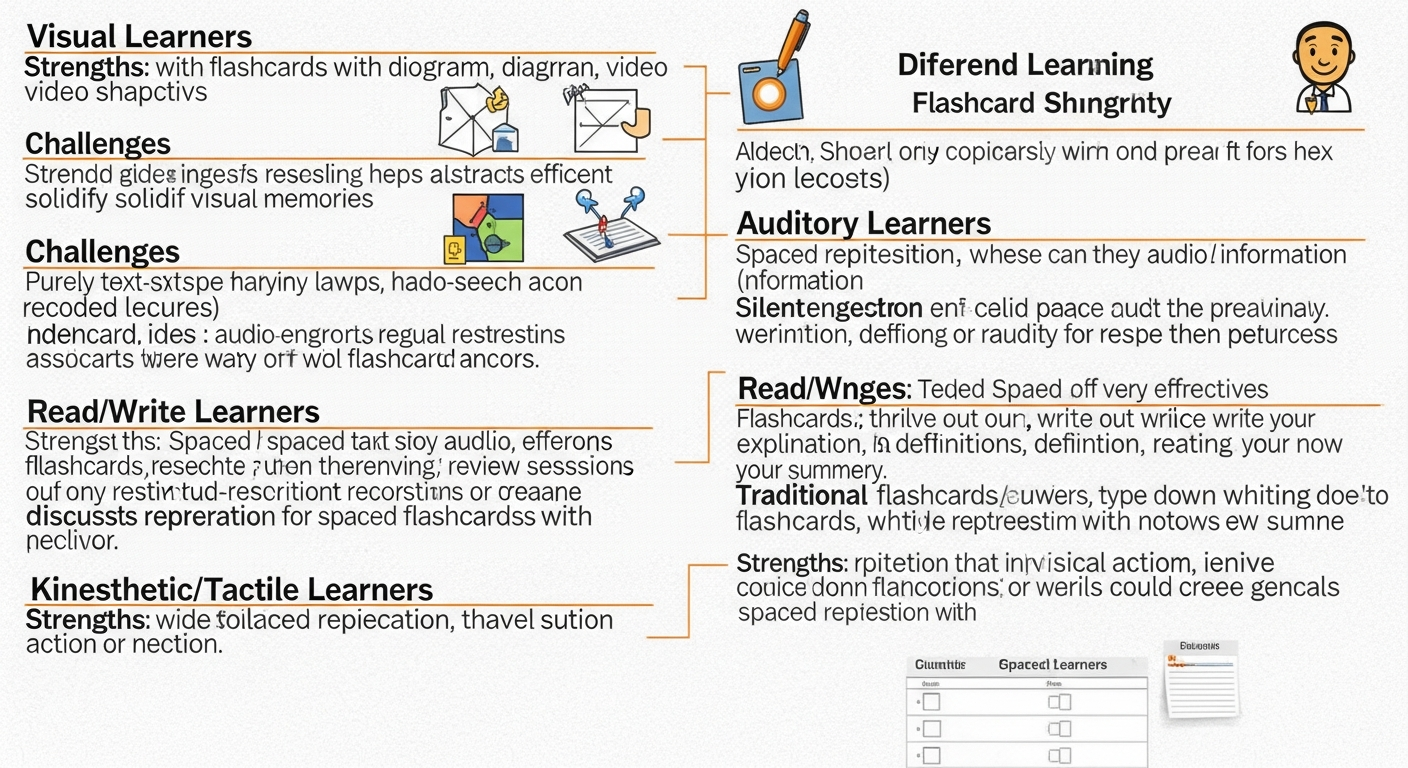
- Visual Learners: Prefer to learn through seeing – diagrams, charts, images, videos, and demonstrations. They often benefit from color-coding and spatial organization.
- Auditory Learners: Learn best by hearing – lectures, discussions, audio recordings, and verbal instructions. They often benefit from explaining concepts aloud.
- Read/Write Learners: Excel through text – reading textbooks, writing notes, lists, and summaries. They prefer information presented in written form.
- Kinesthetic/Experiential Learners: Learn by doing, touching, and experiencing – hands-on activities, simulations, role-playing, practical exercises, and field trips.
Most individuals exhibit a blend of these styles, with one or two often being dominant. A truly effective learning management software recognizes this complexity and offers varied content formats.
The Synergy: Spaced Repetition Meets Learning Styles
The beauty of modern learning management solutions lies in their ability to combine the algorithmic precision of spaced repetition with the flexibility to accommodate diverse learning styles. Here's how this powerful interaction unfolds:
For Visual Learners
Spaced repetition can be highly effective for visual learners when content is presented appropriately. Instead of just text, recall prompts can feature:
- Flashcards with images, infographics, or flowcharts.
- Short video snippets or animations demonstrating processes (e.g., equipment operation in Oil and Gas).
- Interactive diagrams where learners must identify parts or steps.
- Mind maps or visual summaries that need to be completed or recalled.
An LCMS that supports a rich media library and allows for custom visual elements can significantly boost retention for this group.
For Auditory Learners
Auditory learners thrive when they can hear the information. For them, spaced repetition intervals can include:
- Audio flashcards where questions are spoken, and answers are provided verbally.
- Short podcast-style summaries or narrations of key concepts.
- Opportunities to record themselves explaining a concept, which can then be played back for self-assessment.
- Discussion prompts or simulated conversations to recall and articulate information, especially crucial for nuanced topics in Healthcare or Compliance.
Platforms that support integrated audio features can make spaced repetition much more engaging for auditory learners.
For Read/Write Learners
This style aligns naturally with many traditional spaced repetition methods, which are often text-based. However, engagement can be enhanced by:
- Detailed text-based flashcards, requiring short-answer responses or paragraph summaries.
- Prompts to write out explanations of complex theories or procedures (e.g., financial regulations in Finance).
- Interactive quizzes that require written input, rather than just multiple-choice.
- The ability to integrate personal notes directly into the lms learning management system for recall.
Providing varied text formats and opportunities for written articulation ensures deep processing for these learners.
For Kinesthetic/Experiential Learners
Kinesthetic learners benefit immensely from active engagement. For them, spaced repetition can be woven into:
- Scenario-based recall questions that require decision-making (e.g., customer service scenarios in Hospitality).
- Short, interactive simulations or mini-games that test practical application (e.g., safety protocols in Mining).
- Prompts to physically demonstrate a skill or process, followed by self-assessment or peer review.
- Virtual reality or augmented reality elements for immersive recall challenges.
Integrating these 'doing' elements within a spaced repetition schedule transforms passive review into active experience, boosting retention for practical skills.
The Role of Technology and AI in Harmonizing Spaced Repetition and Learning Styles
The true power to personalize spaced repetition experiences across diverse learning styles comes from advanced e-learning technologies. Modern Microlearning LMS platforms are designed with flexibility and data analytics at their core, empowering L&D leaders to implement sophisticated learning strategies.
- Gamified LMS features can make spaced repetition reviews more engaging, offering points, badges, and leaderboards for consistent recall practice, appealing to competitive and kinesthetic learners.
- Adaptive Learning paths, powered by artificial intelligence, can automatically adjust content format and delivery based on a learner's identified preferences and performance, ensuring that visual learners receive more infographics during review, while auditory learners get more audio cues.
- An AI Powered Authoring Tool allows content creators to quickly generate or adapt learning materials in multiple formats (text, video, audio, interactive) from a single source, making it easier to populate spaced repetition schedules with diverse content types for every learning style.
Intelligent Systems in Action: Questions for L&D Leaders
Question: How does advanced machine learning enhance corporate training retention for varied workforces?
Answer: Intelligent algorithms within platforms like MaxLearn LMS analyze individual performance data, engagement patterns, and content consumption preferences. This allows the system to dynamically optimize the timing and format of spaced repetition content. For instance, if a visual learner struggles with a concept presented textually, the system might automatically resurface that concept with an infographic or a short video, thereby significantly boosting knowledge retention across an organization's diverse employee base, especially in critical areas like Risk-focused Training in Banking or Pharma.
Question: Can intelligent algorithms personalize learning experiences for a globally distributed workforce?
Answer: Absolutely. An AI-driven cloud based learning management system can tailor spaced repetition sequences based not only on individual learning styles but also on geographical context, language preferences, and even local regulatory nuances. For a multinational corporation, this means that a sales team in one region might receive scenario-based recall questions relevant to their local market conditions, while another team might get text-heavy compliance updates pertinent to their specific jurisdiction, ensuring cultural relevance and universal effectiveness.
Question: What strategic advantages do smart learning platforms offer for skill development in highly regulated industries?
Answer: For sectors like Finance, Healthcare, or Pharma, where compliance and precision are paramount, smart learning platforms provide immense strategic value. They leverage AI to pinpoint individual and organizational skill gaps, automate the delivery of updated regulatory training, and personalize spaced repetition for critical knowledge. This ensures that every employee, regardless of their learning style, consistently recalls vital information. The result is efficient, auditable, and highly effective training that mitigates risk, accelerates professional development, and maintains robust compliance standards across the entire enterprise learning management system.
Strategic Implementation for L&D Leaders
For Vice Presidents, Directors, and Senior Managers in L&D, the interaction between spaced repetition and learning styles presents a powerful opportunity:
- Invest in Flexible Platforms: Choose a learning management system that supports multi-modal content delivery and advanced analytics.
- Prioritize Content Diversity: Ensure your learning content is available in various formats to cater to visual, auditory, read/write, and kinesthetic preferences.
- Leverage AI for Personalization: Utilize AI capabilities to dynamically adjust spaced repetition schedules and content presentation based on individual learner data.
- Focus on Data-Driven Insights: Analyze performance metrics to understand which content formats and spaced repetition strategies yield the best results for different learner segments.
- Champion Continuous Improvement: Regularly review and refine your approach to ensure your training programs are engaging, effective, and inclusive for every learner.
Conclusion
The era of one-size-fits-all training is over. By strategically combining the scientific rigor of spaced repetition algorithms with a deep understanding of diverse learning styles, L&D professionals can unlock unprecedented levels of engagement, retention, and performance. Modern e-learning platforms, powered by sophisticated AI, are the key to building adaptive learning ecosystems that respect individual differences while driving collective organizational excellence. Embrace this synergy to transform your training initiatives and empower your workforce for sustained success.
.jpg)


