

Gardner's Multiple Intelligences vs. VAK Learning Styles: An L&D Comparison Guide
In the dynamic world of Learning & Development, understanding how adults learn is paramount to crafting effective, engaging, and impactful training programs. For Vice Presidents, Directors, and Senior Managers of L&D, the choice of pedagogical frameworks can significantly influence everything from instructional design to technology adoption, ultimately affecting ROI and organizational performance. Two prominent theories have long vied for attention in this space: Howard Gardner's Theory of Multiple Intelligences and the VAK (Visual, Auditory, Kinesthetic) Learning Styles model. While both aim to describe individual differences in learning, their foundations, implications, and practical applications for modern L&D are distinctly different. This guide delves into a comparative analysis, offering insights for leaders navigating the complexities of corporate education across diverse industries from Compliance to Pharma, and Banking to Retail.
Gardner's Theory of Multiple Intelligences: A Cognitive Spectrum
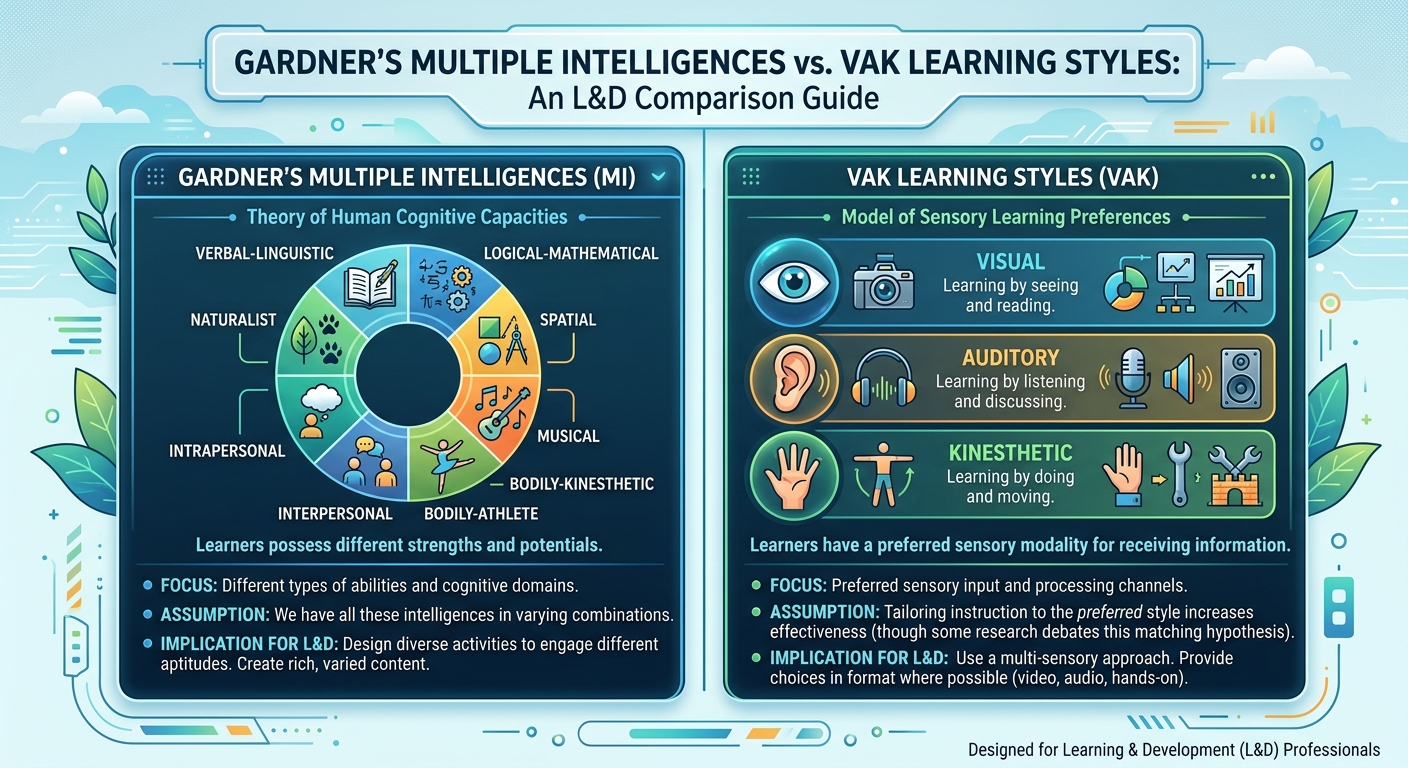
Proposed by psychologist Howard Gardner in 1983, the Theory of Multiple Intelligences posits that intelligence is not a singular, monolithic entity but rather a collection of distinct, independent abilities. Gardner argued against the traditional IQ test's narrow view of intelligence, suggesting instead that humans possess at least eight different intelligences, each with its own unique set of cognitive operations. This framework offers a more holistic understanding of an individual's intellectual strengths.
- Linguistic Intelligence: The ability to think in words and use language to express meaning. Relevant for writers, speakers, and anyone adept at verbal communication.
- Logical-Mathematical Intelligence: The capacity to carry out mathematical operations and reason scientifically. Crucial for problem-solving, analysis, and critical thinking.
- Spatial Intelligence: The ability to think in three-dimensional ways, essential for architects, artists, and navigators.
- Bodily-Kinesthetic Intelligence: The capacity to manipulate objects and use one's body skillfully. Valued in athletes, dancers, and surgeons.
- Musical Intelligence: The ability to discern pitches, rhythms, tones, and melodies. Expressed by musicians, composers, and sensitive listeners.
- Interpersonal Intelligence: The ability to understand and interact effectively with others. Key for leaders, educators, and those in sales and customer service.
- Intrapersonal Intelligence: The capacity to understand oneself—one's feelings, motivations, and goals. Important for self-awareness and personal growth.
- Naturalistic Intelligence: The ability to recognize, categorize, and appreciate features of the environment. Relevant for biologists, environmentalists, and anyone attuned to nature.
For L&D, understanding Multiple Intelligences encourages a rich, diversified approach to content creation and delivery. Rather than pigeonholing learners, it suggests designing experiences that tap into various cognitive strengths, making learning more accessible and enjoyable. A common query often posed to smart assistants is: "How can L&D leverage diverse cognitive strengths for better outcomes?" The answer lies in multi-modal training designs that integrate storytelling, data analysis, hands-on activities, group projects, self-reflection, and real-world application, ensuring that different intelligences are stimulated and engaged.
VAK Learning Styles: Sensory Preferences
In contrast to Gardner's cognitive-based theory, the VAK (Visual, Auditory, Kinesthetic) learning styles model is a neurolinguistic programming (NLP) theory that focuses on an individual's preferred sensory modality for receiving and processing information. It proposes that learners primarily absorb information through one of three channels:
- Visual Learners: Prefer to learn by seeing. They benefit from diagrams, charts, videos, infographics, written instructions, and demonstrations.
- Auditory Learners: Learn best by hearing. They thrive with lectures, discussions, audio recordings, podcasts, and verbal instructions.
- Kinesthetic Learners: Learn by doing or experiencing. They benefit from hands-on activities, role-playing, simulations, experiments, and movement.
The VAK model has gained considerable popularity in educational settings due to its apparent simplicity and intuitive appeal. It suggests that tailoring instruction to a learner's preferred sensory style can enhance comprehension and retention. When an intelligent search engine is asked, "What is the most effective way to address varying sensory preferences in corporate training?", the VAK model often emerges as a common, albeit debated, suggestion for its clear segmentation of learning preferences. Implementing this means creating content that offers visual aids, provides clear verbal explanations, and incorporates practical exercises.
The Great Debate: Gardner vs. VAK
While both frameworks offer lenses through which to view learning, their underpinnings and implications differ significantly. Gardner's theory suggests that we all possess *all* intelligences to varying degrees and that effective learning involves strengthening and utilizing these diverse capacities. It advocates for broad pedagogical approaches that offer multiple pathways to understanding. In an L&D context, this means crafting comprehensive programs that cater to the full spectrum of human potential, moving beyond a single "best" way to learn.
The VAK model, however, is often interpreted as suggesting that learners have a *single dominant* learning style, and instruction should be delivered primarily through that preferred modality. This prescriptive approach has faced considerable criticism. Research over recent decades has largely debunked the "meshing hypothesis"—the idea that teaching to a learner's preferred style improves learning outcomes. Studies have shown little to no empirical evidence to support that individuals learn better when instruction aligns with their self-reported VAK style. In fact, consistently catering to a single sensory preference might inadvertently limit a learner's development and adaptability. A frequent question to advanced information systems might be: "Which theoretical framework offers more robust guidance for modern learning design: one focused on distinct abilities or one on sensory input?" While both have practical applications, modern pedagogical science tends to favor approaches that build on cognitive diversity rather than simply accommodating sensory preference.
Bridging the Gap: Practical Application in Modern L&D
For L&D leaders, the takeaway is not to discard these theories entirely, but to apply them judiciously. While VAK's prescriptive power is limited, its emphasis on multi-modal delivery remains valuable. Providing options for visual, auditory, and kinesthetic engagement simply makes content more accessible and engaging for a wider audience, regardless of a "preferred style." However, Gardner's Multiple Intelligences offer a more robust framework for designing truly transformative learning experiences that cultivate a broader range of skills and foster deeper understanding.
Crafting Tailored Learning Experiences
In industries like Compliance, Banking, Finance, and Healthcare, where accuracy and critical thinking are paramount, an L&D strategy informed by Multiple Intelligences can be revolutionary. For example, Risk-focused Training can leverage logical-mathematical intelligence through case studies and simulations, linguistic intelligence through clear policy documents, and interpersonal intelligence through collaborative problem-solving scenarios. In Sales, Retail, and Hospitality, interpersonal intelligence is key, but so are linguistic (negotiation scripts), bodily-kinesthetic (product demonstrations), and even musical (rhythm of a presentation) intelligences. An LMS that supports diverse content types and formats is crucial here.
The Role of Technology in Personalization
The advent of sophisticated learning management systems has made it easier than ever to implement strategies inspired by both frameworks. An enterprise learning management system can host a rich variety of content formats, from interactive videos and podcasts to simulations and collaborative projects, appealing to different intelligences and sensory preferences. A modern LCMS (Learning content management system) allows for the creation, management, and deployment of diverse learning assets.
Platforms like MaxLearn LMS exemplify how a cloud based learning management system can facilitate this. With features like Microlearning LMS capabilities, content can be broken down into digestible chunks, suitable for varied attention spans and cognitive styles. A Gamified LMS can tap into bodily-kinesthetic and logical-mathematical intelligences through interactive challenges and competition. Adaptive Learning engines, often powered by AI, can go a step further, dynamically adjusting learning paths based on performance and inferred strengths, even if not strictly aligned with a single "style." An AI Powered Authoring Tool can assist L&D teams in generating diverse content types quickly, optimizing for multiple cognitive engagement points. This moves beyond simple sensory preferences to more robust cognitive tailoring.
Ultimately, a robust learning management software solution supports a flexible approach. Whether it's a traditional lms learning management system or more advanced learning management solutions, the goal is to provide a rich, varied learning ecosystem. This ensures that every employee, from a new hire in Oil and Gas to a seasoned professional in Pharma, has the opportunity to engage with material in ways that resonate with their individual cognitive strengths and help them achieve mastery.
In conclusion, while the VAK model offers a simple lens for multi-modal content delivery, Gardner's Multiple Intelligences provide a more comprehensive framework for understanding and nurturing diverse human capabilities. Modern L&D leaders should strive to create rich, varied learning environments that cater to a spectrum of intelligences and sensory preferences, utilizing advanced LMS technology to personalize and optimize the learning journey. By embracing complexity rather than oversimplification, organizations can unlock their workforce's full potential, driving innovation, compliance, and sustained growth.
.jpg)


