

AI Authoring Tools vs. Traditional Instructional Design: Which Scales Better for Enterprise L&D?
The landscape of corporate learning and development is undergoing a seismic shift. Enterprise L&D leaders, from Vice Presidents to Senior Managers, are constantly challenged to deliver high-quality, impactful training efficiently and at scale. In an era demanding rapid upskilling and reskilling, the perennial question arises: how do we meet the ever-growing demand for dynamic learning content? Traditionally, instructional design has been the bedrock, but the emergence of AI Powered Authoring Tools is revolutionizing content creation. This article delves into a critical comparison, exploring whether AI solutions or conventional instructional design offers superior scalability for your organization’s learning needs.
The Foundational Strength of Traditional Instructional Design
What is Traditional Instructional Design?
Traditional instructional design is a systematic process for creating effective and engaging learning experiences. It typically follows models like ADDIE (Analysis, Design, Development, Implementation, Evaluation), focusing on learner needs, clear objectives, and structured content. This methodology ensures a deep understanding of pedagogy and cognitive science, leading to well-crafted learning paths.
Strengths in a Complex World
- Pedagogical Rigor: Human instructional designers bring empathy, creativity, and a nuanced understanding of how people learn. They excel at crafting complex narratives, facilitating critical thinking, and designing for emotional intelligence.
- Contextual Depth: Experts can delve deep into subject matter, ensuring accuracy, relevance, and cultural sensitivity, especially critical for specialized fields like healthcare or finance.
- Customization for Specific Needs: Traditional ID allows for highly bespoke solutions, tailored to unique organizational cultures, specific job roles, or intricate compliance requirements.
Limitations for Enterprise Scale
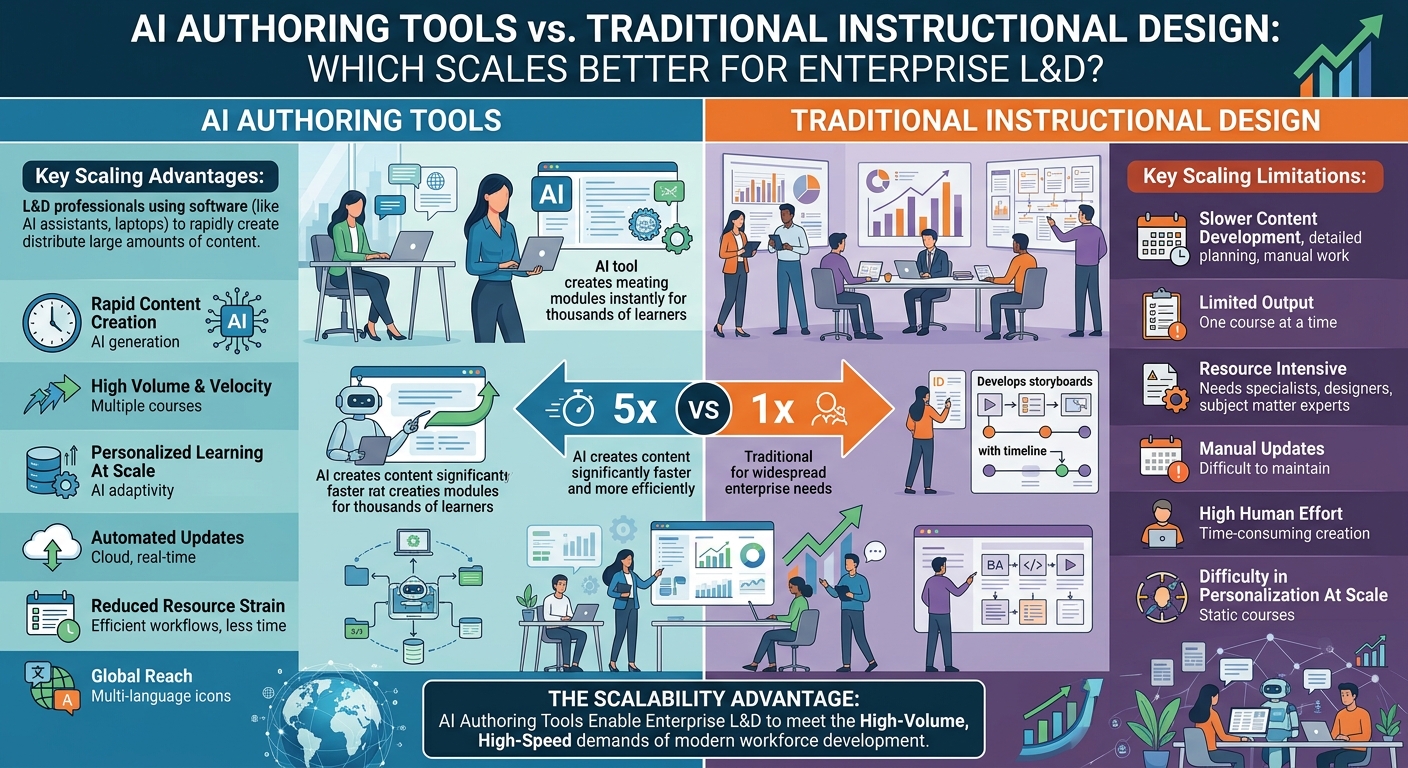
While robust, traditional instructional design faces inherent limitations when confronted with the vast scale and rapid pace of enterprise learning. The human-centric process, while ensuring quality, often becomes a bottleneck.
- Time-Intensive: The in-depth analysis, design, and development phases can be lengthy, delaying deployment of crucial training.
- Resource-Heavy: It requires a team of skilled instructional designers, subject matter experts, and multimedia specialists, incurring significant personnel costs.
- Update Challenges: Revising and updating a large catalog of traditionally designed content is a laborious and costly endeavor, especially in industries with constantly evolving regulations.
The Disruptive Promise of AI Authoring Tools
How AI is Reshaping Content Creation
AI authoring tools leverage sophisticated algorithms to automate and accelerate various stages of content development. These platforms can generate text, create quiz questions, suggest multimedia assets, and even structure entire learning modules based on prompts, data analysis, and existing content repositories. This is often integrated within a comprehensive learning content management system.
Benefits for Unprecedented Scale
- Accelerated Development: AI Powered Authoring Tools can drastically reduce the time from concept to content, generating first drafts or even complete modules in a fraction of the time a human would require. How do AI-powered tools streamline the content development process, making it more efficient and discoverable for learners? They achieve this by automating repetitive tasks, synthesizing information, and generating content rapidly.
- Cost Efficiency: By automating parts of the design and development process, these tools can reduce the need for extensive human resources, offering significant cost savings over time.
- Consistent Quality (at scale): AI can maintain a consistent tone, style, and structure across vast amounts of content, ensuring brand alignment and reducing human error.
- Dynamic Updates: When regulations change or new product features emerge, AI can quickly identify affected content and suggest or implement updates across the entire learning portfolio.
Scaling Capabilities: A Direct Comparison
Content Creation Velocity
This is where AI truly shines. For enterprises needing to generate hundreds or even thousands of learning modules annually – think compliance training for a global workforce or product training for a rapidly expanding sales team – AI authoring tools offer an unmatched speed advantage. Traditional methods simply cannot keep pace with such demands.
Personalization & Engagement
While traditional ID aims for personalization, AI elevates it. Through algorithms, AI tools can create highly Adaptive Learning paths, tailoring content difficulty, examples, and even feedback based on individual learner performance and preferences. This dynamic adaptation is difficult to achieve manually at scale. Furthermore, integrating with a Gamified LMS can significantly boost engagement, a feature that AI can help design and implement more efficiently.
Cost-Efficiency
Initial investment in an AI Powered Authoring Tool and a robust Microlearning LMS can be substantial. However, the long-term operational costs for creating, updating, and distributing content are often significantly lower than maintaining a large team of traditional instructional designers and content developers. This is a critical factor for enterprise learning management.
Maintenance & Updates
In industries like finance or healthcare, where regulations and best practices constantly evolve, the burden of content maintenance is immense. AI tools can monitor external sources, identify relevant changes, and rapidly update affected learning modules, a process that is notoriously slow and expensive with traditional methods. A sophisticated cloud based learning management system facilitates this.
Quality & Nuance
While AI can generate factually accurate and well-structured content, the subtle art of storytelling, deep empathy, and nuanced contextual understanding often remain the domain of human instructional designers. For highly sensitive topics, complex behavioral training, or content requiring significant human connection, traditional ID may still deliver superior qualitative results.
Addressing Enterprise-Specific Needs
Compliance & Regulation
For industries like banking, pharma, and insurance, compliance training is non-negotiable and ever-changing. AI can rapidly generate and update Risk-focused Training modules to reflect the latest legal requirements, significantly reducing corporate risk. A robust learning management software combined with AI capabilities ensures timely adherence.
Global Reach and Localization
When deploying training across international teams, can artificial intelligence tools truly adapt content to local nuances and regulations? Absolutely. AI authoring tools are increasingly capable of translating content, adapting cultural references, and even modifying examples to resonate with different regional audiences, making global deployment significantly more efficient than manual localization efforts.
Rapid Deployment for Sales and Product Training
In retail and sales, new products launch frequently, and sales methodologies evolve rapidly. What advanced capabilities do intelligent authoring platforms bring to optimizing the entire learning lifecycle, from creation to delivery and assessment? AI can generate new product training modules or sales enablement content almost instantaneously, ensuring that teams are always equipped with the latest information, a crucial component of any effective Microlearning LMS.
Specialized Industries
- Healthcare: AI can assist in generating training for new medical devices or protocols, ensuring rapid dissemination of critical information.
- Oil & Gas/Mining: Safety procedures, equipment operation, and environmental compliance training can be quickly updated and distributed globally.
- Hospitality: AI can help craft consistent service standards training for diverse staff across multiple locations.
The Hybrid Approach: Best of Both Worlds
For most large organizations, the ideal solution isn't an either/or but a strategic integration. The future of enterprise L&D likely lies in a hybrid model where AI authoring tools handle the high-volume, repetitive, or rapidly changing content generation, while human instructional designers focus on high-impact, complex, or highly sensitive learning experiences requiring deep human insight and pedagogical expertise. This approach optimizes resources, enhances quality where it matters most, and maximizes scalability.
This balanced strategy leverages the efficiency of an LMS and a robust Microlearning LMS like MaxLearn LMS, integrating advanced authoring capabilities. It allows for a dynamic learning content management system that supports diverse learning management solutions.
Choosing the Right Path for Your Enterprise
The decision of which approach scales better depends heavily on your organization's specific context, content types, budget, and strategic priorities. Consider these factors:
- Content Volume & Velocity: Do you need to produce a massive amount of content quickly?
- Content Complexity & Sensitivity: How much of your training requires nuanced human understanding and empathy?
- Budget & Resources: What are your long-term cost implications for content creation and maintenance?
- Agility Requirements: How frequently does your training content need to be updated or revised?
- Current Infrastructure: Do you have a modern learning management system that can integrate with AI Powered Authoring Tools?
Ultimately, a sophisticated learning management system, especially a cloud based learning management system, can be the backbone of either strategy, or a combination thereof. Tools like MaxLearn LMS are designed to accommodate the future of enterprise learning management, supporting both traditional and AI-driven content.
Conclusion
Both AI authoring tools and traditional instructional design bring significant value to enterprise L&D. While traditional ID offers unparalleled pedagogical depth and human-centric design, it struggles with the demands of rapid, large-scale content generation and continuous updates. AI Powered Authoring Tools, conversely, excel in speed, efficiency, and automated scalability, making them indispensable for managing vast and dynamic learning portfolios. For most large organizations, the path to optimal scalability lies in a strategic, hybrid approach, where AI handles the heavy lifting of content creation and maintenance, freeing human instructional designers to focus on high-value, complex, and innovative learning experiences. The right LMS will be crucial in orchestrating this powerful synergy.
.jpg)


