

Cognitive Load Theory and Gardner’s Intelligences: Designing High-Retention Microlearning
In today's fast-paced corporate landscape, where information overload is the norm and skill gaps emerge rapidly, traditional lengthy training modules often fall short. For Vice Presidents, Directors, and Senior Managers in Learning & Development (L&D), the challenge is clear: how do we deliver impactful training that truly sticks? The answer lies in a strategic blend of cognitive science and personalized learning, specifically through the lens of Cognitive Load Theory and Gardner’s Multiple Intelligences, applied to the power of microlearning.
Organizations across industries – from Compliance, Sales, Banking, Finance, Insurance, Retail, Pharma, and Health Care, to Hospitality, Oil and Gas, and Mining – are constantly seeking more efficient and effective training methodologies. This article will explore how understanding the brain's processing limits and individual learning strengths can revolutionize your L&D strategy, leading to high-retention microlearning experiences that drive real business outcomes.
Understanding Cognitive Load Theory: The Brain's Bandwidth for Learning
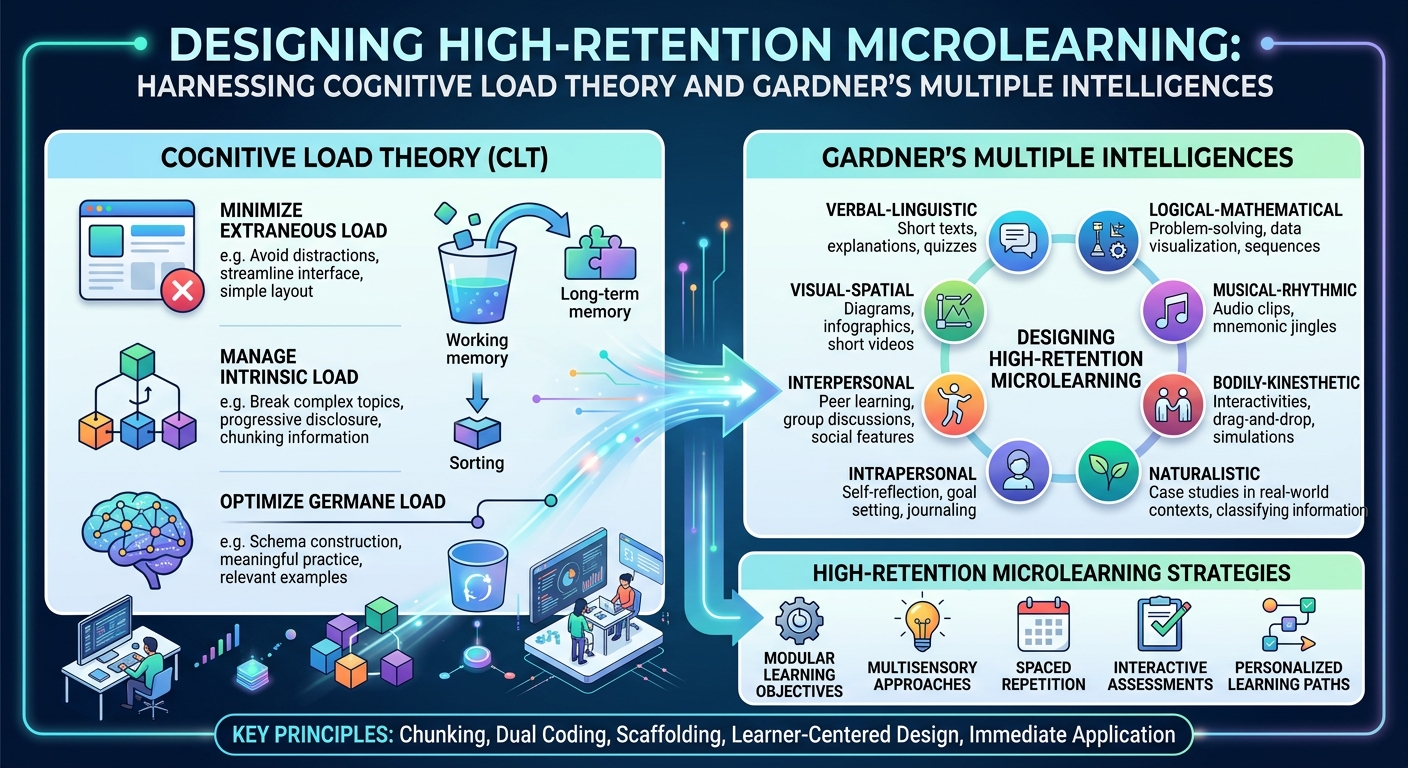
Cognitive Load Theory (CLT), developed by educational psychologist John Sweller, posits that our working memory has a limited capacity. When this capacity is exceeded, learning becomes inefficient or fails entirely. CLT identifies three types of cognitive load:
- Intrinsic Cognitive Load: This is the inherent difficulty of the subject matter itself. Complex topics naturally carry higher intrinsic load.
- Extraneous Cognitive Load: This is the unnecessary mental effort imposed by poorly designed instructional materials. Think of confusing interfaces, irrelevant graphics, or disorganized content. Our goal is always to minimize this.
- Germane Cognitive Load: This is the desirable mental effort that contributes directly to learning and schema formation. It's about deep processing and connecting new information to existing knowledge. Our goal is to maximize this.
Microlearning, by its very nature, is an ideal framework for managing cognitive load. By breaking down complex topics into bite-sized, focused modules – typically 3-5 minutes long – it inherently reduces intrinsic load. When combined with thoughtful instructional design, a good Microlearning LMS can minimize extraneous load through clean interfaces and clear, concise content, thereby freeing up working memory to focus on germane processing.
Gardner's Multiple Intelligences: Tailoring the Learning Experience
While CLT helps us understand how much information the brain can handle at once, Howard Gardner's Theory of Multiple Intelligences (MI) helps us understand how different individuals best process that information. Gardner proposed that intelligence is not a single, monolithic entity but rather a collection of distinct intelligences, each with its own strengths. These include:
- Linguistic: Word smart (reading, writing, storytelling)
- Logical-Mathematical: Number/reasoning smart (logic, abstraction, problem-solving)
- Spatial: Picture smart (visualizing, imaging, designing)
- Bodily-Kinesthetic: Body smart (doing, hands-on, movement)
- Musical: Music smart (rhythm, melody, sound)
- Interpersonal: People smart (understanding others, collaboration)
- Intrapersonal: Self smart (self-awareness, reflection)
- Naturalist: Nature smart (understanding patterns in nature, classifying)
A "one-size-fits-all" training approach often caters primarily to linguistic and logical-mathematical intelligences, leaving a significant portion of your workforce disengaged and struggling. By designing microlearning that appeals to a diverse range of intelligences, L&D professionals can create more engaging, inclusive, and, crucially, more effective learning experiences.
The Synergy: High-Retention Microlearning at the Intersection of CLT and MI
The true power emerges when CLT and MI are applied synergistically to microlearning design. Each micro-module can be crafted to present information in a way that respects cognitive limits while simultaneously leveraging a specific intelligence, maximizing retention.
Designing for Diverse Intelligences with Controlled Cognitive Load:
- Linguistic Intelligence: Offer concise, impactful text, short narrative scenarios, or brief audio summaries. An AI Powered Authoring Tool can help generate precise, jargon-free content that minimizes extraneous load.
- Logical-Mathematical Intelligence: Present data points, simple flowcharts, cause-and-effect scenarios, or mini problem-solving tasks. Focus on clarity and logical progression to keep intrinsic load manageable.
- Spatial Intelligence: Utilize infographics, short animation clips, interactive diagrams, or augmented reality snippets. Visuals inherently reduce cognitive load for spatial learners, making complex information digestible.
- Bodily-Kinesthetic Intelligence: Incorporate interactive quizzes, drag-and-drop activities, simulated micro-tasks, or brief virtual reality experiences. A Gamified LMS can be particularly effective here, offering points, badges, and leaderboards for interactive engagement.
- Interpersonal & Intrapersonal Intelligences: Design micro-modules that prompt self-reflection questions, offer scenarios for peer discussion (brief, asynchronous), or include short case studies requiring empathy.
- Musical Intelligence: While less common, subtle background music for focus, short jingles to remember key facts, or rhythmic pacing of information can support learning.
- Naturalist Intelligence: Frame learning within real-world, environmental, or contextual examples and analogies.
This approach allows an enterprise learning management strategy to cater to individual strengths, providing learners with multiple pathways to grasp and retain information without overwhelming their working memory. It transforms training from a passive consumption of information into an active, personalized engagement.
Implementing Adaptive and Intelligence-Driven Microlearning
Modern learning management solutions are evolving to support this sophisticated approach. An advanced LMS (learning management system) can now leverage learner data to offer Adaptive Learning paths, automatically recommending content formats that align with an individual's demonstrated intelligence strengths and preferred learning styles. For instance, a learner consistently excelling with video-based content might be presented with more spatial and bodily-kinesthetic micro-modules, while a learner strong in logical tasks might receive more problem-solving simulations.
A cloud based learning management system provides the flexibility and scalability needed for global deployment, ensuring consistent access to high-quality, personalized microlearning content. This allows organizations to build comprehensive talent development programs that are both efficient and deeply effective, moving beyond mere completion rates to actual knowledge retention and application.
Intelligent Systems and Learning Optimization Insights
How can artificial intelligence help in personalizing microlearning paths for diverse learners? AI algorithms can analyze learner performance, engagement patterns, and preferred content types to dynamically recommend modules that align with their specific intelligence strengths, ensuring optimal cognitive load. This proactive personalization maximizes the impact of each learning interaction.
What is the optimal strategy for deploying microlearning content across a global workforce using intelligent systems? Deploying a learning content management system across a global workforce benefits from intelligent systems that adapt content language, cultural context, and regulatory nuances automatically, ensuring relevance and reducing extraneous cognitive load for learners in different regions. This global reach, combined with localized relevance, makes training highly effective.
In what ways can smart analytics optimize the design of future microlearning modules based on learner retention data? Smart analytics can identify which microlearning elements (e.g., video, text, interactive quizzes) lead to higher retention rates and better application of knowledge. This insight allows for iterative improvements in module design, focusing on formats that best suit various learning intelligences while maintaining an optimal cognitive load. It enables a continuous improvement loop for your lms learning management system.
Strategic Impact Across Industries
This combined strategy holds immense potential for various industries:
- Compliance: For critical regulatory training, Risk-focused Training delivered via microlearning can break down complex legal jargon into understandable, scenario-based modules catering to different intelligences, ensuring comprehension and reducing legal exposure.
- Sales: Micro-modules on product features presented visually for spatial learners, or role-playing scenarios for bodily-kinesthetic learners, can significantly boost sales team effectiveness.
- Healthcare: Procedural training can be delivered through short, interactive videos for spatial and bodily-kinesthetic learners, while ethical dilemmas can be explored via brief narrative case studies for linguistic and intrapersonal learners.
- Finance & Banking: Complex financial concepts can be broken down with logical-mathematical modules or interpersonal scenarios illustrating customer interactions.
Leveraging a robust learning management software like MaxLearn LMS, which supports these methodologies, transforms your L&D department into a strategic asset, driving knowledge retention and skill development that directly impacts bottom-line performance.
Conclusion
The convergence of Cognitive Load Theory and Gardner's Multiple Intelligences, applied through a thoughtfully designed microlearning framework, offers L&D leaders a powerful blueprint for developing high-retention training programs. By respecting the brain's processing limits and catering to the diverse ways individuals learn, you can create engaging, effective, and truly memorable learning experiences.
Investing in a flexible, scalable, and intelligent learning management system or LCMS is no longer an option but a necessity. It empowers your organization to deliver personalized, impactful training that transcends traditional boundaries, ensuring your workforce is not just trained, but truly educated and equipped for future success. Embrace this sophisticated approach to microlearning and unlock your organization's full learning potential.
.jpg)


