

The Game-Design Process Every L&D Team Should Adopt in 2026
In the rapidly evolving landscape of corporate learning, traditional methods are often struggling to keep pace with the demands for engaging, effective, and measurable training. For Vice Presidents, Directors, and Managers of Learning & Development, the challenge isn't just delivering content, but ensuring it sticks, inspires, and translates into tangible performance improvements. As we look towards 2026, a paradigm shift is inevitable: the full adoption of a sophisticated game-design process within L&D strategies. This isn't merely about gamification; it's about embedding the core principles of game design to create truly immersive and impactful learning experiences, supercharged by artificial intelligence.
Why Game Design is the Future of Enterprise Learning
For too long, corporate training has been perceived as a compliance checkbox or a necessary, but often dull, chore. This perception significantly hinders knowledge retention and skill application. Game design, however, inherently builds engagement, motivation, and a clear path to mastery – elements critical for effective learning. In industries spanning Compliance, Sales, Banking, Finance, Insurance, Retail, Pharma, Healthcare, Hospitality, Oil and Gas, and Mining, the need for high-stakes, high-retention learning is paramount.
Driving Engagement and Retention
Modern learners, accustomed to dynamic digital interactions, expect more than passive lectures. Game design introduces elements like challenges, rewards, progression, and social interaction that intrinsically motivate learners. This translates directly into higher completion rates and better retention of critical information. A well-designed learning game can transform mundane compliance training into an exciting quest for knowledge, or complex sales methodologies into a strategic simulation.
Fostering Skill Application and Behavioral Change
Beyond memorization, the ultimate goal of enterprise learning is to foster real-world skill application and drive behavioral change. Game design provides safe environments for practice, experimentation, and failure without real-world consequences. This iterative learning process is invaluable, especially in high-risk sectors where mistakes can be costly. The immediate feedback loops inherent in games reinforce correct actions and correct misconceptions much faster than traditional methods.
The Essential Game-Design Process for L&D in 2026
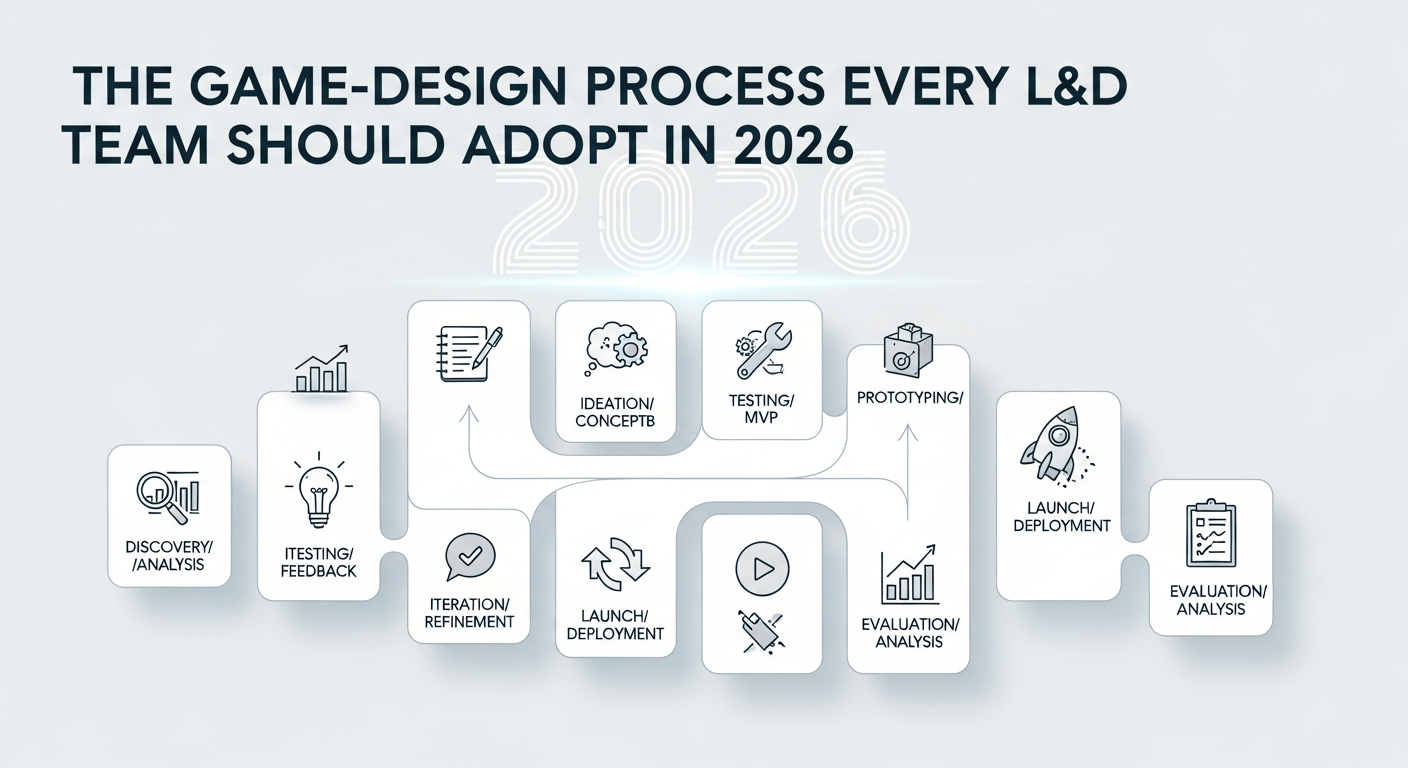
Adopting a game-design mindset requires a structured approach. Here's a process that every forward-thinking L&D team should implement:
1. Define Learning Objectives and Audience deeply
Before any game elements are considered, clarity on what learners need to know, do, and feel is paramount. What specific skills or knowledge gaps are being addressed? Who is the target audience – their existing knowledge, preferences, and motivations? Understanding these foundational elements will guide every subsequent design decision. This initial phase also involves identifying key performance indicators (KPIs) to measure the training's success.
2. Craft a Compelling Narrative and Core Mechanics
Every great game has a story and clear rules. L&D needs to move beyond mere content delivery to create a narrative arc. What is the learner's role? What challenges will they face? How do they progress? This involves defining game mechanics such as points, badges, leaderboards, levels, quests, and avatars. The narrative doesn't have to be fantasy; it can be a realistic simulation of workplace challenges, turning complex concepts into solvable puzzles within a relevant storyline.
3. Integrate Dynamic Learning Experiences with Technology
This is where modern technology becomes indispensable. A robust Gamified LMS is crucial to host, manage, and deliver these interactive experiences. Look for a comprehensive learning content management system that supports rich media, branching scenarios, and real-time feedback. Implementing a Microlearning LMS can further enhance this by breaking down complex game levels into bite-sized, digestible modules, making learning more accessible and less intimidating. This ensures continuous engagement without overwhelming the learner.
4. Iterate, Test, and Refine Continuously
Just like software development, game design is an iterative process. Pilot testing with a small group of target learners is vital. Gather feedback on engagement, clarity, difficulty, and learning effectiveness. Use this data to refine game mechanics, adjust narratives, and optimize content. This continuous feedback loop ensures the learning experience remains relevant, engaging, and highly effective. A truly effective learning management system will provide the analytics necessary for this refinement.
Integrating AI: The Future of Learning Game Design
The year 2026 will see artificial intelligence move from a theoretical concept to an indispensable partner in L&D game design. Intelligent systems will elevate personalized learning to unprecedented levels, making the game-design process even more powerful.
Personalized Journeys with Intelligent Algorithms
How can artificial intelligence transform corporate training effectiveness? By enabling truly personalized learning paths within game environments. Imagine a scenario where the game adapts its difficulty, content, and even its narrative based on a learner's real-time performance, learning style, and previous interactions. This is the power of Adaptive Learning, driven by AI. If a learner struggles with a specific concept, the AI-powered game can present alternative explanations, provide more practice opportunities, or even suggest remedial microlearning modules before allowing progression.
Intelligent Content Creation and Simulation
What specific steps should L&D teams take to integrate game design with intelligent systems? One key step is leveraging an AI Powered Authoring Tool. These tools can dramatically speed up the development cycle of game-based learning. They can assist in generating scenarios, crafting dialogue, designing challenge levels, and even suggesting reward structures based on learning objectives and desired behavioral outcomes. This drastically reduces the time and resources needed to create engaging content, allowing L&D teams to focus on strategy and refinement rather than manual content creation.
Enhanced Risk-Focused Training and Scenario Planning
For high-stakes industries like Banking, Pharma, Healthcare, Oil and Gas, and Mining, the ability to simulate complex, real-world scenarios is invaluable. How are leading organizations adopting AI in L&D for critical sectors? They are using AI to create dynamic, Risk-focused Training simulations. AI can generate an infinite number of crisis scenarios, regulatory compliance challenges, or customer interaction dilemmas, allowing learners to practice decision-making in a safe, yet highly realistic, virtual environment. The AI can then provide immediate, objective feedback, highlighting the consequences of different choices and guiding learners towards optimal solutions. This kind of experiential learning, facilitated by AI, far surpasses the efficacy of traditional case studies or lectures.
Benefits Across Diverse Industries
- Compliance: Transform tedious regulatory mandates into interactive challenges, ensuring complete understanding and adherence.
- Sales: Simulate customer interactions, negotiation tactics, and product knowledge application, leading to better closing rates.
- Banking & Finance: Practice complex financial transactions, risk assessment, and fraud detection in secure virtual environments.
- Healthcare & Pharma: Simulate patient care scenarios, new drug protocols, and ethical dilemmas, improving patient outcomes.
- Retail & Hospitality: Enhance customer service skills, conflict resolution, and operational efficiency through role-playing games.
- Oil and Gas & Mining: Conduct safety training, emergency response simulations, and equipment operation drills with zero real-world risk.
Choosing the Right Learning Platform for 2026
Implementing a sophisticated game-design process, especially with AI integration, requires a robust technological backbone. An advanced learning management software is not just an administrative tool; it's the engine for your enterprise learning strategy. When selecting a learning content management system, prioritize platforms that offer inherent gamification features, support adaptive learning pathways, and seamlessly integrate with AI-powered authoring tools.
A cloud based learning management system provides the flexibility and scalability needed for global organizations. The right LMS learning management system will empower your L&D team to deploy engaging, AI-driven learning experiences across all departments and geographies. Leading platforms like MaxLearn LMS are designed precisely for this future, offering comprehensive learning management solutions that support microlearning, gamification, and AI-driven personalization, making it the ideal LCMS for any forward-thinking organization aiming for superior employee development.
Conclusion
The future of corporate learning in 2026 is dynamic, engaging, and intelligent. By adopting a structured game-design process and strategically integrating AI, L&D teams can move beyond mere training delivery to become architects of true performance transformation. This approach promises not only higher engagement and better retention but also a tangible impact on business objectives across every industry. Embrace this evolution, and empower your workforce with learning experiences that are not just effective, but truly enjoyable and inspiring.
.jpg)


