

What Is Spaced Repetition and How Does It Stop Knowledge Loss?
In today's fast-paced corporate environment, where information overload is the norm and continuous learning is critical, the battle against knowledge loss is constant. For Vice Presidents, Directors, and Senior Managers in Learning & Development, ensuring that vital skills and information stick is paramount. Whether it's compliance regulations, complex sales strategies, intricate financial products, or critical healthcare protocols, the investment in training yields little if the knowledge quickly fades. This is where Adaptive Learning and a powerful learning management system (LMS) come into play, with spaced repetition at its core.
Spaced repetition is not just a study technique for students; it's a scientifically proven methodology for optimizing long-term retention, an essential tool in any modern Microlearning LMS strategy. Let's delve into what spaced repetition is and how it can be your organization's secret weapon against the dreaded forgetting curve.
The Forgetting Curve and the Imperative for Retention
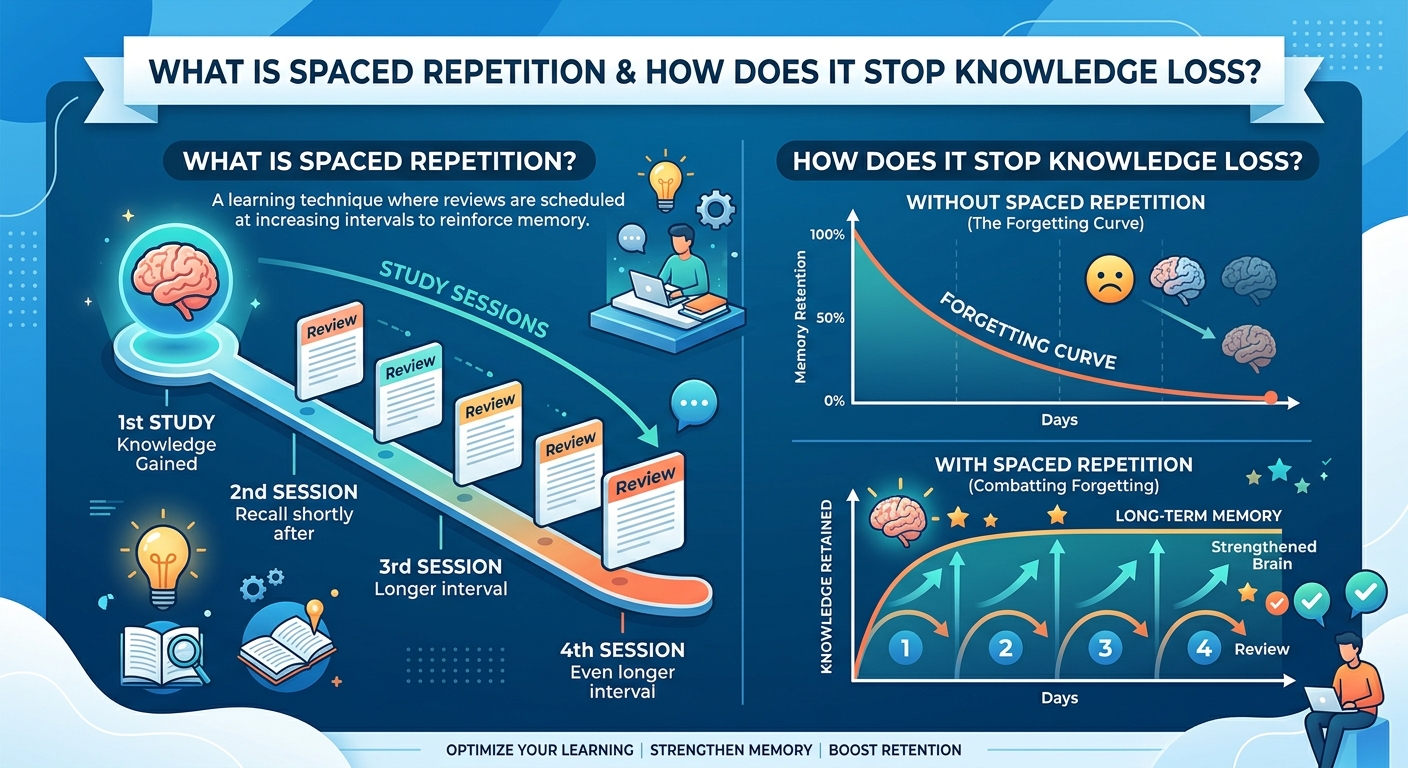
In 1885, German psychologist Hermann Ebbinghaus introduced the "Forgetting Curve," illustrating how quickly newly acquired information is forgotten if not reinforced. His research showed that within just a few days, a significant portion of what was learned is lost. This curve poses a monumental challenge for L&D professionals across all industries—from Banking and Finance to Pharma and Oil and Gas. Every training hour and dollar spent is undermined if the knowledge vanishes.
The solution isn't more training, but smarter training. The goal is to move information from short-term memory to long-term memory, creating robust, accessible knowledge. This is precisely what spaced repetition is designed to achieve.
What Exactly Is Spaced Repetition?
Spaced repetition is an evidence-based learning technique that involves reviewing information at progressively longer intervals. Instead of cramming or reviewing material at fixed, regular intervals, spaced repetition optimizes the review schedule based on how well an individual knows the material. The core idea is to present information just as you're about to forget it, reinforcing the memory and strengthening its neural pathways.
Imagine your employees are learning about new compliance regulations in the financial sector or mastering a new product line in retail. With spaced repetition, instead of a one-off training session, they'd encounter key concepts multiple times. Initially, reviews might be close together (e.g., 1 day, 3 days), then spaced further apart (e.g., 1 week, 2 weeks, 1 month, 3 months), and so on. This intelligent spacing capitalizes on the brain's natural memory processes, ensuring maximum retention with minimal time investment.
The Science Behind Effective Knowledge Retention
The effectiveness of spaced repetition lies in several cognitive principles:
- Active Recall: Instead of passively rereading, spaced repetition forces learners to actively retrieve information from memory, strengthening the recall process.
- Desirable Difficulty: The slight challenge of recalling information just before it's forgotten makes the memory trace stronger. Too easy, and the brain doesn't work hard enough; too difficult, and it causes frustration. Spaced repetition hits the sweet spot.
- Consolidation: Each successful retrieval consolidates the memory, making it more robust and less susceptible to decay over time.
How Does Spaced Repetition Stop Knowledge Loss in the Enterprise?
For enterprise learning, spaced repetition transitions from an academic concept to a strategic imperative. Here's how it combats knowledge loss:
- Sustained Compliance: In highly regulated industries like Healthcare, Pharma, or Banking, retaining compliance knowledge is non-negotiable. Spaced repetition ensures employees consistently recall critical policies and procedures, drastically reducing risks. For managing these risks, consider Risk-focused Training solutions.
- Enhanced Sales Performance: Sales teams in any industry—from Retail to Oil and Gas—need to recall product features, pricing, and objection handling techniques instantly. Spaced repetition, often delivered through a Gamified LMS, ensures this knowledge is always top-of-mind, leading to improved conversions and customer satisfaction.
- Operational Excellence: In sectors like Mining or Hospitality, procedural knowledge is crucial for safety and efficiency. Spaced repetition modules integrated into an LMS can ensure operational teams consistently remember and apply best practices.
- Cost-Efficiency: By reducing the need for repeated comprehensive training sessions, spaced repetition saves significant time and resources. A well-implemented learning content management system (LCMS) with spaced repetition capabilities ensures training investments yield long-term returns.
Leveraging AI for Smarter Spaced Repetition
The manual implementation of spaced repetition across a large workforce can be daunting. This is where advanced technology, particularly artificial intelligence, revolutionizes the approach. A modern enterprise learning management system, often referred to as a learning management system, is no longer just a repository for courses but a sophisticated platform for intelligent learning delivery.
How smart algorithms personalize learning paths?
Artificial intelligence in a cloud based learning management system can analyze individual learner performance data – their strengths, weaknesses, and response times. Based on this, it dynamically adjusts the spaced repetition schedule for each learner. If an employee consistently gets a question right, the system extends the review interval. If they struggle, it shortens it. This ensures a truly personalized and efficient learning experience, unlike traditional one-size-fits-all training.
Leveraging predictive analytics for proactive training?
Imagine a system that can predict which topics an employee is likely to forget based on past performance and the complexity of the material. Predictive analytics, powered by AI, can identify potential knowledge gaps before they impact performance. This allows the lms learning management system to proactively deliver timely refreshers, ensuring critical knowledge is reinforced precisely when needed. This proactive approach is particularly valuable for Risk-focused Training, ensuring compliance knowledge never truly fades.
Global reach and consistent knowledge retention across remote teams?
For organizations with a distributed or global workforce, maintaining consistent knowledge levels is a significant challenge. An enterprise learning management solution with AI-driven spaced repetition can deliver personalized refreshers to employees worldwide, regardless of their location. This ensures that a sales manager in New York, a healthcare professional in London, and a hospitality worker in Dubai all receive optimal reinforcement, guaranteeing consistent understanding of company policies, product knowledge, or safety protocols.
Choosing the Right Tools for an Intelligent Approach
To effectively deploy spaced repetition across your organization, you need a robust learning management software that incorporates intelligent features. Look for a solution like MaxLearn LMS that offers:
- Built-in Spaced Repetition Engines: Automating the scheduling and delivery of knowledge checks.
- AI-Powered Authoring Tools: For creating engaging, interactive content that can be easily broken down into microlearning modules suitable for spaced repetition. Consider an AI Powered Authoring Tool to streamline content creation for diverse training needs.
- Microlearning Capabilities: Small, digestible content units are ideal for spaced repetition and fit seamlessly into busy work schedules.
- Analytics and Reporting: To track individual and team-level knowledge retention and identify areas needing further attention.
- Gamification Features: To keep learners engaged and motivated through the review process, especially when paired with a Gamified LMS.
Conclusion
Knowledge loss is an expensive problem, impacting everything from compliance and productivity to innovation and customer satisfaction. Spaced repetition offers a powerful, scientifically validated solution to combat the forgetting curve. By strategically reinforcing critical information at optimal intervals, L&D leaders can ensure that training investments translate into lasting knowledge and improved performance across all industries and roles.
Embracing a modern learning management solutions with AI-driven spaced repetition capabilities is no longer a luxury but a necessity for any organization committed to building a knowledgeable, resilient, and high-performing workforce. Stop knowledge from slipping away and empower your employees to retain what truly matters.
.jpg)


