

What Is the Ebbinghaus Forgetting Curve and Why Does It Matter in Corporate Training?
As Vice Presidents, Directors, and Senior Managers in Learning & Development, you invest significant resources into corporate training. Whether it's for critical compliance updates, boosting sales performance, or onboarding new talent, the goal is always clear: to equip your workforce with lasting knowledge and skills. Yet, a persistent challenge looms over every training initiative: knowledge retention. How much of that meticulously crafted content truly sticks? The answer, often disheartening, brings us to a foundational psychological principle that shapes how we learn and, crucially, how we forget: The Ebbinghaus Forgetting Curve.
Understanding this curve isn't just an academic exercise; it's a strategic imperative for modern L&D. In an era where continuous learning is non-negotiable across industries like Banking, Finance, Insurance, Retail, Pharma, and Healthcare, combating knowledge decay is key to maximizing your training ROI and fostering a truly skilled, adaptive workforce. This article delves into the Ebbinghaus Forgetting Curve, its profound implications for corporate training, and how an innovative Microlearning LMS and other advanced learning technologies can help your organization overcome its challenges.
Unpacking the Ebbinghaus Forgetting Curve
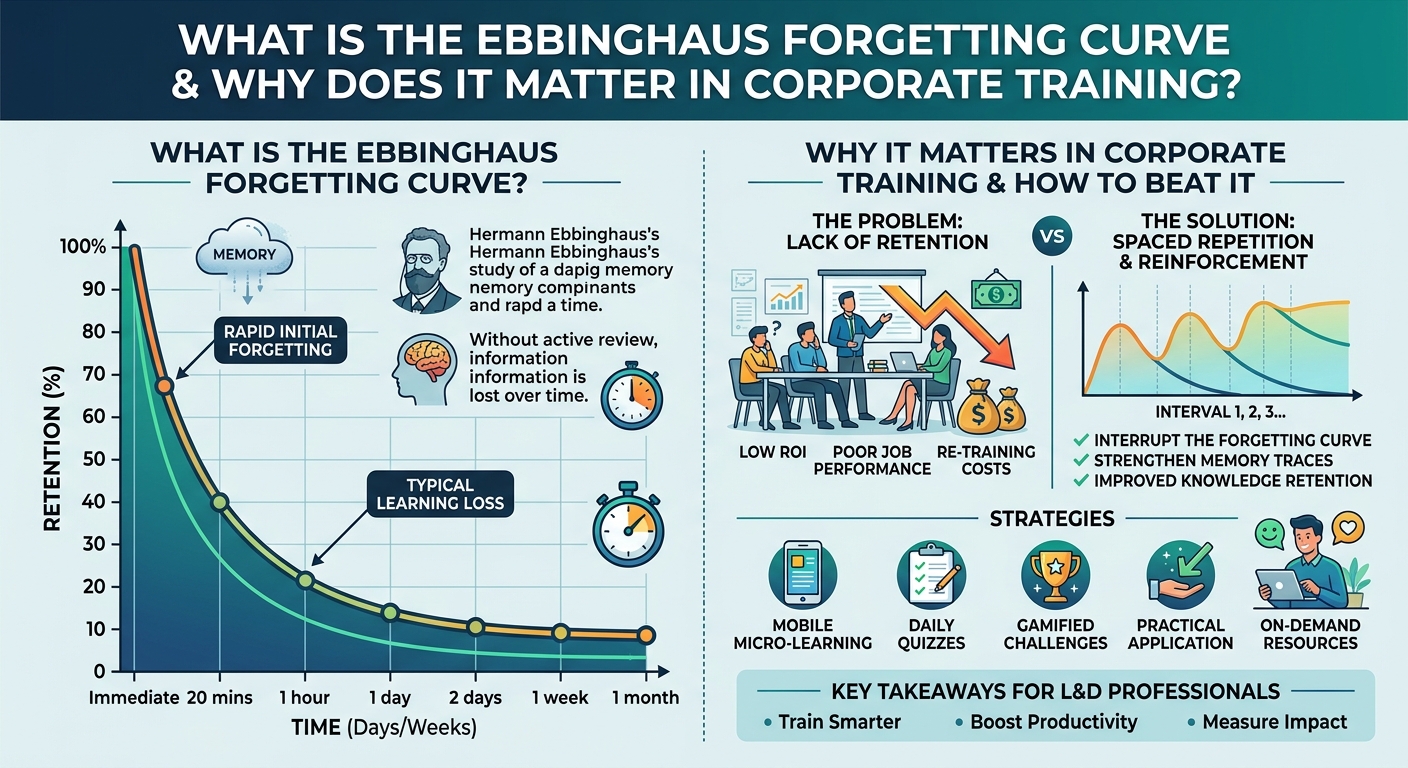
In the late 19th century, German psychologist Hermann Ebbinghaus conducted pioneering research into memory. Using himself as a subject, he meticulously studied the rate at which newly learned information is forgotten over time. His findings revealed a consistent, albeit stark, pattern: without any reinforcement, memory for new information declines rapidly at first, then levels off. This phenomenon is what we now know as the Ebbinghaus Forgetting Curve.
Imagine a scenario where an employee attends an intensive one-day training session. Ebbinghaus's research suggests that within just one hour, they might have forgotten 50% of the material. Within a day, this could drop to 70%, and after a week, it could be as low as 90%. This isn't a reflection of poor learning ability; it's a fundamental aspect of human memory. Our brains are wired to prune information deemed non-essential to make room for new data, and without active recall or application, newly acquired knowledge is quickly categorized as 'non-essential.'
The Anatomy of Forgetting
- Rapid Initial Decline: The most significant drop in retention occurs almost immediately after learning.
- Gradual Plateau: The rate of forgetting slows down over time, but the memory never fully recovers to its initial strength without intervention.
- Impact of Meaningfulness: While Ebbinghaus primarily studied meaningless syllables, real-world, meaningful information might have a slightly slower initial decay, but the curve's fundamental shape remains.
Why the Ebbinghaus Forgetting Curve Matters in Corporate Training
For L&D professionals, the implications of the Forgetting Curve are monumental. It directly impacts the effectiveness and return on investment of every corporate training program, from intricate compliance training in Oil and Gas to crucial sales methodologies in Retail. If employees forget a significant portion of what they learn, the value of that training diminishes rapidly, leading to wasted resources and potential risks.
Direct Consequences for Organizations:
- Reduced ROI: High training costs yield low practical application if knowledge isn't retained.
- Compliance Risks: In regulated industries like Pharma, Finance, and Healthcare, forgetting critical information can lead to non-compliance, fines, and reputational damage. Risk-focused Training becomes ineffective without retention.
- Performance Gaps: Skills acquired but quickly forgotten don't translate into improved job performance, impacting productivity and innovation across Hospitality, Mining, and other sectors.
- Employee Frustration: Employees may feel overwhelmed by information they are expected to know but struggle to recall, leading to decreased morale.
- Ineffective Onboarding: New hires forget key processes and company policies, extending their ramp-up time and increasing early-stage errors.
This challenge underscores the need for a sophisticated learning management system that goes beyond mere content delivery to actively combat the forgetting curve. An effective LMS is no longer just a repository; it's a strategic tool for sustained knowledge acquisition and retention. Modern learning management software must integrate retention-focused features to deliver real value.
Strategies to Combat the Forgetting Curve
Fortunately, the Ebbinghaus Forgetting Curve is not an insurmountable barrier. Modern L&D strategies, bolstered by cutting-edge technology, offer powerful ways to reinforce learning and ensure knowledge longevity. A robust learning content management system or a comprehensive learning management solution can be instrumental in deploying these methods effectively.
1. Spaced Repetition and Reinforcement
This is the most direct counter to Ebbinghaus's findings. Instead of one-off training events, information is revisited at increasing intervals over time. A sophisticated lms learning management system can automate the delivery of quizzes, reminders, and mini-lessons, pushing content to learners precisely when they are most likely to forget it but still able to recall it with effort. This active recall strengthens neural pathways, solidifying memory.
2. Microlearning
Breaking down complex topics into bite-sized, digestible modules is a game-changer. Microlearning modules are typically 3-10 minutes long, focusing on a single learning objective. This approach reduces cognitive load, making information easier to absorb and recall. A dedicated Microlearning LMS is designed to deliver this type of content efficiently, making it ideal for busy professionals who need quick access to specific knowledge.
3. Gamification
Turning learning into a game harnesses intrinsic motivation. Elements like points, badges, leaderboards, and challenges make learning engaging and encourage repeated interaction with the material. A Gamified LMS can transform dull compliance modules or sales training into interactive experiences, prompting learners to revisit content to improve scores or unlock new levels, thereby naturally reinforcing knowledge.
4. Adaptive Learning
Not all learners are alike, nor do they forget at the same rate or in the same areas. Adaptive Learning tailors the learning path based on an individual's performance, strengths, and weaknesses. If an employee struggles with a particular concept, the enterprise learning management system can automatically provide additional resources or practice opportunities, ensuring personalized reinforcement exactly where it's needed. This is crucial for nuanced topics in sectors like Finance and Banking.
5. Contextual Relevance and Application
Learning is most potent when it's immediately applicable to the job. Providing opportunities for learners to use new knowledge in real-world scenarios or simulations helps cement it in long-term memory. This can be facilitated through practical exercises, case studies, or simulations embedded within a modern learning management system.
Leveraging AI for Enhanced Retention in eLearning
The advent of artificial intelligence offers unprecedented capabilities to further combat the forgetting curve. Modern cloud based learning management system platforms are increasingly integrating AI to optimize learning experiences and retention strategies. Consider how intelligent systems can address common challenges:
How can artificial intelligence personalize my organization's training content?
AI algorithms can analyze a learner's engagement data, performance on assessments, and even their job role to dynamically adjust content delivery. This allows for hyper-personalized learning paths, ensuring that each employee receives the right information at the right time, tailored to their individual needs and forgetting patterns. An AI Powered Authoring Tool can even suggest content modifications or create new microlearning modules on the fly to fill identified knowledge gaps.
What are the benefits of using AI for tracking employee learning progress?
AI-driven analytics within an advanced LCMS can provide L&D managers with deep insights into learning efficacy. It can predict areas where employees are likely to forget, identify training bottlenecks, and even recommend interventions before knowledge decay becomes critical. This proactive approach saves time and resources, ensuring that training investments yield maximum returns.
Can intelligent systems improve recall rates for complex compliance topics?
Absolutely. For industries like Pharma and Health care, where compliance is paramount, AI can schedule intelligent spaced repetition for high-risk topics, presenting scenario-based questions or short refreshers precisely when an employee's memory for a specific regulation might be waning. This targeted reinforcement significantly boosts recall rates for vital, complex information, minimizing legal and operational risks.
MaxLearn LMS: Your Partner in Conquering Forgetfulness
To effectively implement these strategies and truly overcome the Ebbinghaus Forgetting Curve, organizations need a robust and intelligent learning platform. MaxLearn LMS is designed precisely for this purpose. By combining a flexible Microlearning LMS with powerful Gamified LMS features, Adaptive Learning capabilities, and an intuitive AI Powered Authoring Tool, MaxLearn provides a comprehensive learning management system that ensures your training investments translate into lasting knowledge and measurable performance improvements.
From ensuring critical Risk-focused Training sticks in the Banking sector to rapidly upskilling sales teams in Retail, MaxLearn empowers L&D leaders to build resilient learning ecosystems. It's more than just a learning management software; it's a strategic partner in fostering a culture of continuous learning and high performance.
Conclusion
The Ebbinghaus Forgetting Curve serves as a critical reminder that effective corporate training extends far beyond initial content delivery. It demands a thoughtful, continuous approach to knowledge reinforcement and application. For L&D Vice Presidents, Directors, and Managers, recognizing and actively addressing this natural memory decay is paramount to ensuring your training initiatives truly impact business outcomes.
By strategically implementing techniques like spaced repetition, microlearning, gamification, and adaptive learning—all powered by modern enterprise learning management systems and augmented by AI—organizations can transform transient knowledge into enduring expertise. Don't let your valuable training investments fade into forgotten memories. Embrace intelligent learning solutions to build a smarter, more capable workforce that retains what matters most.