

How to Use Gamification to Turn Dry Regulatory Training into an Engaging Experience
For Vice Presidents, Directors, and Senior Managers in Learning & Development, the phrase "regulatory training" often conjures images of uninspired presentations, endless policies, and glazed-over employee eyes. It’s a necessary evil, a critical safeguard for compliance across industries like Banking, Finance, Insurance, Pharma, Healthcare, and Oil & Gas. Yet, its inherent dryness often leads to disengagement, poor retention, and ultimately, increased risk for the organization. But what if there was a way to transform these essential, often tedious, sessions into captivating experiences that employees actually look forward to? Enter gamification – the strategic application of game-design elements and game principles in non-game contexts.
In today's fast-paced corporate environment, where an effective LMS is paramount, embracing innovative learning methodologies is no longer a luxury but a necessity. This article explores how gamification, powered by a sophisticated Gamified LMS, can revolutionize regulatory compliance training, making it not just bearable, but truly engaging and effective.
The Pervasive Challenge of Regulatory Compliance Training
Regulatory training is non-negotiable. Whether it's HIPAA in Healthcare, AML/KYC in Banking, OSHA in Mining, or GDPR in Retail, organizations must ensure their workforce understands and adheres to a complex web of rules. The stakes are incredibly high: non-compliance can lead to hefty fines, reputational damage, and even legal action. Despite this, traditional approaches often fall short:
- Information Overload: Regulatory documents are dense, detailed, and often overwhelming.
- Lack of Relevance: Learners struggle to connect abstract rules to their day-to-day tasks.
- Passive Learning: Text-heavy modules and lecture-style formats promote memorization over genuine understanding and application.
- Low Engagement: Monotony breeds boredom, leading to minimal participation and poor knowledge retention.
- Difficulty in Measuring Impact: It's hard to assess true comprehension beyond a simple quiz score.
These challenges are universal across industries, from Sales to Hospitality, making the quest for a more effective learning content management system a strategic imperative.
Gamification: A Paradigm Shift for Learning
Gamification isn't just about adding badges; it's about leveraging innate human desires for achievement, competition, collaboration, and meaning to drive behavior and motivation. When applied to regulatory training, it can:
- Boost Engagement: By turning learning into a challenge or a quest, learners become active participants.
- Improve Retention: Interactive scenarios, immediate feedback, and repeated practice solidify knowledge.
- Enhance Application: Gamified simulations allow learners to apply rules in realistic, low-stakes environments.
- Provide Immediate Feedback: Learners understand their mistakes and correct them instantly, fostering a growth mindset.
- Create a Positive Learning Culture: Training becomes less of a chore and more of an opportunity for skill development.
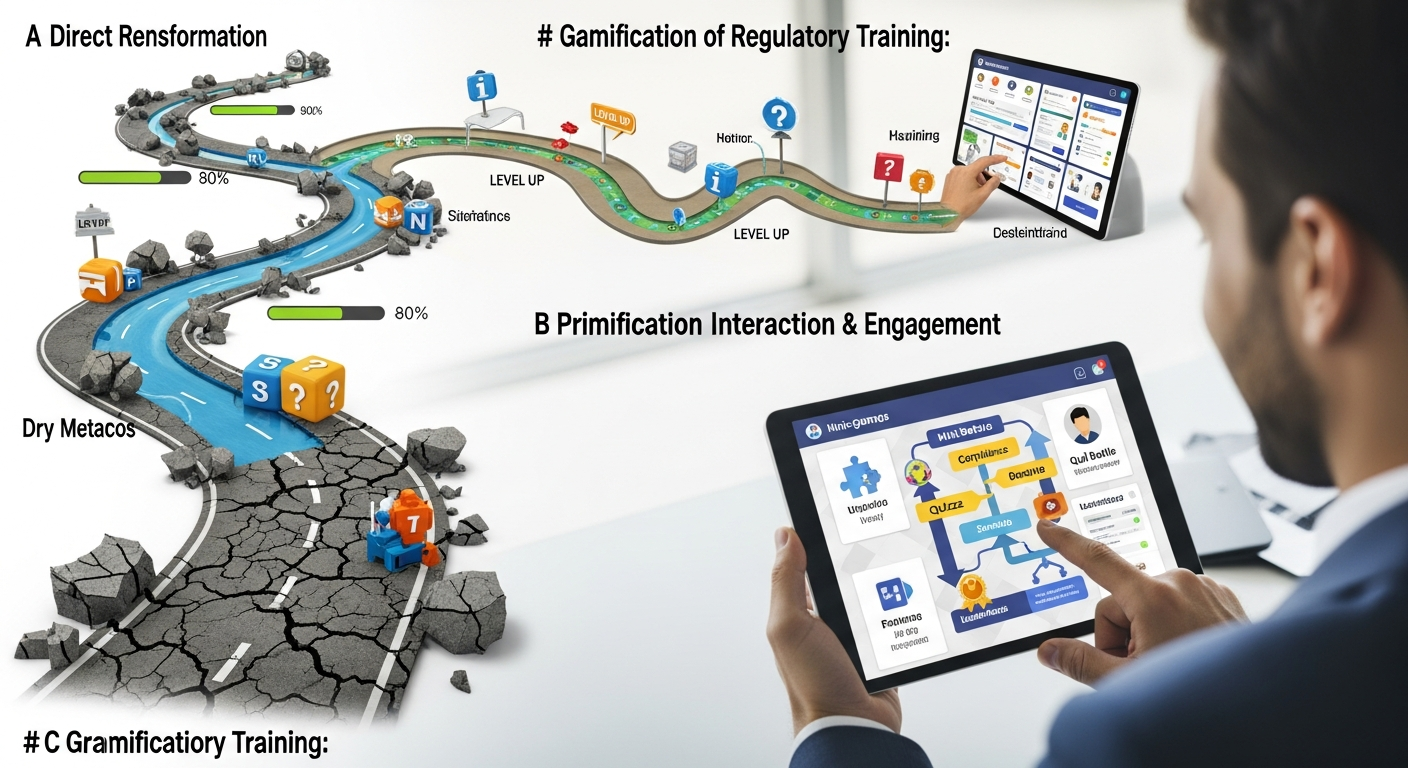
Imagine your employees navigating a virtual 'compliance city,' earning points for correctly identifying ethical dilemmas, unlocking new levels for mastering data privacy regulations, or collaborating in teams to resolve a simulated regulatory breach. This is the power of a modern learning management system that incorporates gamification.
Practical Strategies for Gamifying Regulatory Training
Implementing gamification effectively requires thoughtful design, typically within a robust Gamified LMS. Here's how you can turn dry content into dynamic experiences:
1. Points, Badges, and Leaderboards (PBLs)
These are the foundational elements. Points can be awarded for completing modules, answering questions correctly, or participating in discussions. Badges signify achievement and mastery of specific regulatory topics. Leaderboards foster healthy competition, encouraging learners to strive for excellence.
2. Narrative and Storytelling
Transform dry policy documents into compelling narratives. Create scenarios where learners play the role of a compliance officer, an employee facing an ethical dilemma, or an investigator. This makes the regulations relevant and memorable. For instance, a pharma company could create a story-driven module about ensuring drug safety throughout the supply chain.
3. Challenges and Quests
Break down complex regulations into manageable challenges or 'quests.' Each quest could cover a specific facet of compliance, with clear objectives and rewards upon completion. Think of it as a Microlearning LMS approach applied to gamification, delivering bite-sized, engaging content.
4. Simulations and Branching Scenarios
Allow learners to make decisions in simulated environments and experience the consequences. In finance, this could be a scenario about identifying suspicious transactions. In healthcare, it might involve making choices regarding patient data privacy. Branching scenarios adapt the learning path based on the learner's choices, providing a highly personalized experience.
5. Progress Tracking and Visual Feedback
Visual progress bars, skill trees, or virtual journeys give learners a sense of accomplishment and show them how far they've come and what lies ahead. This constant feedback loop is crucial for motivation in any learning management software.
The Crucial Role of AI in Gamified Regulatory Training
The synergy between artificial intelligence and gamification elevates regulatory training to new heights. AI-driven insights can personalize, optimize, and enhance the learning experience in ways traditional methods cannot. A cutting-edge lms learning management system like MaxLearn LMS leverages this synergy.
Q: How can AI help in setting precise, measurable learning objectives within gamified regulatory modules?
A: AI can analyze past performance data, industry benchmarks, and real-world compliance incidents to suggest Risk-focused Training objectives. It ensures that gamified challenges directly address critical compliance gaps and areas of high risk. This intelligence helps in designing game mechanics that reward the mastery of these specific objectives, making the training directly impactful on business outcomes. An AI Powered Authoring Tool can further streamline the creation of such targeted gamified content.
Q: How can AI adapt gamified regulatory content based on a learner's location or regional compliance requirements?
A: AI in a cloud based learning management system can leverage location data to dynamically serve up region-specific scenarios, challenges, and leaderboards. For instance, a gamified module for financial regulations could automatically present challenges relevant to European GDPR for a learner in Germany, versus CCPA for a learner in California. This ensures learners are always engaging with the most pertinent regulatory information, making the learning experience highly relevant and efficient, particularly for a global enterprise learning management system.
Q: How does AI personalize the gamified experience for each learner to maximize engagement and comprehension?
A: Through Adaptive Learning, AI can track individual progress, identify knowledge gaps, and adjust the difficulty or type of gamified challenges in real-time. If a learner consistently struggles with anti-money laundering regulations, for example, the system can automatically unlock additional quests, provide targeted feedback, or offer supplementary resources. Conversely, if a learner quickly masters a topic, AI can fast-track them to more advanced challenges, ensuring a truly personalized and engaging journey that keeps them motivated and continuously learning. This intelligent personalization is a hallmark of a powerful LCMS.
Choosing the Right Learning Management Solution
To effectively implement gamification and leverage AI for regulatory training, a robust learning management software is essential. Look for a solution that offers:
- Comprehensive gamification features (points, badges, leaderboards, narratives, challenges).
- AI capabilities for personalization, content recommendations, and objective setting.
- Support for Microlearning LMS strategies for bite-sized, digestible content.
- Analytics to track engagement, progress, and compliance readiness.
- Scalability for your organization's growth and evolving regulatory landscape.
A platform like MaxLearn LMS offers these capabilities, transforming your compliance training from a dreaded obligation into an exciting opportunity for growth and risk mitigation. It’s more than just a learning management system; it’s a strategic partner in fostering a culture of continuous learning and compliance.
Conclusion
The era of dull, ineffective regulatory training is over. By embracing gamification, empowered by AI and supported by a sophisticated learning management solutions, L&D leaders can transform a critical business function into an engaging, effective, and even enjoyable experience. This strategic shift not only ensures compliance and reduces organizational risk but also fosters a more knowledgeable, engaged, and productive workforce across all sectors, from Retail to Oil and Gas. Invest in a future where regulatory training is not just completed, but truly mastered.
.jpg)


