

Mastering Learning: The Principle Of Operant Conditioning in Modern L&D
As leaders in Learning & Development, you are constantly seeking strategies to cultivate high-performing teams, ensure compliance, and drive measurable business impact. At the heart of effective training lies a profound understanding of human behavior and how it can be shaped. One of the most powerful psychological frameworks for achieving this is the Principle Of Operant Conditioning.
Developed by B.F. Skinner, operant conditioning posits that learning occurs through rewards and punishments for behavior. Simply put, behaviors that are followed by desirable consequences are more likely to be repeated, while those followed by undesirable consequences are less likely. For L&D professionals, especially those navigating the complexities of corporate training across diverse sectors like Banking, Pharma, Retail, or Oil and Gas, understanding and applying this principle can revolutionize how your teams learn, adapt, and excel.
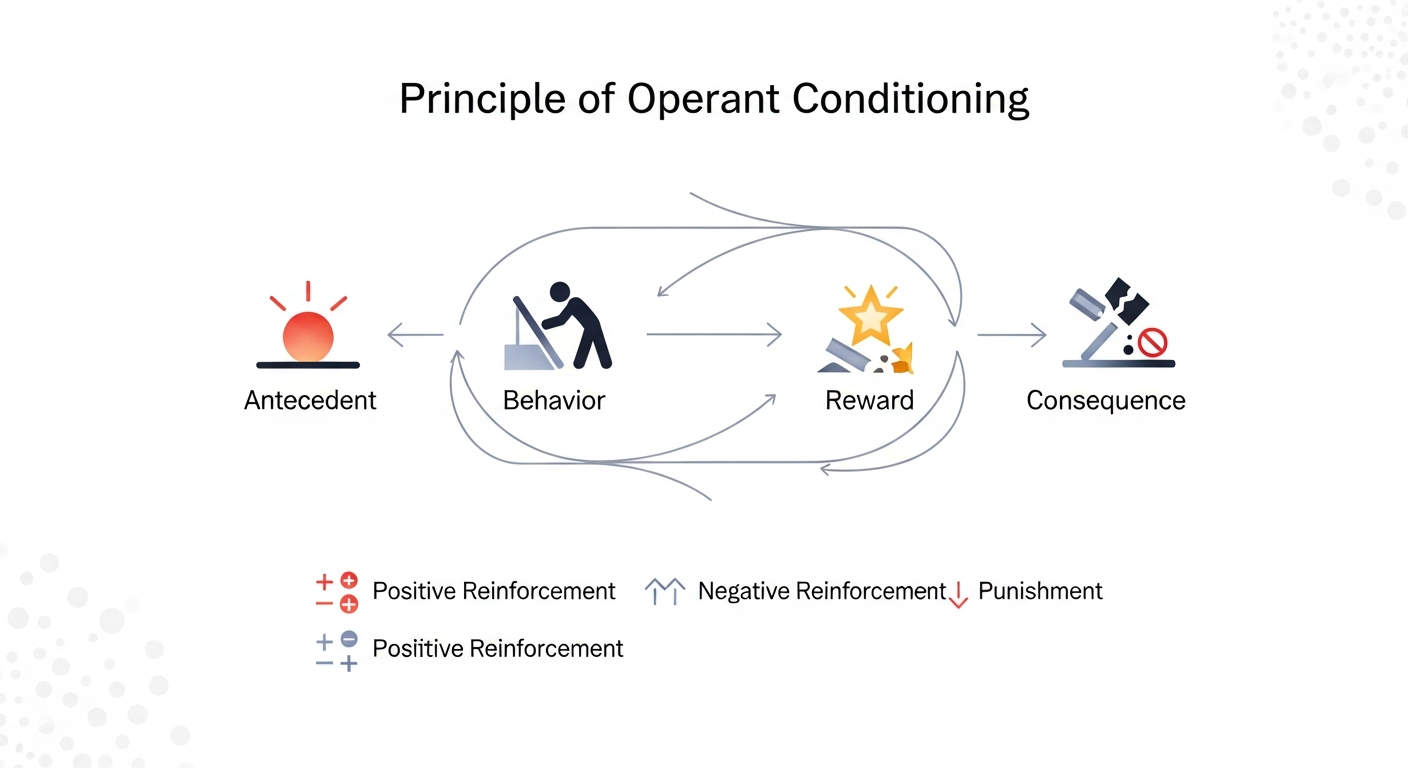
The Core Pillars: Reinforcement and Punishment
Operant conditioning is built on four key concepts, each offering unique leverage points for L&D:
- Positive Reinforcement: Adding a desirable stimulus to increase a behavior. Think of it as a reward.
- Negative Reinforcement: Removing an undesirable stimulus to increase a behavior. This isn't punishment; it's about making a situation better to encourage action.
- Positive Punishment: Adding an undesirable stimulus to decrease a behavior. This introduces a negative consequence.
- Negative Punishment: Removing a desirable stimulus to decrease a behavior. This takes away something valued.
Applying Reinforcement for Enhanced Learning
The power of positive reinforcement in L&D cannot be overstated. When employees successfully complete a module, demonstrate a new skill, or achieve a compliance milestone, immediate and meaningful recognition reinforces that behavior. This could be in the form of:
- Digital badges or certifications.
- Public acknowledgment or leaderboards.
- Opportunities for further development or promotion.
- Tangible rewards or incentives.
Consider a sales team learning new product features. An Microlearning LMS delivering bite-sized content followed by immediate quizzes and points can create a continuous loop of positive reinforcement, making the learning process engaging and effective. Similarly, in healthcare, correctly following a new safety protocol could be reinforced through peer recognition systems or integration into performance reviews, increasing adherence.
Negative reinforcement, though often misunderstood, also plays a role. Imagine a complex, multi-step process for reporting a security incident in Banking. If training streamlines this process, making it simpler and less cumbersome to report correctly, employees are more likely to adopt the new, correct procedure. The removal of the previous, frustrating barrier reinforces the adoption of the new, desired behavior.
Strategic Use of Punishment and Extinction
While reinforcement focuses on encouraging desired behaviors, punishment and extinction aim to decrease undesirable ones. In L&D, the ethical and practical application of punishment requires extreme care. For instance, in Compliance training, failing to meet regulatory standards might lead to retraining (positive punishment – adding an undesirable task) or temporary restriction from certain duties (negative punishment – removing a desirable activity). The goal is always corrective, not punitive, focusing on education and behavioral correction rather than just retribution.
Extinction involves removing the reinforcement that maintains an undesirable behavior. If employees are engaging in a risky practice because it saves them time, and that time-saving is implicitly "rewarding" the behavior, removing that perceived reward (e.g., through stricter monitoring and immediate correction without harsh penalty) can lead to the behavior's gradual disappearance.
Modern L&D and Operant Conditioning in Action
Today's learning technologies offer unprecedented opportunities to apply the Principle Of Operant Conditioning at scale:
- Gamification: Gamified LMS platforms leverage points, badges, leaderboards, and levels as powerful positive reinforcers, making learning fun and competitive. This is particularly effective in Sales training, where friendly competition drives engagement and skill development.
- Adaptive Learning Paths: Platforms employing Adaptive Learning automatically adjust content difficulty and pace based on learner performance. Successfully mastering a concept (positive reinforcement) unlocks more advanced material, while struggling might trigger remedial content (negative reinforcement – removing the stress of difficult material until foundations are solid).
- Real-time Feedback: Immediate feedback on quizzes, simulations, or practical exercises acts as powerful reinforcement (or mild punishment, in the case of incorrect answers), allowing learners to adjust their behavior quickly.
- Scenario-Based Training: In industries like Health Care or Oil and Gas, simulations can provide safe environments to experience consequences of actions, effectively employing mild punishment for incorrect choices (e.g., a "patient outcome" changes for the worse) to reinforce correct procedures.
Leveraging AI for Enhanced Behavioral Shaping
Artificial Intelligence is transforming how L&D can apply operant conditioning, making it more personalized, predictive, and scalable.
How can technology enhance behavioral change in learning?
Modern learning platforms, especially those integrated with an AI Powered Authoring Tool, can personalize reinforcement schedules. AI can identify when a learner is struggling and offer immediate, targeted support (negative reinforcement by removing cognitive load) or provide a challenging but achievable task that, when completed, offers significant positive reinforcement. For instance, an AI can analyze performance data to offer custom feedback loops, ensuring that reinforcement is delivered precisely when and how it's most impactful for an individual.
What innovative methods can drive sustained employee engagement and performance?
AI can predict learner attrition or disengagement by analyzing interaction patterns. This allows L&D to proactively intervene with tailored content or engagement strategies (e.g., sending a personalized message of encouragement or recommending a highly relevant, rewarding Risk-focused Training module). By continuously optimizing the learning experience based on individual responses, AI ensures that the reinforcement learners receive is always relevant and motivating, thus sustaining engagement over time.
How can we ensure training programs lead to measurable improvements in critical areas like compliance and sales?
AI-driven analytics can track behavioral changes directly correlated with training completion. For a compliance program, AI can monitor incident rates or policy adherence post-training, identifying where desired behaviors are (or aren't) being adopted. In sales, it can link training on a new sales methodology directly to improved conversion rates. This data allows L&D to refine reinforcement strategies, ensuring that the desired behavioral outcomes are consistently achieved and reinforced, proving the ROI of training initiatives.
Conclusion: Shaping a Future of Skilled Performance
The Principle Of Operant Conditioning offers L&D leaders a scientifically validated roadmap for fostering desired behaviors and diminishing undesirable ones across all industries. By strategically implementing positive and negative reinforcement, and judiciously using punishment and extinction, you can design training programs that not only educate but profoundly shape performance.
In an era where continuous learning and behavioral adaptation are paramount for organizational success, integrating these psychological principles with cutting-edge learning technologies—from microlearning to AI-powered adaptive platforms—is no longer optional. It's the key to building resilient, skilled, and highly compliant workforces capable of navigating tomorrow's challenges and seizing new opportunities.
.jpg)


