

Why Your 60-Minute Annual Webinars Are Failing: A Cognitive Retention Comparison with Daily 3-Minute Sprints
For too long, the annual, hour-long webinar has been the cornerstone of corporate training, particularly in critical sectors like compliance, sales, banking, finance, insurance, retail, pharma, healthcare, hospitality, oil and gas, and mining. As Vice Presidents, Directors, and Senior Managers of Learning & Development, you’ve likely invested significant resources in these programs. Yet, despite the effort, the elusive goal of sustained knowledge retention and behavioral change often remains just that—elusive. It's time to ask a crucial question: are these lengthy, infrequent training sessions truly effective, or are they a relic of an outdated pedagogical model?
This article delves into the cognitive science behind learning and retention, contrasting the inherent failures of the traditional 60-minute annual webinar with the remarkable success of daily 3-minute learning sprints. We'll explore why a paradigm shift towards a modern Microlearning LMS isn't just a trend, but a necessity for building a truly effective and adaptable workforce.
The Cognitive Cliff: Why 60-Minute Annual Webinars Fall Short
Imagine cramming a year's worth of essential information into a single hour. Now, imagine expecting your employees to recall and apply that information perfectly 11 months later. This scenario, unfortunately, is the reality for many organizations relying on annual webinars for crucial training, from new compliance regulations to sales techniques or product updates.
The Forgetting Curve in Action
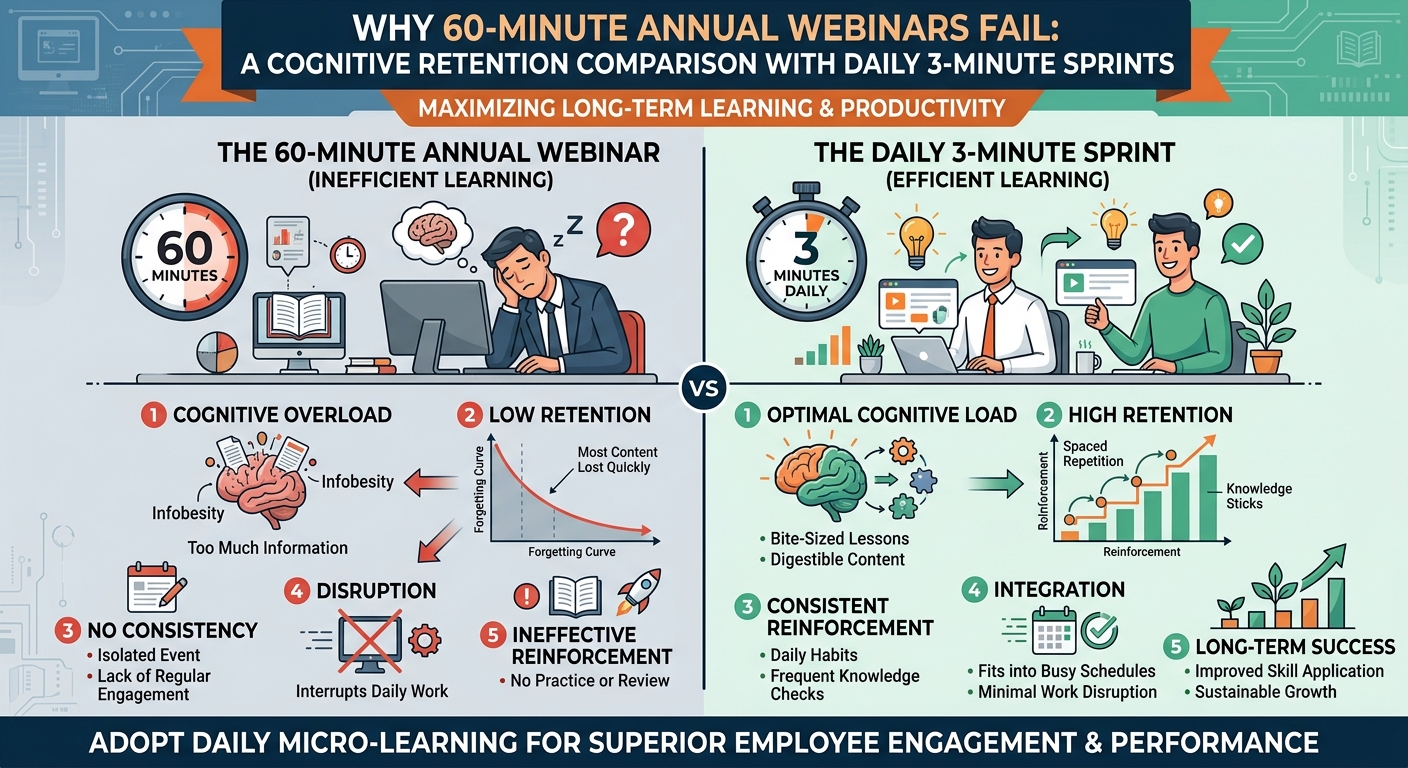
Hermann Ebbinghaus’s "Forgetting Curve" famously illustrates that within just hours of learning new information, we begin to forget a significant portion of it. By day seven, without reinforcement, the retention rate can drop to below 10%. A 60-minute webinar, delivered once a year, sets learners up for failure from the start:
- Information Overload: A flood of data in a short period overwhelms working memory, making it difficult for the brain to process, encode, and store information effectively in long-term memory.
- Lack of Engagement: Maintaining focus for a full hour, especially on complex or dry topics, is challenging. Distractions abound, and passive listening leads to minimal cognitive effort.
- Irrelevance by Application: When the information is delivered far in advance of its practical application, its perceived relevance diminishes. Learners struggle to connect the training to real-world scenarios, leading to poor transfer of learning.
- Logistical Hurdles: Coordinating schedules for large groups, dealing with technical glitches, and ensuring attendance can be a significant drain on resources, often resulting in mandatory, unenthusiastic participation.
For any organization aiming for a high-performing and compliant workforce, especially those handling sensitive data or customer interactions like banking, finance, and healthcare, the limitations of this approach are severe. It's not just about delivering content; it's about ensuring it sticks and is applied when it matters most.
The Power of Pacing: Cognitive Science and 3-Minute Sprints
In stark contrast to the annual marathon, daily 3-minute learning sprints leverage fundamental principles of cognitive science to drastically improve retention and application. This approach is the cornerstone of modern Microlearning LMS methodologies.
Cognitive Principles at Play:
- The Spacing Effect: Learning is more effective when study sessions are spaced out over time, rather than crammed into a single session. Short, frequent bursts allow the brain time to consolidate information, forming stronger neural pathways.
- Active Recall: Daily sprints often incorporate quizzes or challenges that force learners to actively retrieve information. This process strengthens memory and identifies knowledge gaps instantly.
- Attention Span Optimization: The average adult attention span is significantly shorter than an hour. Three-minute modules align perfectly with our natural ability to focus, making learning digestible and engaging.
- Reduced Cognitive Load: By breaking down complex topics into bite-sized pieces, learners experience less cognitive overload. This allows for deeper processing of each concept before moving on.
- Just-in-Time Learning: When learning is delivered frequently, it can be aligned much closer to the moment of need. This increases relevance and immediate applicability, crucial for sales teams needing up-to-date product knowledge or compliance officers adapting to new regulations.
Implementing a sophisticated Gamified LMS with daily sprints transforms learning from a dreaded chore into an engaging, integral part of the workday. From pharma reps needing to understand new drug profiles to retail staff learning seasonal promotions, the benefits are clear.
The Smart Shift: Implementing Daily 3-Minute Sprints
Transitioning from annual webinars to daily 3-minute sprints requires a strategic approach, but the long-term gains in knowledge retention, employee engagement, and overall performance are immeasurable. This is where the right learning management system becomes paramount.
Key Advantages of Daily Sprints:
- Superior Retention: Consistent, spaced repetition actively combats the forgetting curve, embedding knowledge firmly in long-term memory.
- Enhanced Engagement: Short, interactive modules, often integrated with Gamified LMS elements like leaderboards and points, make learning fun and motivate continuous participation.
- Personalization & Adaptability: Modern Adaptive Learning platforms can tailor content delivery based on individual performance and learning styles, ensuring each employee receives the most relevant training.
- Measurable Impact: Frequent assessments provide granular data on knowledge gaps, allowing L&D teams to quickly identify and address areas where employees are struggling. This data-driven approach is invaluable for all industries, from oil and gas to insurance.
- Agility and Scalability: Easily update content, roll out new modules, and scale training across diverse teams and global operations. A cloud based learning management system makes this possible.
Intelligence-Driven Learning: Addressing Key L&D Questions
As L&D leaders navigate the evolving landscape of corporate training, leveraging advanced technologies is crucial. Here are insights into how intelligent systems support effective daily sprints:
How can technology personalize learning paths for diverse global teams?
Intelligent learning platforms analyze individual performance data, job roles, and regional compliance requirements to dynamically deliver tailored content. For example, an enterprise learning management system can serve specific learning management solutions to an employee in a sales role in Europe, focusing on GDPR compliance and regional sales tactics, while an employee in Asian operations receives relevant local market insights. This ensures that every learner receives content that is not only relevant to their specific role but also to their geographic context, optimizing impact across vast, international teams.
What innovative tools are available to measure the real-time impact of short, frequent training?
Modern LMS platforms provide advanced analytics dashboards that track engagement rates, completion times, quiz scores, and even sentiment analysis in real-time. By leveraging a robust learning content management system, L&D can instantly identify modules with low retention, pinpoint specific knowledge gaps across the organization, and correlate training completion with business outcomes. For instance, in retail, managers can see how quickly new product training impacts sales figures, or in mining, how new safety microlearnings reduce incident rates. These capabilities offer a level of immediate feedback and optimization that traditional webinars simply cannot match, enabling truly data-driven decisions for continuous improvement.
How can organizations ensure training content remains relevant and actionable for specific job roles and locations?
The key lies in an AI Powered Authoring Tool integrated within your lms learning management system. Such tools allow for rapid content creation and localization. For instance, in financial services, a single core module on fraud detection can be quickly adapted with examples pertinent to different regional banking regulations. Similarly, a learning management software can prompt content creators to update modules based on changes in compliance laws or market trends, ensuring that the daily 3-minute sprints are always delivering the most current and actionable information. This proactive approach to content management ensures that training is always aligned with operational needs and specific job functions, keeping your workforce at the forefront of their respective fields.
Driving Business Growth with Modern Learning
The shift from antiquated annual webinars to dynamic daily sprints isn't just about better retention; it's about building a more agile, knowledgeable, and resilient workforce capable of driving business growth. For industries steeped in regulations like compliance and healthcare, this means significantly reducing Risk-focused Training and ensuring consistent adherence to policies.
Imagine your sales force consistently trained on new product features and objection handling, your compliance officers always up-to-date with the latest regulations, or your customer service team proficient in every interaction. This is the promise of modern eLearning solutions. A comprehensive MaxLearn LMS empowers you to deliver this cutting-edge experience.
Conclusion
The evidence is clear: the 60-minute annual webinar is a relic that fails to meet the demands of modern cognitive science and today's fast-paced business environment. Its limitations in engagement, retention, and applicability are simply too great.
As L&D leaders, your role is pivotal in guiding your organization towards more effective learning strategies. Embracing the power of daily 3-minute sprints, supported by a robust LMS and advanced features like Adaptive Learning and AI Powered Authoring Tool, is not just an upgrade—it's a transformation. It’s an investment in a smarter, more capable workforce that will drive compliance, boost sales, reduce risks, and ultimately, secure your organization's future success. It's time to move beyond passively consuming information and empower your employees with knowledge that truly sticks.
.jpg)


