

Unlocking Engaging Learning: Generating Scenario-Based Prompts with AI Course Generators
In today's fast-evolving corporate landscape, the demand for effective, engaging, and scalable employee training is at an all-time high. Learning and Development (L&D) leaders – from VPs to Managers – are constantly seeking innovative strategies to equip their teams with the skills needed to navigate complex challenges, maintain compliance, boost sales performance, and drive financial acumen. Traditional training methods often fall short in fostering true understanding and practical application. This is where scenario-based learning emerges as a powerful solution, and with the advent of artificial intelligence, its creation has become more accessible and impactful than ever before.
Imagine being able to rapidly develop hyper-realistic training modules that challenge your employees to make critical decisions in simulated environments, whether they're navigating complex compliance regulations in banking, closing a high-stakes deal in sales, managing patient care in healthcare, or ensuring safety protocols in oil and gas. AI-powered course generators are transforming this vision into reality, offering an unprecedented capability to generate sophisticated scenario-based learning prompts. This article will guide L&D professionals through leveraging these advanced tools to create compelling, experience-driven training that sticks.
Why Scenario-Based Learning Matters More Than Ever
Scenario-based learning places learners in realistic situations, requiring them to analyze information, make decisions, and experience the consequences (positive or negative) of their choices in a safe environment. This approach is particularly critical across diverse industries:
- Compliance: In banking, finance, and insurance, employees must understand and apply intricate regulations. Scenarios can simulate anti-money laundering investigations or data privacy breaches.
- Sales & Retail: Sales professionals benefit from practicing objection handling, negotiation tactics, and customer service scenarios.
- Pharma & Healthcare: Clinical decision-making, ethical dilemmas, and patient communication can be effectively trained through simulated patient interactions.
- Hospitality: Staff can practice handling difficult customer situations or operational challenges.
- Oil & Gas / Mining: Safety protocols, emergency response, and operational decision-making are paramount.
The benefits are clear: enhanced critical thinking, improved decision-making skills, better knowledge retention, and a direct link between learning and on-the-job performance. Delivering such impactful training often requires a sophisticated Microlearning LMS, capable of presenting bite-sized, relevant content. Furthermore, to maximize engagement and make learning more interactive, many organizations opt for a Gamified LMS.
The Rise of AI in Learning Content Creation
The traditional process of developing robust scenario-based training is labor-intensive, requiring significant time from instructional designers, subject matter experts, and content creators. However, the emergence of artificial intelligence has dramatically shifted this paradigm. AI Powered Authoring Tools can now assist L&D teams in automating repetitive tasks, generating content variations, and even suggesting complex branching logic for scenarios. This shift enables L&D departments to:
- Increase Efficiency: Drastically reduce the time and resources needed for content creation.
- Scale Production: Generate a high volume of diverse scenarios to cater to different roles, departments, and learning paths.
- Enhance Personalization: Tailor scenarios more effectively to individual learner needs and performance data.
Understanding Scenario-Based Learning Prompts
At its core, a scenario-based learning prompt is the initial setup or question that an AI course generator uses to create an interactive learning experience. It defines the context, the characters, the challenge, and the desired learning outcome. A well-crafted prompt acts as the blueprint for an engaging and effective scenario. It should guide the AI to:
- Establish a believable context relevant to the industry and role.
- Introduce a clear problem or decision point.
- Specify the type of interaction or choice the learner needs to make.
- Outline the learning objectives the scenario aims to achieve.
Generating Effective Prompts with AI Course Generators
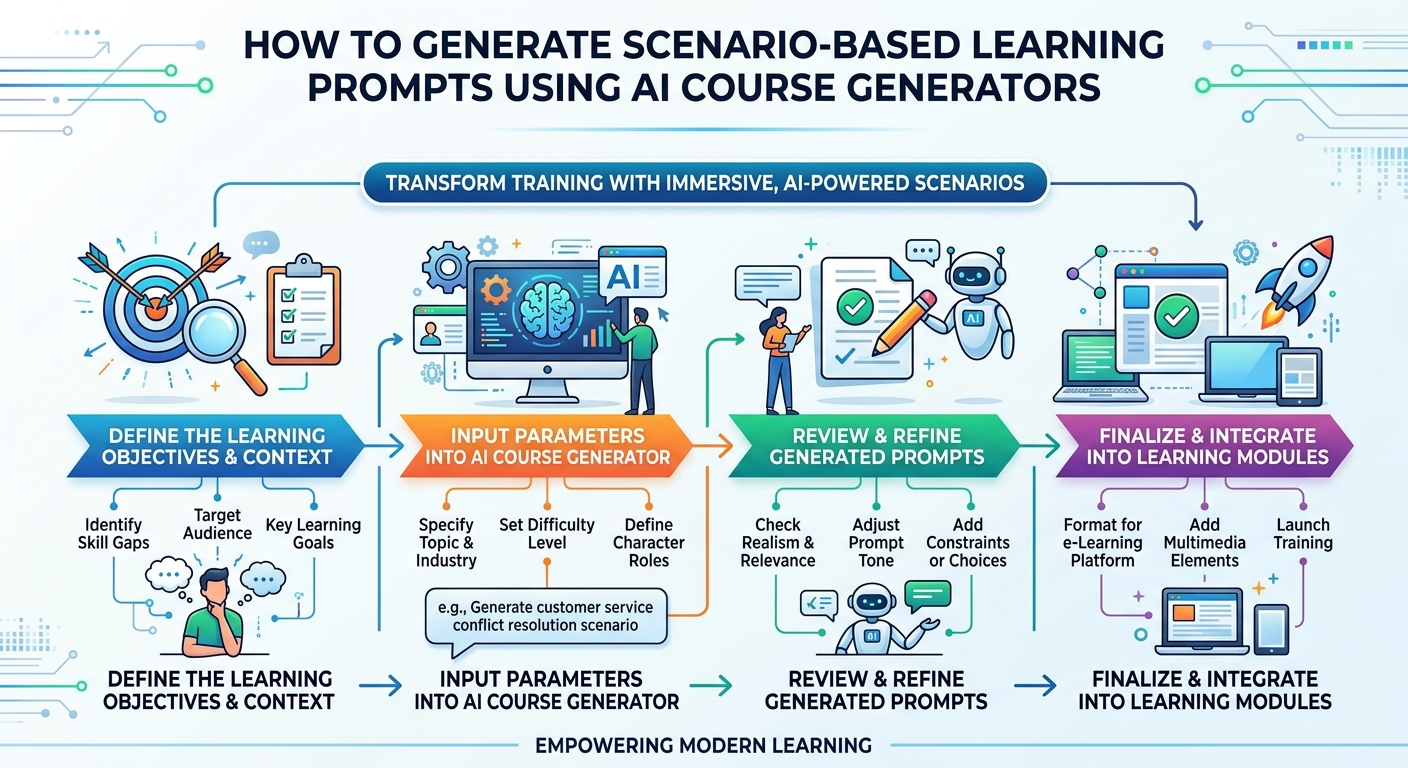
Leveraging AI to generate compelling scenario-based learning prompts is a structured process. Here’s a step-by-step guide for L&D leaders:
Step 1: Define Clear Learning Objectives and Audience
Before interacting with any AI tool, clarity on your training goals is paramount. What specific skills or knowledge do you want your learners to acquire? Who are your learners (e.g., new sales associates, senior compliance officers, front-line healthcare staff)?
Querying an Intelligent System: "What is the most effective way to structure learning objectives for diverse teams globally involved in financial compliance training, ensuring relevance across different regulatory environments?"
The more precise your objectives and audience definition, the better the AI can tailor its output. For example, a scenario for risk managers in finance will differ significantly from one for retail customer service representatives.
Step 2: Provide Rich Context and Constraints
AI models thrive on context. Feed your AI course generator detailed information about the industry, specific roles, common challenges, and any relevant constraints (e.g., time limits, budget restrictions, ethical guidelines). For instance, when creating Risk-focused Training, you might specify the type of risk (financial, operational, reputational) and the specific regulations involved.
Example AI Input: "Generate a scenario prompt for new pharmaceutical sales representatives. The context is a physician's office visit. The challenge involves addressing a doctor's skepticism about a new drug's side effects, adhering to strict promotional guidelines."
Step 3: Craft Initial Prompt Statements
Start with a clear, concise statement that sets the stage for the AI. Think of it as the first sentence of your story. This initial prompt guides the AI in generating the core elements of the scenario.
- "Create a customer service scenario where the learner handles an irate customer complaining about a delayed delivery."
- "Develop a leadership dilemma where a manager must motivate a demotivated team member without compromising project deadlines."
- "Formulate a compliance training scenario focusing on data privacy breaches in a retail setting."
Querying an Intelligent System: "How can an intelligent system help me formulate compelling scenario starters that directly address common customer objections encountered by our B2B sales force?"
Step 4: Iterate and Refine with AI Feedback
This is where the power of the AI Powered Authoring Tool truly shines. Once you provide an initial prompt, the AI will generate variations, suggest alternative pathways, or even ask clarifying questions. Use these suggestions to refine your scenario. For example, if you're developing Adaptive Learning modules, the AI can help design scenarios that adjust difficulty based on learner performance.
AI Response Example: "Would you like to introduce a time-sensitive element to the customer service scenario? Or perhaps an unexpected twist, like the customer revealing they are a competitor's executive?"
This iterative process allows you to co-create with the AI, enhancing the depth and realism of your scenarios.
Step 5: Integrate and Deliver
Once your AI has helped you generate a suite of robust scenario prompts and even full scenario branches, the next step is to integrate these into your chosen learning content management system. A modern LMS allows you to upload these interactive modules, track learner progress, and measure impact. Many organizations find a cloud based learning management system offers the flexibility and scalability needed for modern training initiatives. An enterprise learning management solution like MaxLearn LMS simplifies content deployment and management across large organizations.
Best Practices for AI-Generated Scenarios
While AI offers incredible capabilities, human oversight remains crucial:
- Maintain Human Vetting: Always review AI-generated content for accuracy, relevance, and bias. Subject matter experts (SMEs) are indispensable for validating the realism and pedagogical effectiveness of scenarios.
- Focus on Learning Outcomes: Ensure every scenario, regardless of how it was generated, directly contributes to your predefined learning objectives.
- Test and Validate: Pilot your AI-generated scenarios with a small group of learners. Gather feedback and use it to refine prompts and content. This continuous improvement ensures your learning management software is delivering maximum impact.
- Ethical Considerations: Be mindful of the data you feed the AI and the output it generates. Ensure scenarios are inclusive, unbiased, and respect privacy.
- Leverage as a Tool, Not a Replacement: View the AI course generator as a powerful assistant that augments the skills of your L&D team, rather than replacing them.
The Future of Learning with AI
The capabilities of AI in learning content creation are only just beginning. We can anticipate even more sophisticated AI models that can:
- Generate full, multi-branching scenarios from a single, high-level prompt.
- Automatically adapt scenarios in real-time based on learner performance and emotional state (via biofeedback, where applicable).
- Create personalized learning paths by dynamically assembling relevant scenarios from a vast library.
The evolution of the learning content management system and overall learning management solutions will undoubtedly be intertwined with these advancements. An advanced learning management system like MaxLearn LMS is at the forefront of this integration, offering powerful tools for managing and delivering cutting-edge AI-generated content. As L&D leaders, embracing this technology will be key to staying competitive and ensuring your workforce is prepared for tomorrow's challenges.
Conclusion
Generating scenario-based learning prompts with AI course generators represents a significant leap forward for L&D professionals across all industries. From compliance and finance to sales and healthcare, AI empowers organizations to create highly engaging, relevant, and effective training experiences at an unprecedented scale. By understanding how to effectively prompt and guide these intelligent tools, L&D VPs, Directors, Senior Managers, and Managers can transform their training initiatives, fostering a culture of continuous learning and practical application. Investing in the right learning management software and embracing AI as a strategic partner will be crucial in building a future-ready workforce.
.jpg)


