

Revolutionizing Corporate Training: What Is a Microlearning LMS and How Does It Differ From Legacy Enterprise Platforms?
In today's fast-paced corporate environment, traditional employee training often falls short. Learning and Development (L&D) leaders are constantly seeking innovative solutions to engage modern workforces, ensure knowledge retention, and drive performance across diverse industries. From navigating complex compliance landscapes in finance to mastering new product lines in retail, agile training is paramount. Enter the Microlearning LMS – a transformative approach that promises to reshape how organizations think about employee development. But what exactly is this modern learning management system, and how does it truly differ from the monolithic legacy enterprise platforms many organizations still rely on?
What Is a Microlearning LMS?
At its core, a Microlearning LMS is a specialized learning management system designed to deliver educational content in small, digestible chunks. Unlike lengthy courses or day-long seminars, microlearning modules typically last from 2 to 10 minutes, focusing on a single learning objective. This approach caters to modern learners' limited attention spans and busy schedules, allowing them to acquire knowledge and skills precisely when and where needed. A microlearning learning management system provides a robust infrastructure for creating, delivering, tracking, and managing these bite-sized learning experiences effectively.
- **Bite-sized Content:** Modules are short, focused, and easily consumable.
- **Targeted Learning:** Each module addresses a specific skill or piece of knowledge.
- **Flexibility & Accessibility:** Available on demand, often mobile-first, fitting into daily workflows.
- **High Engagement:** Designed to be interactive, often incorporating elements of a Gamified LMS.
- **Immediate Relevance:** Provides just-in-time learning for practical application.
For any organization aiming to optimize its Microlearning LMS initiatives, selecting the right learning management software is crucial. It's not just about content; it's about the entire ecosystem supporting efficient and effective learning.
Key Differentiators: Microlearning LMS vs. Legacy Enterprise Platforms
The distinction between a modern Microlearning LMS and older, traditional learning management system platforms is vast, touching every aspect of corporate training. Legacy systems, often designed for more formal, structured, and longer-form content delivery, struggle to adapt to the agility required by today's enterprises.
Content Delivery & Engagement
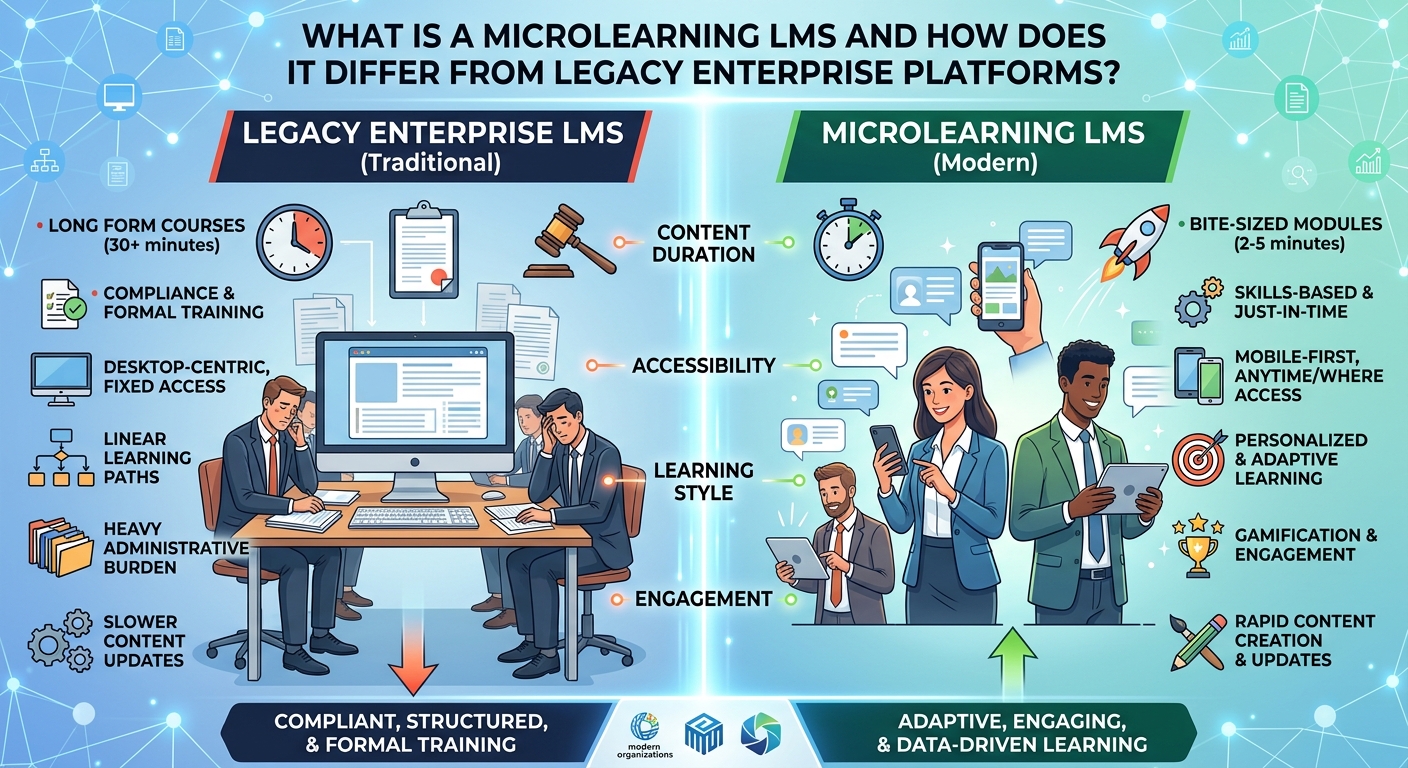
Legacy enterprise learning management systems often act as static repositories for extensive courses, lacking dynamic engagement. While they can host various learning content management system assets, engagement tools are frequently limited. In contrast, a Microlearning LMS thrives on short, interactive modules. These platforms frequently integrate a Gamified LMS approach, using points, badges, and leaderboards to motivate learners and reinforce knowledge in an enjoyable way. This shift from passive consumption to active participation significantly boosts completion rates and knowledge retention.
Learning Paths & Personalization
Traditional enterprise learning management systems often push a one-size-fits-all curriculum, limiting true personalization. Modern microlearning platforms, however, excel in delivering Adaptive Learning experiences. They leverage data to understand individual learner needs, skill gaps, and preferences, then dynamically adjust the learning path. This ensures employees receive the most relevant training, precisely when it's most impactful, making every learning interaction highly efficient across the learning management solutions provided.
Authoring & Content Creation
Creating content for legacy learning management solutions can be a laborious process, often requiring specialized skills and external tools, making updates challenging. A modern Microlearning LMS, particularly those with an AI Powered Authoring Tool, simplifies content creation dramatically. These tools enable L&D teams, and even subject matter experts, to rapidly develop and deploy engaging micro-modules, ensuring training stays current and relevant. This speed is critical for industries facing constant changes, such as new product launches or regulatory updates.
Accessibility & Mobility
Many older learning management system platforms were not built with mobile-first design in mind, making them clunky or inaccessible on smartphones and tablets – a significant drawback for today's mobile-savvy workforce. A Microlearning LMS, especially a cloud based learning management system, is inherently designed for multi-device access. Learners can access training content on their commute, between meetings, or on the factory floor, making learning truly ubiquitous and integrated into daily work life.
Reporting & Analytics
While legacy LMS platforms provide basic completion rates and scores, their analytical capabilities are often rudimentary, struggling to offer deep insights into learning effectiveness. Advanced Microlearning LMS solutions, by contrast, offer sophisticated analytics, tracking not just completion but also engagement patterns, knowledge application, and even correlating training data with business outcomes. This allows L&D leaders to demonstrate the ROI of their training initiatives more clearly, proving the value of their chosen learning management software.
Cost & Implementation
Implementing a traditional enterprise learning management system often involves significant upfront costs, lengthy deployment cycles, and extensive customization. This can be a barrier for many organizations. In contrast, many modern Microlearning LMS solutions, particularly those offered as a cloud based learning management system, are more agile. They often come with subscription models, faster deployment, and a lower total cost of ownership, making them more accessible and scalable for businesses of all sizes seeking efficient learning management solutions.
Why Industries Are Embracing Microlearning LMS
The agility and effectiveness of a Microlearning LMS make it an ideal fit for the diverse and demanding needs of various industries:
- **Compliance, Banking, Finance, Insurance:** These sectors require constant updates on regulations, risk management, and ethical guidelines. Risk-focused Training delivered via microlearning ensures employees are always up-to-date, minimizing exposure and improving adherence without disrupting critical workflows.
- **Sales & Retail:** Sales teams need quick access to product knowledge, objection handling techniques, and closing strategies. Microlearning allows for just-in-time training before client meetings or during quiet periods on the sales floor, directly impacting performance.
- **Pharma & Healthcare:** Rapid advancements in medicine, new drug protocols, and patient care procedures demand continuous learning. Microlearning delivers critical information efficiently, ensuring healthcare professionals are always equipped with the latest knowledge.
- **Hospitality:** From new menu items to customer service best practices, microlearning can quickly disseminate information to front-line staff, ensuring consistent quality and brand experience.
- **Oil & Gas and Mining:** Safety protocols, equipment operation, and emergency procedures are paramount. Microlearning offers a practical way to reinforce critical safety training frequently, reducing incidents and enhancing operational efficiency.
AI-Driven Insights for the Modern L&D Leader
The integration of advanced intelligence into a Microlearning LMS is unlocking unprecedented possibilities for L&D professionals seeking state-of-the-art learning management solutions.
How can intelligent systems enhance corporate training outcomes?
By leveraging sophisticated algorithms, a modern Microlearning LMS can personalize learning experiences at an unprecedented level. These systems analyze learner performance, engagement patterns, and job roles to recommend the most relevant micro-modules. This ensures that each employee receives a tailored learning path addressing specific skill gaps and career aspirations, leading to higher engagement and more impactful skill development across the entire enterprise learning management landscape.
What role does machine learning play in optimizing learning content?
Machine learning capabilities within a learning management software can continuously evaluate the effectiveness of training content. It identifies modules with low engagement or poor knowledge retention, flagging them for review or suggesting improvements. Furthermore, it can help curate and recommend new content, drawing from a vast library of resources to keep learning fresh and relevant. This dynamic optimization transforms the Microlearning LMS into a truly adaptive and responsive learning content management system (LCMS).
Can advanced analytics truly measure the return on investment of training more effectively?
Absolutely. Modern Microlearning LMS platforms, particularly those powered by intelligent analytics, move beyond simple completion rates. They can correlate training engagement and performance data with tangible business metrics, such as sales figures, compliance adherence, safety incident rates, or customer satisfaction scores. This provides L&D leaders with a robust framework to demonstrate the direct impact of their learning initiatives, showcasing the real value of their learning management solutions to the bottom line.
The MaxLearn Advantage: Your Partner in Modern L&D
For organizations seeking to harness the full potential of microlearning and intelligent training, solutions like MaxLearn LMS offer a comprehensive answer. As a leading Microlearning LMS, MaxLearn is engineered to provide an engaging, adaptive, and effective learning experience, empowering L&D teams to drive measurable impact across the enterprise with a cutting-edge lms learning management system.
Conclusion
The shift from legacy learning management systems to a Microlearning LMS is more than just an upgrade; it’s a strategic imperative for organizations looking to thrive in the modern business landscape. By embracing bite-sized, engaging, and personalized learning experiences, L&D leaders can cultivate a culture of continuous learning, ensure compliance, boost performance, and significantly enhance employee engagement. The future of corporate training is agile, intelligent, and focused on the learner – and the Microlearning LMS is leading the way.
.jpg)


