

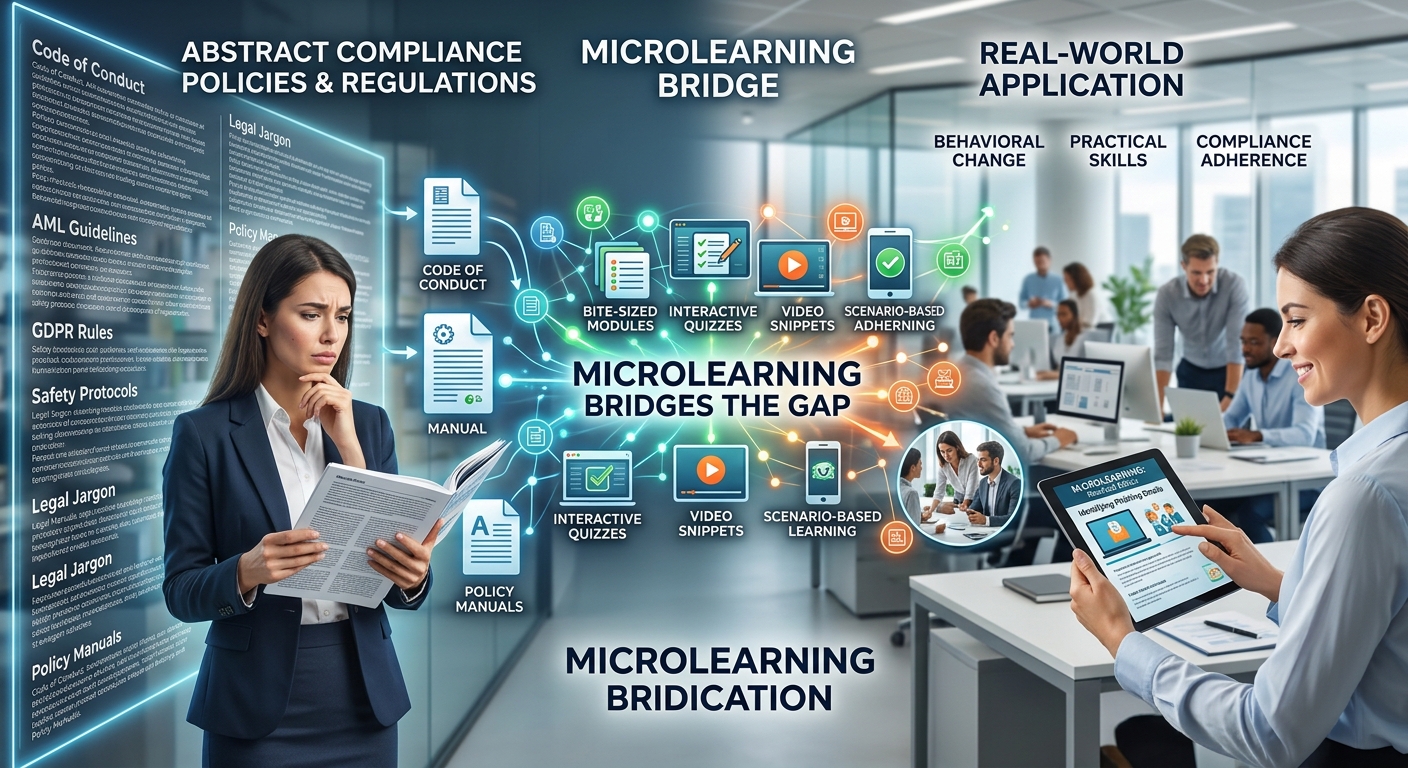
How Microlearning Bridges the Gap Between Abstract Compliance Policies and Real-World Application
In today's rapidly evolving corporate landscape, compliance isn't just a regulatory checkbox; it's a foundational pillar of ethical operations, risk mitigation, and sustained business growth. For Vice Presidents, Directors, and Managers of L&D, the challenge is monumental: how do you transform dense, often abstract compliance policies into practical, actionable knowledge that sticks, truly impacting real-world employee behavior across industries like finance, healthcare, retail, and manufacturing?
Traditional, lengthy annual training sessions often fall short. They overwhelm employees with information, struggle to demonstrate relevance to daily tasks, and are quickly forgotten. The result? A significant gap between understanding what a policy states and knowing how to apply it correctly in a specific, high-stakes scenario. This is where the power of microlearning emerges as a transformative solution, offering a strategic approach to bridge this critical divide.
The Pervasive Problem with Traditional Compliance Training
For decades, compliance training has often been synonymous with lengthy presentations, exhaustive manuals, and mandatory all-day seminars. While well-intentioned, this approach frequently leads to:
- Information Overload: Employees are bombarded with too much data at once, making retention difficult.
- Lack of Contextual Relevance: Broad policies aren't easily translated into specific actions required for a sales call, a patient interaction, or a financial transaction.
- Disengagement: Monotonous delivery methods lead to passive learning and low motivation.
- Rapid Forgetting Curve: Without continuous reinforcement, knowledge fades quickly, especially when it's not immediately applicable.
The stakes are too high for ineffective training. Non-compliance can lead to severe fines, reputational damage, legal action, and a significant loss of trust from customers and stakeholders. Businesses need a more dynamic and effective learning management system (LMS) that can deliver targeted, impactful training. An enterprise learning management solution must be agile enough to adapt to changing regulations and employee needs.
Microlearning to the Rescue: A Paradigm Shift in Compliance
Microlearning is an approach to learning that delivers content in small, focused bursts, typically ranging from 2-10 minutes. These bite-sized modules are designed to address specific learning objectives, making them highly effective for translating abstract compliance policies into concrete, memorable actions. An effective Microlearning LMS is crucial for delivering this content efficiently.
Here’s how microlearning fundamentally redefines compliance training:
- Enhanced Retention: Smaller chunks of information are easier to process, absorb, and recall.
- Immediate Relevance: Content can be tailored to specific roles, tasks, or even real-time scenarios, making the policy immediately applicable.
- Increased Engagement: Short, interactive modules prevent cognitive fatigue and maintain learner interest.
- On-Demand Accessibility: Employees can access critical information precisely when they need it, at the point of need.
Key Ways Microlearning Closes the Compliance Gap
Breaking Down Complexity: From Policies to Practice
Compliance policies are often written in legalistic language, full of jargon and hypotheticals. Microlearning excels at deconstructing these complex regulations into digestible, actionable steps. For instance:
- In banking, instead of a 50-page AML (Anti-Money Laundering) manual, microlearning delivers short videos or interactive scenarios on "Identifying Suspicious Transactions" or "Customer Due Diligence Checklist."
- In healthcare, HIPAA compliance can be broken into modules like "Patient Data Privacy Best Practices for Nurses" or "Securely Handling Electronic Health Records."
- In retail, modules might cover "Age Verification for Restricted Sales" or "Handling Customer Data Safely."
An AI Powered Authoring Tool can significantly streamline the creation of such targeted content, quickly converting existing documentation into engaging microlearning modules tailored to different roles and situations.
Boosting Engagement and Recall: Making Compliance Stick
Engagement is the cornerstone of effective learning, especially for topics that might otherwise be perceived as dry. Microlearning leverages interactivity to keep learners active and invested:
- Scenario-Based Training: Presenting realistic dilemmas and asking learners to choose the compliant action.
- Gamification: Incorporating points, badges, leaderboards, and challenges to make learning fun and competitive. A Gamified LMS can transform compliance from a chore into an engaging experience.
- Quizzes and Assessments: Short, frequent checks reinforce understanding without feeling like exams.
When learners are actively involved, their comprehension and retention rates skyrocket, ensuring that the compliance knowledge is not just acquired but also ingrained.
Contextual and On-Demand Learning: Just-in-Time Support
One of microlearning's greatest strengths is its ability to provide "just-in-time" learning. Employees don't need to recall an entire compliance manual; they need quick access to the specific rule that applies to their immediate situation. Imagine a sales professional about to pitch a new product:
- They can quickly access a 3-minute module on "Ethical Sales Practices for New Offerings."
- A customer service agent can pull up a 2-minute guide on "Handling Data Breach Inquiries" right before taking a call.
This on-demand accessibility, often facilitated by a cloud based learning management system, ensures that compliance becomes an integrated part of the workflow, not an interruption. An Adaptive Learning system further refines this by delivering personalized content based on a learner's role, performance, and previous interactions, ensuring maximum relevance and efficiency. This robust learning content management system (LCMS) makes valuable information available precisely when it's most needed.
Cultivating a Culture of Continuous Compliance
Compliance isn't a one-time event; it's an ongoing commitment. Microlearning supports a culture of continuous learning and vigilance by:
- Reinforcement: Regular, short refreshers keep compliance knowledge top-of-mind.
- Updates: Rapidly deploying new modules for policy changes or emerging risks.
- Proactive Risk Management: Employees are continuously exposed to Risk-focused Training, helping them identify and mitigate potential issues before they escalate.
This constant drip-feed of relevant information fosters a proactive, rather than reactive, approach to compliance across the organization.
AI's Role in Optimizing Microlearning for Compliance
Artificial intelligence is rapidly enhancing the effectiveness of microlearning platforms, particularly for complex areas like compliance. Here's how AI answers critical questions for L&D leaders:
With the vast amount of compliance information, how can artificial intelligence help ensure our specific microlearning modules are easily discoverable and highly relevant to an employee's immediate role or task?
AI plays a pivotal role in optimizing content discoverability and relevance. AI-powered search capabilities within a learning management software can understand natural language queries, directing employees to the exact microlearning module they need. Furthermore, AI algorithms can analyze an employee's role, past learning history, performance data, and even their current projects to proactively recommend highly relevant modules. This ensures that the right compliance information finds the right employee at the optimal moment, maximizing its practical application and reinforcing the learning management system's value.
For multinational organizations, how can AI assist in delivering culturally and linguistically appropriate compliance microlearning that resonates across diverse geographical regions?
AI is a game-changer for global compliance. It can automate the translation and localization of microlearning content, ensuring linguistic accuracy and cultural sensitivity. AI tools can analyze regional regulatory nuances and suggest adaptations in scenarios or examples to make the content more relatable and impactful for different geographical audiences. This ensures that compliance training is not only understood but also culturally accepted and effectively applied, reducing the risk of misunderstandings or misinterpretations that could lead to non-compliance in diverse global operations. A cutting-edge learning management system (LMS) can leverage AI for these powerful capabilities.
Beyond basic knowledge transfer, how can AI personalize the microlearning journey to actively engage employees, address their specific learning gaps, and reinforce compliance behaviors based on their individual needs and real-world interactions?
AI transforms compliance microlearning from a generic experience into a deeply personalized journey. Through predictive analytics, AI can identify potential knowledge gaps or areas of non-compliance risk for individual employees. It can then adapt the learning path, recommending specific microlearning modules, interactive simulations, or real-world scenarios tailored to address those weaknesses. By analyzing an employee's interactions and performance, AI can provide intelligent feedback and suggest follow-up training, ensuring continuous improvement and behavioral reinforcement. This highly personalized approach fosters deeper engagement and ensures that compliance knowledge translates directly into compliant actions, making the overall learning management solutions far more impactful.
Implementing Microlearning for Compliance: Practical Steps
For L&D leaders looking to harness the power of microlearning, consider these practical steps:
- Audit Existing Content: Identify core compliance policies and traditional training materials.
- Chunk and Curate: Break down large topics into specific learning objectives that can be addressed in 3-7 minute modules.
- Invest in the Right Tools: Choose a robust learning management software that supports microlearning delivery, tracking, and reporting, such as MaxLearn LMS.
- Start Small, Iterate, and Scale: Pilot microlearning for a specific policy or department, gather feedback, refine, and then expand.
- Measure Impact: Track completion rates, assessment scores, and crucially, observe behavioral changes and reduction in compliance incidents.
Conclusion
The gap between abstract compliance policies and their real-world application can be a source of significant risk and frustration for organizations. Microlearning, especially when powered by advanced AI capabilities, offers a compelling solution. By delivering targeted, engaging, and on-demand content, it transforms compliance from a burdensome obligation into an intuitive, continuous learning process. For L&D leaders across every industry, embracing microlearning is not just an efficiency gain; it's a strategic imperative for fostering a truly compliant, ethical, and resilient workforce.
.jpg)


