

How to Calculate the ROI of an Enterprise Microlearning Platform (With Real Formulas)
As a Vice President, Director, or Senior Manager in Learning & Development, you're constantly seeking innovative solutions to enhance employee performance, foster skill development, and ensure compliance across your organization. The shift towards microlearning has been transformative, offering bite-sized, engaging content that fits into the modern, fast-paced work environment. But with any significant investment, especially in a sophisticated Microlearning LMS, the ultimate question remains: what's the return on investment (ROI)?
Justifying the adoption of an enterprise learning management system, whether it's for Sales, Banking, Pharma, or any sector, requires more than anecdotal evidence. It demands a clear, data-driven approach to demonstrate tangible value. This article will equip you with the formulas and framework needed to accurately calculate the ROI of your microlearning platform, proving its strategic importance to stakeholders.
Why Microlearning? The Business Case for Agility
In today's dynamic business landscape – from the rigorous compliance demands of Finance and Healthcare to the rapid product cycles in Retail and Pharma, or the safety-critical environments of Oil and Gas and Mining – traditional long-form training often falls short. Microlearning platforms address these challenges by delivering:
- Increased Engagement: Short, focused modules prevent cognitive overload and improve retention.
- On-Demand Access: Learners can access information precisely when they need it, at the point of need.
- Flexibility & Scalability: Easily deployable across a global workforce, vital for sectors like Hospitality and multinational corporations.
- Faster Time-to-Competency: Especially crucial for new hires or upskilling in rapidly evolving industries.
- Reduced Disruption: Minimal time away from core job responsibilities.
These benefits translate directly into potential cost savings and performance improvements, forming the bedrock of your ROI calculation.
The Challenge of Measuring L&D ROI
Historically, proving the financial impact of L&D initiatives has been a complex endeavor. Intangible benefits like improved morale or a stronger learning culture are difficult to monetize. However, with the right methodology and a robust learning management software, many of these benefits can be quantified. Our focus here is on tangible, measurable outcomes that directly impact the bottom line.
Understanding the Components of Microlearning ROI
To calculate ROI, you need two key components: the total investment (costs) and the total monetary benefits (gains).
Quantifying the Costs (Investment)
The total investment in an enterprise microlearning solution encompasses various elements:
- Platform Subscription/Licensing: The annual or recurring cost of your chosen learning management system, such as a cloud based learning management system.
- Content Creation/Curation: Development costs for new microlearning modules, including instructional design, media production, and potentially an AI Powered Authoring Tool.
- Implementation & Integration: One-time costs for setting up the platform and integrating it with existing HRIS or other systems.
- Administration & Support: Ongoing internal staffing costs for managing the learning content management system, user support, and content updates.
- Training for Administrators/Content Creators: Costs associated with getting your team up to speed on the new learning management solution.
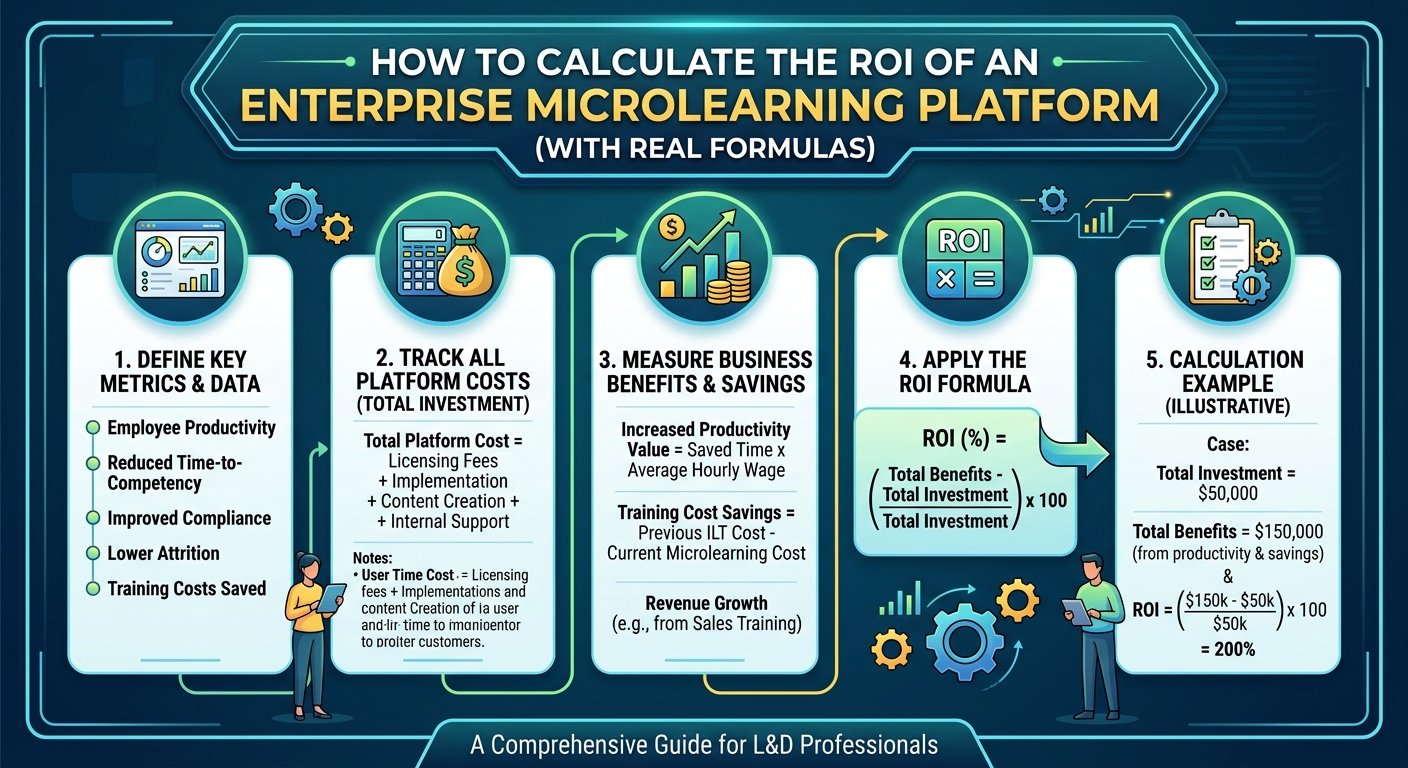
Formula for Total Investment (TI):
TI = Platform Costs + Content Creation Costs + Implementation Costs + Administration Costs + Training Costs
Quantifying the Benefits (Gains)
Monetizing the benefits of microlearning requires connecting learning outcomes to business results. Here are common areas of quantifiable gain:
- Improved Performance & Productivity: Enhanced skills lead to fewer errors, faster task completion, and higher quality output.
- Reduced Training Time & Associated Costs: Microlearning often reduces the need for expensive, time-consuming classroom training or lengthy e-learning courses.
- Enhanced Compliance & Risk Mitigation: Critical for industries like Banking, Finance, and Pharma, reducing potential fines, legal fees, or operational disruptions through effective Risk-focused Training.
- Higher Employee Engagement & Retention: A more engaging learning experience can lead to reduced turnover, saving recruitment and onboarding costs.
- Faster Onboarding: New hires become productive quicker.
- Data-Driven Insights: An advanced lms learning management system provides analytics to continually optimize training and identify skill gaps.
The Core ROI Formula
Once you have quantified your costs and benefits, the fundamental ROI formula is straightforward:
ROI (%) = [(Total Monetary Benefits - Total Investment) / Total Investment] * 100
Calculating Microlearning ROI: Step-by-Step with Formulas
Step 1: Quantify Total Investment (TI)
As outlined above, sum all direct and indirect costs associated with the microlearning platform over a specific period (e.g., one year).
Example:
Platform Subscription (MaxLearn LMS) = $50,000
Content Creation = $30,000
Implementation = $10,000
Admin/Support = $20,000
Training = $5,000
TI = $50,000 + $30,000 + $10,000 + $20,000 + $5,000 = $115,000
Step 2: Quantify Tangible Benefits (Total Monetary Benefits - TMB)
a) Productivity Gains
Improved skills lead to increased output or efficiency. This is often measured through metrics like sales figures, error rates, or processing times.
Productivity Gain = (Average Output Increase per Employee * Number of Employees Trained * Average Revenue per Unit of Output) - (Increased Labor Cost due to Output)
Alternatively, for efficiency:
Productivity Gain = (Hours Saved per Employee * Number of Employees Trained * Average Hourly Wage)
Example (Efficiency): 500 sales reps save 1 hour/week (50 hours/year) due to better sales training. Average hourly wage = $30.
Productivity Gain = 500 * 50 * $30 = $750,000
b) Reduced Training Time Costs
Microlearning can significantly reduce time spent in traditional, longer training sessions, freeing up employee time for productive work.
Reduced Training Time Cost = (Hours Saved per Employee from Traditional Training * Number of Employees Trained * Average Hourly Wage)
Example: 1,000 employees used to spend 2 full days (16 hours) in compliance training. Now, with microlearning, it's 4 hours. Saving = 12 hours/employee. Average hourly wage = $40.
Reduced Training Time Cost = 1,000 * 12 * $40 = $480,000
c) Compliance Savings
For industries facing heavy regulation, effective Risk-focused Training through a robust enterprise learning management system can prevent costly penalties.
Compliance Savings = (Reduction in Incidents/Fines * Average Cost per Incident/Fine)
Example: Reduced compliance breaches by 10, preventing 2 potential fines of $200,000 each.
Compliance Savings = 2 * $200,000 = $400,000
d) Employee Retention/Turnover Savings
A positive learning culture, supported by engaging training from a Gamified LMS, can reduce turnover. The cost of replacing an employee can be substantial (30-150% of annual salary).
Retention Savings = (Reduction in Turnover Rate * Number of Employees * Average Cost of Turnover per Employee)
Example: Turnover rate reduced by 1% for 5,000 employees. Average cost of turnover = $15,000.
Retention Savings = (0.01 * 5,000) * $15,000 = $750,000
Summing Total Monetary Benefits (TMB):
Assuming the examples above are from the same program:
TMB = $750,000 (Productivity) + $480,000 (Reduced Training) + $400,000 (Compliance) + $750,000 (Retention) = $2,380,000
Step 3: Calculate the ROI
Using our example figures:
ROI (%) = [($2,380,000 - $115,000) / $115,000] * 100
ROI (%) = [$2,265,000 / $115,000] * 100
ROI (%) = 19.695 * 100 = 1969.5%
A nearly 2000% ROI demonstrates immense value. Even a more conservative calculation typically shows a significant positive return.
Leveraging Advanced Technology for Enhanced ROI Measurement
Modern enterprise learning management systems, like MaxLearn LMS, integrate advanced analytics and AI, making ROI calculation and continuous optimization much more precise.
What insights does advanced technology offer for training impact across regions or across departments?
A robust cloud based learning management system ensures uniform content delivery, localization capabilities, and centralized reporting across diverse geographic operational footprints, crucial for industries like Pharma or Oil & Gas. By tracking engagement and performance data across different teams and locations, you can precisely identify where training is most effective and where adjustments are needed, offering insights that traditional methods simply cannot.
How can a smart platform accurately predict which training modules will yield the highest performance improvement for individual employees?
Through AI-driven analytics, tracking engagement, completion rates, and post-training performance metrics, an enterprise learning management system can offer predictive insights into content effectiveness and personalized learning paths. This allows L&D leaders to proactively optimize content and delivery, focusing resources on areas that promise the greatest return.
What are the most effective strategies for identifying specific learning gaps within diverse employee groups and tailoring content for maximum impact?
By leveraging data analytics and AI within a modern learning content management system, organizations can identify skill deficiencies at a granular level. This intelligence allows for the development and deployment of Adaptive Learning paths, ensuring content is highly relevant and impactful for each segment of the audience. This targeted approach maximizes learning efficacy and, by extension, ROI.
Real-World Application & Strategic Considerations
While the formulas provide a solid foundation, remember to consider the strategic long-term benefits. For a sales organization, a microlearning platform could mean faster product knowledge acquisition, leading to increased sales velocity. In healthcare, it could mean better patient outcomes through up-to-date procedural training. The beauty of a comprehensive learning management system is its versatility across segments.
Don't just calculate ROI once; make it an ongoing process. Regularly review your metrics, adjust your microlearning content, and refine your approach. This continuous improvement cycle, powered by analytics from your LMS, will ensure your platform consistently delivers maximum value.
Conclusion
Calculating the ROI of an enterprise microlearning platform is not just an accounting exercise; it's a strategic imperative. By systematically quantifying your investment and measuring tangible benefits using the formulas provided, L&D leaders can powerfully demonstrate the value of their initiatives. This data-driven approach strengthens your position, secures future funding, and ultimately drives better business outcomes across your organization. Embrace the power of numbers to champion your microlearning success.
.jpg)


