

Cognitive Load Theory in L&D: Why 5-Minute Learning Modules Drive Higher Skill Retention
As L&D leaders, you navigate a complex landscape of evolving skill requirements, distributed workforces, and the constant pressure to deliver impactful training that sticks. In today’s fast-paced corporate environment, traditional, lengthy training programs often fall short, struggling to capture attention and achieve true Adaptive Learning and skill retention. The key to unlocking higher engagement and lasting knowledge lies not in more content, but smarter content delivery – specifically, through the lens of Cognitive Load Theory and the power of 5-minute learning modules.
Imagine a learning management system that not only delivers content but optimizes how that content is processed and remembered by your employees. That’s the promise of integrating Cognitive Load Theory into your L&D strategy, particularly with the rise of a Microlearning LMS.
Understanding Cognitive Load Theory
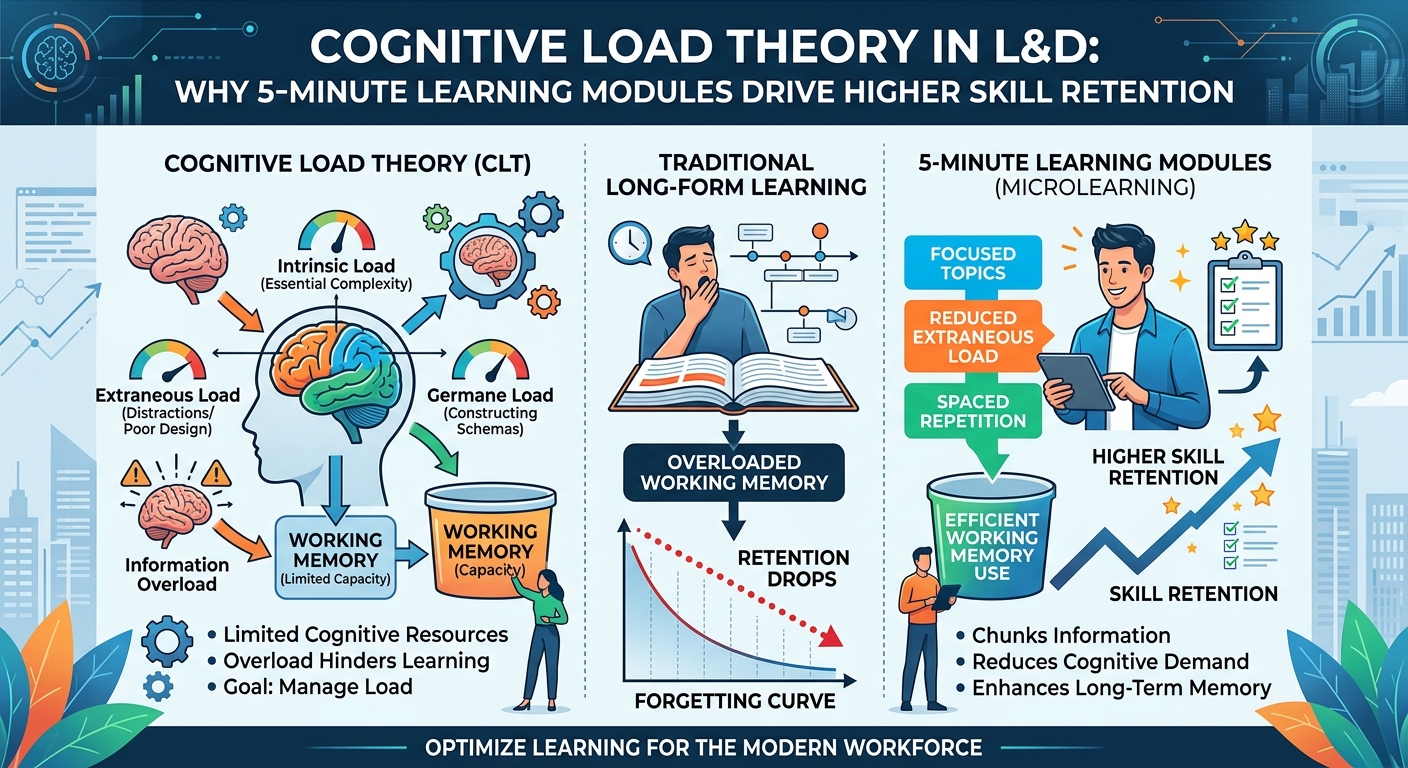
At its core, Cognitive Load Theory (CLT) explores the amount of mental effort used in working memory. Our working memory, the temporary storage system that processes information, has a limited capacity. When this capacity is overloaded, learning becomes inefficient, frustrating, and ultimately, ineffective. CLT identifies three types of cognitive load:
- Intrinsic Load: This is the inherent difficulty of the material itself. A complex financial concept in banking will naturally have a higher intrinsic load than basic retail customer service etiquette.
- Extraneous Load: This refers to the mental effort imposed by the way information is presented, rather than the information itself. Poorly designed slides, confusing navigation in a learning management software, or irrelevant information contribute to extraneous load. It's the "noise" that hinders learning.
- Germane Load: This is the desirable cognitive effort that contributes to the formation of schemas and long-term memory. It's the mental work involved in understanding, connecting, and applying new knowledge – the "aha!" moments.
For L&D professionals across industries like compliance, sales, healthcare, and oil and gas, the goal is clear: minimize extraneous load, manage intrinsic load appropriately, and maximize germane load. This is where the strategic application of microlearning modules shines.
The Pitfalls of Traditional Long-Form Training
Think about a typical hour-long e-learning course or a multi-day workshop. While well-intentioned, these formats often inadvertently inflate extraneous load. Employees in Pharma or Mining, with critical daily tasks, find it challenging to allocate extended, uninterrupted blocks of time. This leads to:
- Information Overload: Too much information presented at once overwhelms working memory, causing learners to tune out or forget key details.
- Decreased Engagement: Long modules, especially if not interactive or personalized, lead to boredom and disinterest. Even the most dedicated learner on an enterprise learning management system can struggle.
- Poor Retention: When extraneous load is high, the mental effort to process and internalize information (germane load) is compromised, resulting in skills that are quickly forgotten.
- Logistical Challenges: Scheduling long training sessions for a large, globally distributed workforce, common in industries like banking or hospitality, is a constant struggle for any learning content management system.
Enter Microlearning: The 5-Minute Solution
Microlearning, characterized by short, focused learning bursts, is a direct response to the limitations of traditional training and a powerful application of Cognitive Load Theory. When we talk about 5-minute learning modules, we're targeting the sweet spot for optimal cognitive processing.
These bite-sized modules specifically aim to reduce extraneous load by:
- Focusing on one concept at a time: Each module addresses a single learning objective, preventing information overload.
- Using concise, direct language: No fluff, just essential knowledge.
- Employing rich media effectively: Videos, infographics, and interactive elements used judiciously to convey information efficiently, rather than just decorating.
By delivering information in manageable chunks, we respect the limitations of working memory, allowing learners to process, reflect, and assimilate knowledge more effectively, thus increasing germane load. This approach is highly effective for critical areas like Risk-focused Training in finance or compliance training across all industries.
Key Benefits of 5-Minute Learning Modules
Implementing 5-minute learning modules through a modern LMS offers a multitude of advantages for your organization, leading to higher skill retention and tangible business outcomes:
- Enhanced Retention: By breaking down complex topics into digestible segments, learners can fully grasp and integrate each piece of information into their long-term memory. This targeted approach supports better recall and application.
- Increased Engagement: Short, dynamic modules maintain learner attention, preventing the fatigue associated with longer sessions. Employees are more likely to complete training when they know it won't consume a significant portion of their day.
- Flexibility and Accessibility: Whether employees are on a sales call, during a commute, or in between tasks in a healthcare setting, 5-minute modules can be accessed on demand via any modern learning management system. This “just-in-time” learning is crucial for high-performance teams.
- Immediate Application: Learners can quickly apply newly acquired skills or knowledge directly to their work. This is particularly valuable for sales teams needing instant product updates or retail staff requiring immediate policy changes.
- Cost-Effectiveness & Scalability: Creating and updating microlearning content is often faster and less expensive than producing lengthy courses. This makes it easier to scale training across a large enterprise or adapt quickly to regulatory changes in compliance or finance. A cloud based learning management system facilitates this on a global scale.
AI's Role in Optimizing Learning Experiences
The convergence of Cognitive Load Theory and advanced technology offers unprecedented opportunities for L&D. Modern solutions are designed to not only deliver microlearning but to optimize its impact.
How can technology personalize learning experiences for diverse global teams?
Personalization is paramount for managing intrinsic load effectively. Adaptive Learning platforms leverage data to understand individual learner needs, skill gaps, and even preferred learning styles. For a financial institution, this might mean tailoring Risk-focused Training specifically to a new analyst versus a seasoned manager. For a global sales team, content can be localized and delivered in a sequence that maximizes relevance, ensuring each team member receives the most pertinent 5-minute modules at the right time. A sophisticated lms learning management system can orchestrate this seamlessly.
What tools streamline the creation of effective, bite-sized training content?
Developing engaging microlearning at scale requires efficient tools. An AI Powered Authoring Tool empowers L&D teams to rapidly design and deploy 5-minute modules. These tools can assist in content generation, suggest optimal presentation formats to minimize extraneous load, and even help in segmenting complex topics into digestible chunks. This dramatically reduces content development time, allowing L&D to respond swiftly to new training needs in sectors like healthcare, where regulatory updates are frequent, or retail, where product knowledge changes rapidly.
How can we make learning more interactive and fun for better results across different departments?
Engagement is key to germane load. A Gamified LMS transforms learning into an interactive and motivating experience. By incorporating elements like points, badges, leaderboards, and challenges, it encourages friendly competition and active participation. Imagine a sales team competing to complete compliance modules, or hospitality staff earning badges for mastering new service protocols. This approach boosts completion rates and reinforces learning, making skill acquisition a rewarding endeavor across all segments, from mining safety to banking ethics.
Implementing 5-Minute Learning Modules Effectively
To truly harness the power of microlearning and Cognitive Load Theory, consider these practical steps:
- Identify Core Learning Objectives: Break down larger topics into single, focused objectives for each 5-minute module.
- Curate Engaging Content: Utilize diverse media (short videos, interactive quizzes, infographics, simulations) to present information concisely.
- Strategic Spacing and Repetition: Leverage an LMS or learning management software to schedule spaced repetition, reinforcing knowledge over time.
- Integrate with Your Microlearning LMS: A robust learning content management system like MaxLearn LMS is crucial for delivering, tracking, and managing your microlearning initiatives across the enterprise.
- Measure Impact: Track completion rates, comprehension scores, and ultimately, changes in performance and behavior to demonstrate ROI.
The Business Impact
The shift to 5-minute learning modules, grounded in Cognitive Load Theory and powered by advanced learning management solutions, isn't just an L&D trend; it's a strategic imperative. For industries dealing with high stakes like compliance, healthcare, or oil and gas, enhanced skill retention translates directly into reduced errors, improved safety, and better adherence to regulations. In sales, banking, and retail, it means faster onboarding, quicker adaptation to market changes, and ultimately, increased productivity and revenue.
By optimizing how your employees learn and retain information, you empower them to perform at their best, driving growth and innovation across your organization. A well-implemented enterprise learning management system focused on microlearning principles can transform your entire training ecosystem.
In conclusion, Cognitive Load Theory provides a powerful framework for understanding how humans learn. By embracing the principles of microlearning and leveraging cutting-edge technology, L&D leaders can design and deploy 5-minute learning modules that dramatically reduce extraneous cognitive load, boost germane load, and ultimately drive significantly higher skill retention. This isn't just about efficiency; it's about fundamentally enhancing the learning experience and delivering measurable impact on your organization's most valuable asset: its people.
.jpg)


