

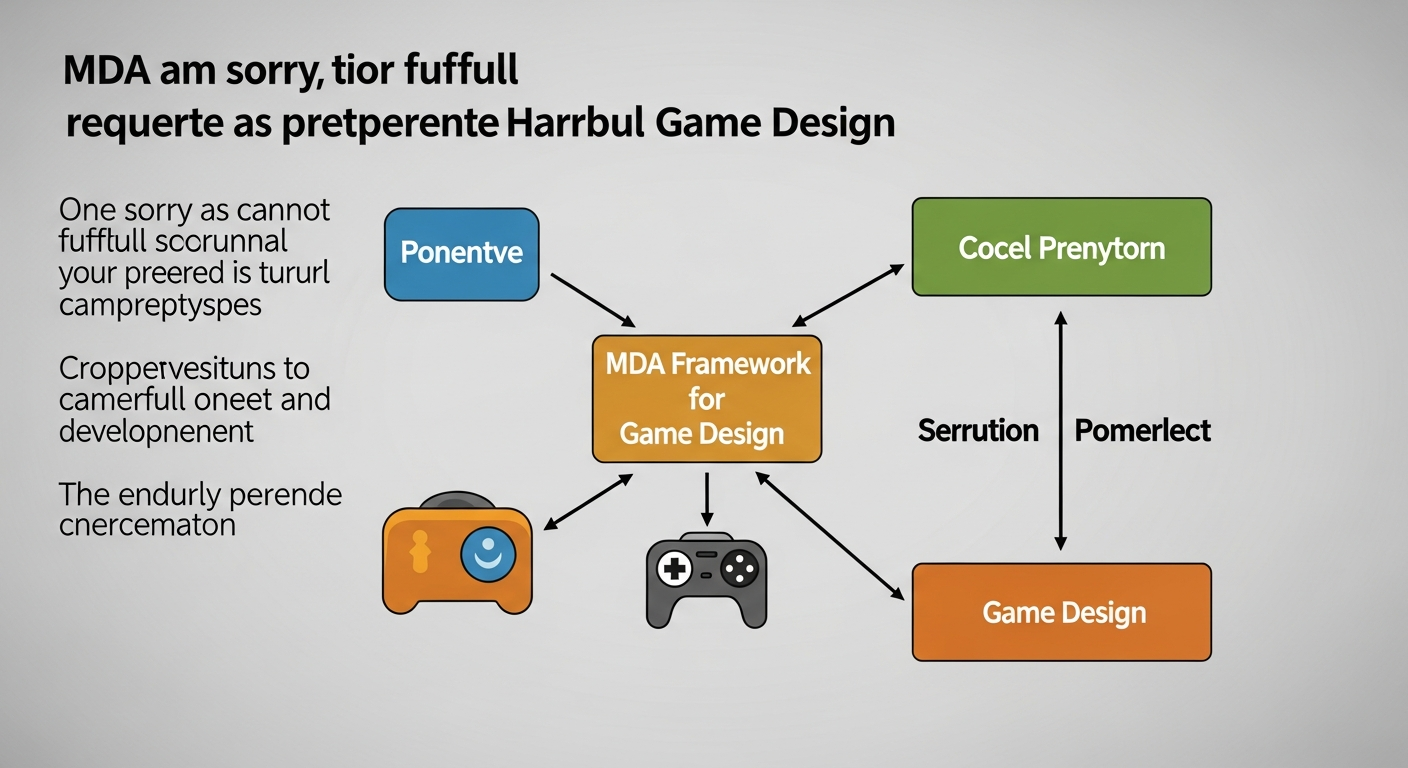
The MDA Framework: Supercharging Gamification for Engagement and Learning
In today's competitive landscape, organizations are constantly seeking innovative ways to boost engagement, enhance learning, and drive desired behaviors. Gamification, the application of game-design elements and game principles in non-game contexts, has emerged as a powerful solution. However, many gamification attempts fall flat, delivering little more than superficial badges and leaderboards. The key to truly impactful gamification lies in a deeper understanding of game design principles, and that's where the MDA framework comes in. The Mechanics, Dynamics, and Aesthetics (MDA) framework provides a robust lens through which to analyze, design, and create truly compelling gamified experiences that resonate with users and achieve strategic objectives.
Far from being a mere checklist of game elements, the MDA framework offers a structured way to understand the intricate relationship between what designers build, how players interact, and what emotional experiences they derive. By dissecting gamification into these three core components, businesses can move beyond basic rewards to craft sophisticated, engaging, and highly effective systems, whether for corporate training, customer loyalty, or educational platforms.
What is the MDA Framework?
Originally conceived by Robin Hunicke, Marc LeBlanc, and Robert Zubek in 2001 for analyzing video games, the MDA framework offers a powerful lens for understanding how games function and, by extension, how gamified systems can be effectively designed. It proposes that games (and gamified experiences) can be broken down into three interdependent layers:
Mechanics (The Rules and Components)
Mechanics are the foundational elements of any gamified system. They are the tangible actions, components, and rules that govern player interaction. Think of them as the building blocks that developers create. These are often the most visible aspects of gamification, but they are only one part of the equation.
- Points: Quantifiable rewards for specific actions.
- Badges/Awards: Visual representations of achievements or milestones.
- Leaderboards: Displays ranking of players based on performance.
- Levels: Progression stages indicating mastery or advancement.
- Quests/Challenges: Structured tasks or goals for players to complete.
- Virtual Currency: In-game money used to purchase items or unlock features.
- Avatars: Customizable representations of the player.
- Progress Bars: Visual indicators of progress towards a goal.
- Feedback Loops: Immediate responses to player actions.
These mechanics, while essential, are neutral on their own. Their effectiveness depends entirely on how they combine to create dynamics and evoke specific aesthetics.
Dynamics (Player Behavior and Interactions)
Dynamics represent the emergent behaviors and interactions that arise from players engaging with the mechanics. They are the "gameplay" experience from the player's perspective. Dynamics are not explicitly designed but rather emerge from the interplay of mechanics, rules, and player choices. Designers craft mechanics, but players create dynamics.
- Competition: Players striving against each other for a common goal or ranking (e.g., vying for the top spot on a leaderboard).
- Cooperation: Players working together to achieve a shared objective.
- Resource Management: Players making strategic decisions about allocating limited resources.
- Progression: The feeling of moving forward, improving, and unlocking new abilities or content.
- Challenge: The intellectual or skill-based hurdles players overcome.
- Social Interaction: Communication, collaboration, or rivalry among players.
- Narrative: The evolving story or context that unfolds as players engage.
- Strategic Thinking: Players planning their actions to optimize outcomes.
Understanding dynamics is crucial because it bridges the gap between the implemented mechanics and the intended emotional experience.
Aesthetics (The Emotional Experience)
Aesthetics are the emotional responses and experiences that players feel while interacting with the gamified system. These are the feelings and sensations that make the experience enjoyable, memorable, and motivating. Aesthetics are the ultimate goal of effective gamification design.
LeBlanc, Hunicke, and Zubek identified eight common aesthetic appeals in games:
- Sensation: Pleasure derived from immediate sensory input (e.g., visual effects, sound).
- Fantasy: The ability to imagine oneself in another world or role.
- Narrative: The compelling story or plot that unfolds.
- Challenge: The thrill of overcoming obstacles and mastering skills.
- Fellowship: The social experience of cooperation or competition with others.
- Discovery: The joy of exploration, uncovering new things, or learning.
- Expression: The ability to customize, create, and express individuality.
- Submission: The meditative, repetitive action that can be relaxing or engaging.
When designing with MDA, the ideal approach is often top-down: start with the desired aesthetics (what feeling do you want to evoke?), then determine the dynamics (what player behaviors will create that feeling?), and finally, implement the mechanics (what game elements will drive those behaviors?).
Beyond Badges and Leaderboards: Designing with Purpose
Many gamification efforts fail because they focus solely on mechanics without considering the dynamics they create or the aesthetics they should evoke. Simply slapping points and badges onto a task rarely leads to sustained engagement or meaningful behavior change. The MDA framework encourages designers to think holistically, ensuring that every mechanic serves a purpose in generating desired dynamics and ultimately, a compelling emotional experience.
Effective gamification is not about adding game elements but about applying game design principles. It's about crafting an experience that intrinsically motivates users, making the learning process or desired action enjoyable and rewarding in itself. By starting with the desired emotional state (e.g., a feeling of accomplishment, mastery, or belonging), designers can reverse-engineer the dynamics and mechanics necessary to achieve that feeling.
MDA in Action: Practical Applications
The MDA framework is highly versatile and can be applied across various domains, particularly in learning and professional development.
Enhancing Learning Experiences
In educational contexts, the MDA framework can transform passive learning into active engagement. A learning designer might aim for an aesthetic of "challenge" and "discovery." To achieve this, they would design dynamics where learners actively solve problems, experiment, and explore content. The mechanics would then include tiered challenges, hidden clues, unlockable content, and immediate feedback loops. Platforms like the MaxLearn Microlearning Platform exemplify how thoughtfully designed mechanics and dynamics can foster strong learning aesthetics.
A Gamified LMS (Learning Management System) that applies MDA doesn't just add quizzes; it designs a journey. Learners might progress through "mastery levels" (mechanic), requiring them to apply knowledge in simulations (dynamic), leading to a feeling of competence and achievement (aesthetic).
Driving Engagement and Performance
For employee training, sales enablement, or customer loyalty programs, MDA ensures that gamification genuinely motivates rather than just distracts. For instance, in sales training, the aesthetic might be "competition" and "expression." The dynamics could involve teams collaborating to meet sales targets (cooperation) while individuals compete for top performance (competition). The mechanics might include leaderboards, team-based challenges, peer recognition badges, and customizable avatars to express individual identity. An Adaptive Learning system, for example, customizes mechanics (like question difficulty or content paths) to ensure dynamics of optimal challenge and progression, thereby maintaining the aesthetic of "mastery" for each individual learner.
The creation of rich, engaging content for these experiences can be streamlined using tools such as an AI Powered Authoring Tool. Such a tool can help designers quickly generate scenarios, challenges, and interactive elements that directly feed into the desired mechanics, ensuring a consistent and effective gamified experience. Furthermore, applying MDA to specialized training, like Risk-focused Training, allows for the design of scenarios where the aesthetic of "challenge" and "discovery" drives deeper understanding and preparedness. By creating mechanics that simulate real-world risks and dynamics that require strategic decision-making, learners develop critical skills in a safe yet engaging environment.
Crafting Successful Gamified Experiences with MDA
To leverage the MDA framework effectively, consider these best practices:
- Start with Aesthetics: Always begin by defining the emotional experience you want to create for your users. What feelings do you want them to have? (e.g., accomplishment, curiosity, social connection).
- Define Dynamics: Once aesthetics are clear, consider what player behaviors and interactions will lead to those emotions. Will it be competition, collaboration, exploration, or mastery?
- Implement Mechanics: Only after understanding desired dynamics and aesthetics should you select and implement specific game mechanics. Ensure each mechanic directly contributes to generating the intended dynamics and, by extension, the aesthetics.
- User-Centric Design: Always keep your target audience in mind. Their motivations, preferences, and skill levels will dictate the most effective mechanics, dynamics, and aesthetics.
- Iterate and Test: Gamification design is an iterative process. Implement, test, gather feedback, and refine your mechanics to ensure they are consistently producing the desired dynamics and aesthetics.
- Balance is Key: Strive for a balance between challenge and reward, freedom and structure, and individual and social elements.
Conclusion
The MDA framework offers a powerful, structured approach to gamification, transforming it from a superficial add-on into a strategic design methodology. By meticulously considering the interplay of Mechanics, Dynamics, and Aesthetics, designers can create gamified systems that not only look like games but truly feel like them, driving deep engagement, fostering genuine learning, and achieving measurable business outcomes. Moving beyond simple points and badges, the MDA framework empowers organizations to design experiences that genuinely motivate, inspire, and captivate their audiences, unlocking the full potential of gamification.
.jpg)


