

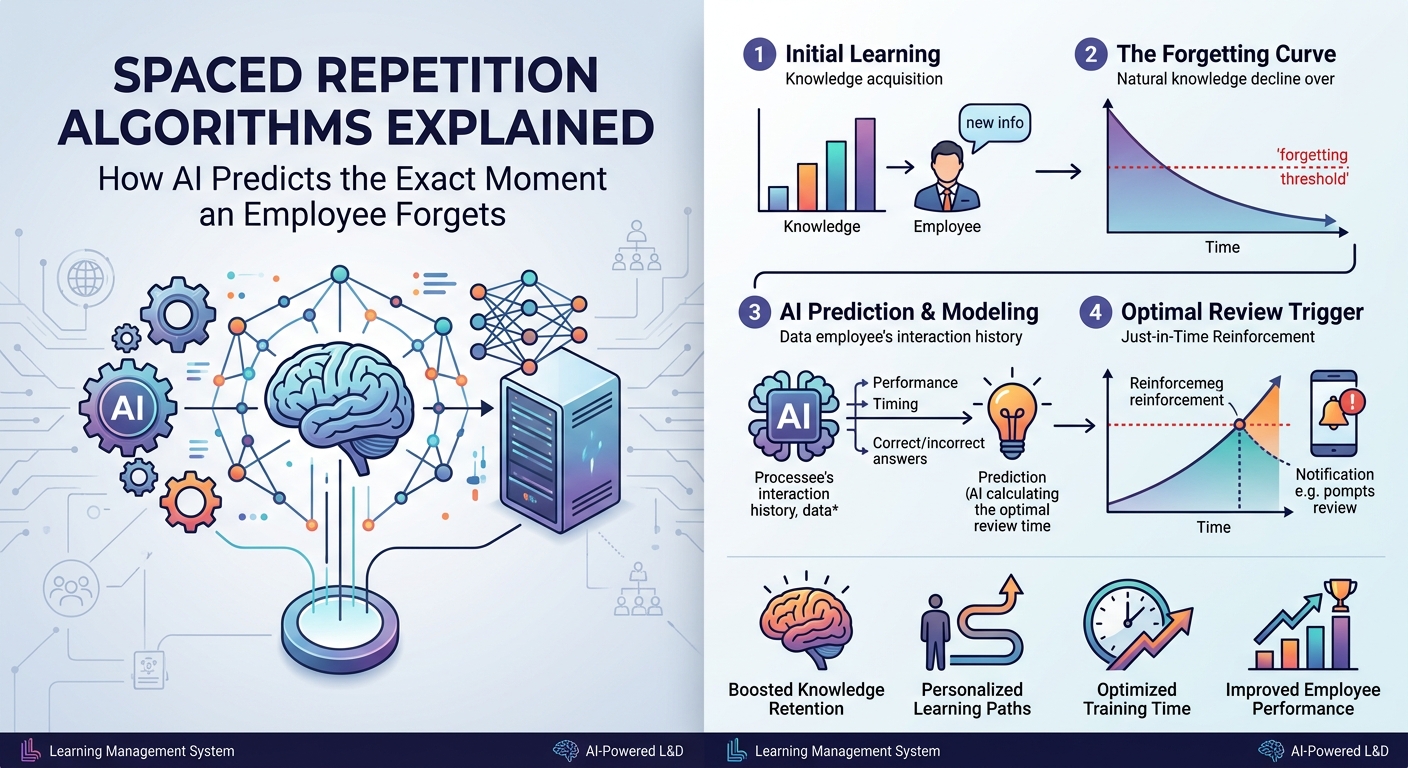
Spaced Repetition Algorithms Explained: How AI Predicts the Exact Moment an Employee Forgets
In the dynamic landscape of modern business, continuous learning is not just an advantage—it's a necessity. Yet, for Learning & Development (L&D) leaders, a persistent challenge looms: the "forgetting curve." Employees invest time and effort in training, only for critical information to fade from memory over time. This erosion of knowledge impacts everything from compliance adherence and sales performance to customer service quality and risk mitigation. What if you could precisely anticipate when an employee is about to forget a crucial piece of information, and intervene at the optimal moment? Thanks to advancements in Artificial Intelligence, this is no longer a futuristic fantasy but a present-day reality, powered by sophisticated spaced repetition algorithms.
For Vice Presidents, Directors, and Senior Managers of L&D, understanding this powerful synergy between AI and spaced repetition is key to unlocking unprecedented levels of employee knowledge retention and operational efficiency. Across industries like compliance, sales, banking, finance, insurance, retail, pharma, healthcare, hospitality, oil and gas, and mining, the ability to ensure sustained learning can translate directly into tangible business growth and reduced operational risk.
The Forgetting Curve: A Universal Challenge
The concept of the forgetting curve, pioneered by psychologist Hermann Ebbinghaus in the late 19th century, illustrates how information is lost over a period if there are no attempts to retain it. Without reinforcement, a significant portion of newly acquired knowledge can vanish within days or even hours. Traditional training methods, often relying on one-off sessions or annual refreshers, are inherently ill-equipped to combat this natural cognitive phenomenon effectively.
Enter spaced repetition. At its core, spaced repetition is an evidence-based learning technique that involves reviewing information at increasing intervals of time. Instead of cramming, it strategically schedules recall practice, ensuring that knowledge is revisited just as it's about to be forgotten. This method significantly enhances long-term memory retention by strengthening neural connections each time information is successfully recalled.
How AI Revolutionizes Spaced Repetition
While the principle of spaced repetition is sound, managing individual learning schedules for hundreds or thousands of employees manually is an impossible task. This is where Artificial Intelligence steps in, transforming spaced repetition from a labor-intensive technique into a highly scalable, hyper-personalized, and incredibly powerful learning engine. AI-powered algorithms predict, with remarkable accuracy, the precise moment each employee is likely to forget specific information.
These intelligent algorithms do more than just space out reviews; they analyze a multitude of data points:
- An employee's past performance on quizzes and assessments.
- Their response times and confidence levels during recall attempts.
- The difficulty level of the specific learning content.
- Individual learning styles and historical retention patterns.
- Contextual factors, such as the criticality of the information for a specific role or task.
By processing these factors, the AI continuously adjusts the review intervals for each piece of content, for every single learner. This creates a truly Adaptive Learning path, ensuring that employees spend their precious time reviewing what they truly need to reinforce, not what they already know or what's irrelevant.
Diving Deeper: The Algorithms at Play
Many modern spaced repetition systems build upon foundational algorithms like SM-2 (SuperMemo 2), developed in the late 1980s. SM-2 uses factors like item difficulty and performance to calculate the next review date. However, today's AI-driven systems go far beyond this initial model, leveraging advanced machine learning and predictive analytics.
- Predictive Modeling: AI algorithms utilize various predictive models to forecast an individual's "forgetting point." These models can range from sophisticated regression analyses to more complex neural networks, which are adept at recognizing intricate patterns in learner behavior.
- Reinforcement Learning: Some advanced systems might even incorporate elements of reinforcement learning, where the algorithm "learns" to optimize review schedules through a process of trial and error, continually refining its predictions based on the outcomes of its recommendations.
- Bayesian Inference: Bayesian models can be used to update probabilities of retention based on new evidence (e.g., a correct or incorrect answer), providing a probabilistic estimate of when a piece of information will be forgotten.
The result is a highly granular and dynamic review schedule, delivered typically through a sophisticated LMS or learning content management system, that maximizes retention efficiency and minimizes wasted learning time. This intelligent approach, often facilitated by a powerful cloud based learning management system, is a game-changer for any enterprise learning management strategy.
Tangible Benefits for L&D and Business Outcomes
The application of AI-powered spaced repetition algorithms within a modern learning management system offers profound benefits across diverse industries:
- Enhanced Compliance: In highly regulated sectors like banking, finance, pharma, and healthcare, ensuring employees retain critical compliance knowledge is paramount. Risk-focused Training, augmented by AI, guarantees that crucial regulations and protocols are never forgotten, significantly reducing the potential for costly errors, fines, and reputational damage.
- Improved Sales Performance: For sales teams in retail, insurance, or any industry, consistent recall of product features, sales techniques, and objection handling is vital. An AI Powered Authoring Tool can help create targeted content that, combined with spaced repetition, keeps sales knowledge sharp, directly impacting conversion rates and revenue.
- Reduced Retraining Costs: By preventing knowledge decay, organizations drastically cut down on the need for extensive refresher courses and redundant training programs. This translates into significant cost savings and more efficient use of L&D resources.
- Faster Skill Acquisition: Whether it's mastering new equipment in oil and gas, understanding complex financial products, or adopting new healthcare procedures, AI-driven spaced repetition accelerates the journey from learning to mastery.
- Better Employee Engagement: Employees appreciate personalized learning experiences that respect their time and focus on their specific needs. This leads to higher satisfaction and engagement with learning initiatives, making an LCMS powered by AI a truly effective solution.
Implementing AI-Driven Spaced Repetition with a Modern Learning Platform
To harness the power of AI-driven spaced repetition, organizations need more than just an idea; they need a robust technology infrastructure. A cutting-edge learning management software or learning management solutions is essential. Look for platforms that integrate these intelligent capabilities seamlessly.
- Microlearning LMS Integration: Spaced repetition works best with bite-sized content. A Microlearning LMS allows for the creation and delivery of concise learning modules that are perfect for periodic review.
- Gamified LMS Features: Incorporating game-like elements can significantly boost engagement with spaced repetition exercises, making the review process more enjoyable and less of a chore.
- Advanced Analytics: A robust lms learning management system should provide L&D leaders with deep insights into knowledge gaps, retention rates, and the effectiveness of their training programs, allowing for continuous optimization.
The future of corporate learning is personalized, predictive, and proactive. Platforms like MaxLearn LMS exemplify how an advanced learning management system can integrate these sophisticated algorithms to transform organizational learning.
Frequently Asked Questions About Intelligent Learning
How can artificial intelligence personalize learning for every team member?
Intelligent systems achieve personalization by continuously analyzing individual learning patterns, historical performance data, and confidence levels for each piece of content. This data allows the algorithms to dynamically adjust the difficulty, format, and frequency of learning interventions, ensuring that each team member receives the most relevant content at their optimal learning pace and schedule. The result is a truly unique and efficient learning path tailored to individual needs, maximizing knowledge retention.
Can these intelligent learning systems work effectively for a globally distributed workforce?
Absolutely. Modern AI-powered learning platforms are designed with global workforces in mind. They operate on cloud-based infrastructures, making them accessible anytime, anywhere, across different time zones and geographical locations. Furthermore, the algorithms themselves are location-agnostic; they adapt to individual learning data irrespective of where the learner is situated, ensuring consistent and effective knowledge reinforcement for every employee, from a regional office to a remote oil rig.
What kind of data does this technology use to make such accurate predictions?
The technology relies on a rich tapestry of behavioral and performance data. This includes an employee's correct and incorrect answers on quizzes, the time taken to respond, their self-assessed confidence levels, completion rates of modules, and even interactions with the learning content itself. By processing these diverse data points through sophisticated machine learning models, the system can build a predictive model of an individual's "forgetting curve" for specific information, allowing it to schedule review prompts precisely when they are most needed.
Conclusion
The advent of AI-powered spaced repetition algorithms marks a pivotal moment for L&D professionals. By effectively combating the forgetting curve, these intelligent systems ensure that critical knowledge not only sticks but is available exactly when employees need it most. For industries ranging from high-stakes compliance to competitive sales, adopting such predictive learning technologies is no longer a luxury but a strategic imperative. It's about empowering your workforce with enduring knowledge, driving operational excellence, and ultimately, securing your organization's future success.
.jpg)


