

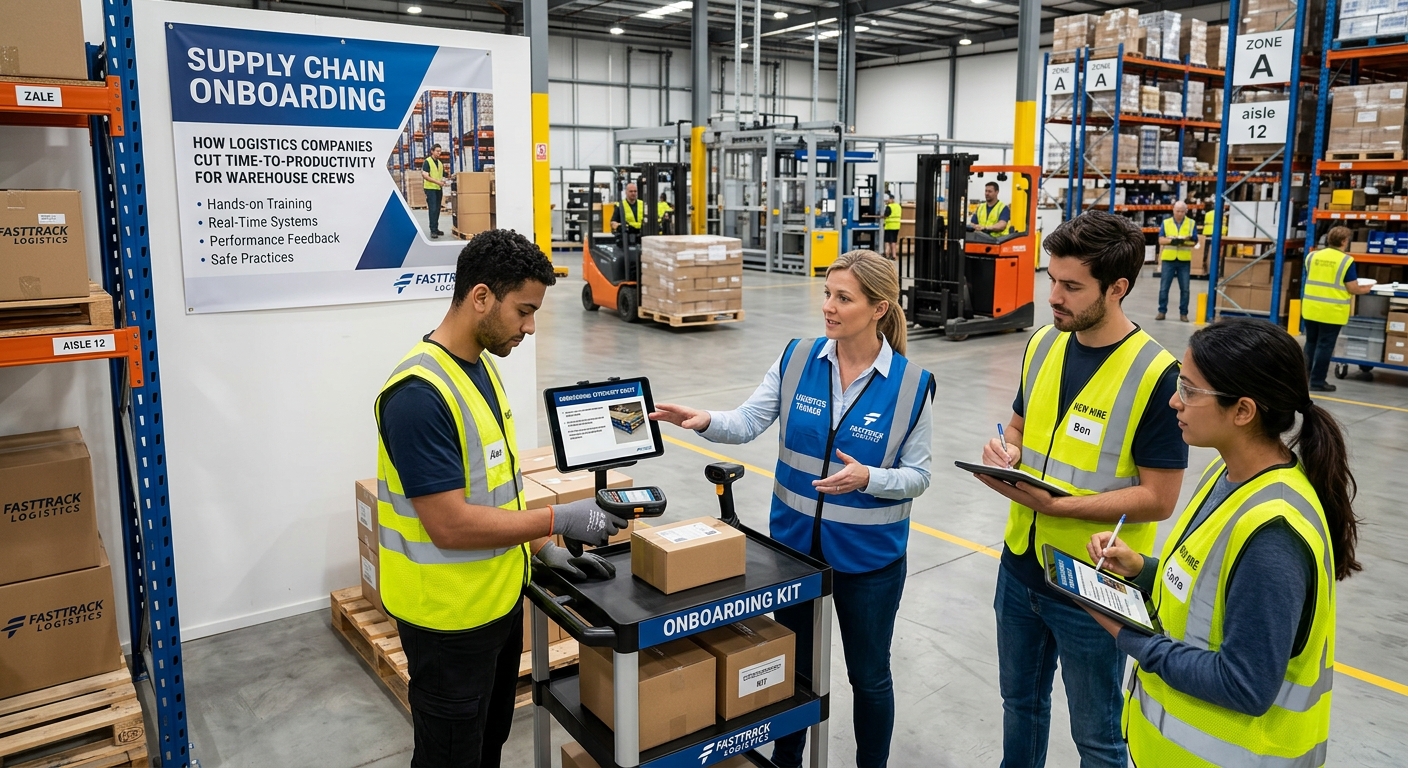
Supply Chain Onboarding: How Logistics Companies Cut Time-to-Productivity for Warehouse Crews
In the fast-paced world of logistics, efficiency is king. Every minute saved, every error prevented, directly impacts the bottom line. For Vice Presidents, Directors, and Senior Managers of L&D, the challenge is clear: how do we get new warehouse crews up to speed, safely and productively, in the shortest possible time? The answer lies in transforming traditional supply chain onboarding with innovative learning technologies. This article explores how modern learning management solutions are revolutionizing the way logistics companies train their vital warehouse workforce, significantly cutting time-to-productivity.
The High Stakes of Warehouse Onboarding
Warehouse operations are complex ecosystems, demanding precision, adherence to safety protocols, and a deep understanding of intricate processes. New hires, regardless of their prior experience, face a steep learning curve. The cost of inefficient onboarding extends beyond just lost time; it impacts safety records, compliance adherence, inventory accuracy, and ultimately, customer satisfaction. Slow onboarding can lead to:
- Increased safety incidents due to lack of familiarity with equipment and procedures.
- Higher error rates in picking, packing, and shipping, leading to rework and returns.
- Decreased overall team productivity as experienced staff divert time to basic training.
- Higher employee turnover, as new hires feel overwhelmed and unsupported.
- Non-compliance with industry regulations, incurring penalties and reputational damage.
For L&D leaders, the imperative is to design an onboarding program that not only transfers knowledge but also builds confidence and competence rapidly, making new hires productive contributors from day one. This requires a robust learning management system.
Traditional Onboarding Pitfalls
Many logistics companies still rely on outdated onboarding methods that are ill-suited for the modern warehouse environment. These often include:
- Lengthy, generic classroom sessions with little hands-on application.
- Overwhelming new hires with dense manuals and theoretical information.
- "Shadowing" programs that are inconsistent and dependent on the availability and teaching skills of individual mentors.
- Lack of standardized training, leading to variations in performance across different crews or locations.
- Infrequent assessment and feedback, making it difficult to identify and address learning gaps early.
These approaches often result in prolonged ramp-up times, disengaged learners, and a delayed return on investment for new hires. It's time for a strategic shift towards more dynamic and effective learning management software.
Leveraging Modern Learning Technologies
The digital age offers powerful tools to overcome traditional onboarding challenges. A robust Microlearning LMS can be the cornerstone of an efficient new hire journey, transforming how warehouse teams learn and apply critical skills. The right enterprise learning management system provides a scalable, consistent, and engaging platform for all training needs, from safety certifications to operational procedures.
The Power of Bite-Sized Learning
Imagine breaking down complex warehouse procedures into short, digestible modules. This is the essence of microlearning, delivered effectively through a specialized Microlearning LMS. Instead of hours of classroom instruction, new hires can access 3-5 minute videos, interactive quizzes, or quick guides directly on their mobile devices. This approach reduces cognitive overload, improves retention, and allows trainees to learn at their own pace, on the job, or during downtime. It’s a highly efficient way to deliver specific, task-oriented knowledge, making a true learning content management system.
Making Learning Engaging and Effective
Engagement is crucial for retention. A Gamified LMS injects elements of friendly competition, points, badges, and leaderboards into the learning process. For warehouse crews, this can mean competing to complete safety training modules, master equipment operation simulations, or accurately identify hazardous materials. Gamification transforms mandatory training into an enjoyable experience, boosting motivation and ensuring that critical information sticks. This type of learning management software significantly enhances participation and mastery.
Tailoring the Learning Journey
Every new hire brings a unique set of skills and experiences. Adaptive Learning platforms leverage data to personalize the training path. If a new employee demonstrates proficiency in forklift operation, the system can automatically fast-track them past basic modules and present more advanced scenarios. Conversely, if they struggle with inventory management software, the system can provide additional resources, practice exercises, or re-present information in a different format. This intelligent approach ensures that training is always relevant, efficient, and tailored to individual needs, maximizing the impact of every learning minute.
Streamlining Content Creation
Developing high-quality, relevant training content can be a time-consuming bottleneck for L&D teams. An AI Powered Authoring Tool significantly accelerates this process. These tools can help generate initial drafts of modules, suggest interactive elements, or even adapt existing content for different formats (e.g., turning a long manual into a series of microlearning videos). This allows L&D professionals to focus on refining and customizing content, ensuring accuracy and alignment with operational realities, rather than spending countless hours on basic content generation. This is a game-changer for maintaining an up-to-date learning content management system or LCMS.
Addressing Key Performance Drivers with Intelligent Tools
The synergy of these technologies within an enterprise learning management environment directly impacts critical warehouse performance indicators.
Safety and Compliance First
Logistics environments inherently carry risks. Ensuring that every crew member understands and adheres to safety protocols is paramount. Risk-focused Training, delivered via a sophisticated MaxLearn LMS, prioritizes modules addressing high-risk areas. By presenting safety procedures in an engaging, repeatable microlearning format and using adaptive paths to ensure mastery, companies can drastically reduce incidents and maintain a spotless compliance record. This approach to learning management solutions helps mitigate potential hazards proactively.
Enhancing Operational Efficiency
Beyond safety, these tools directly contribute to faster operational ramp-up. New hires can quickly grasp warehouse layouts, WMS (Warehouse Management System) functionalities, picking strategies, and shipping protocols. The instant access to performance support, delivered through their lms learning management system, reduces reliance on supervisors for basic questions, freeing up experienced staff to focus on higher-value tasks. This streamlined process is a hallmark of an effective cloud based learning management system.
Intelligent Insights for Onboarding Excellence
Modern learning platforms, particularly a robust learning management system, go beyond just delivering content. They provide powerful analytics that L&D leaders can leverage for continuous improvement, offering a level of insight that was previously unattainable. These systems help answer critical questions about learning efficacy and operational impact.
Q: How can technology personalize the onboarding path for new hires based on their existing skills and learning pace?
A: Advanced learning platforms employ sophisticated algorithms to create an individualized learning optimization strategy. By analyzing pre-assessment scores, previous work experience data, and real-time performance within training modules, the system dynamically adjusts the content, pace, and sequence of learning activities. This ensures that each new hire receives precisely the training they need, when they need it, accelerating their journey to full productivity and avoiding redundant instruction.
Q: In what ways can smart systems assist in identifying and addressing regional or location-specific training needs for diverse warehouse operations?
A: Leveraging geospatial training optimization, an intelligent learning content management system can map training content to specific warehouse locations, considering unique facility layouts, equipment types, local regulations, or regional product mixes. The system can then automatically deliver relevant, localized content to new hires based on their assigned site. This ensures that training is highly contextual and immediately applicable, bridging the gap between general knowledge and site-specific operational nuances across a distributed logistics network.
Q: How can advanced analytics predict which training modules are most effective in boosting a new employee's productivity and reduce error rates in a warehouse setting?
A: Through intelligent performance forecasting, a comprehensive learning management system collects and analyzes vast amounts of data on learner engagement, assessment scores, module completion times, and critically, post-training operational performance (e.g., picking accuracy, processing speed, safety incidents). By correlating training data with real-world outcomes, the system can identify which specific modules or learning pathways lead to the highest productivity gains and lowest error rates, allowing L&D teams to continuously optimize their onboarding curriculum for maximum impact.
Choosing the Right Learning Management Solution
For L&D leaders, selecting the right learning management system is a strategic decision. A modern enterprise learning management solution should be more than just a content repository; it should be an integrated platform that drives performance. Look for a cloud based learning management system that offers:
- Seamless mobile accessibility for on-the-job training.
- Robust analytics and reporting capabilities.
- Scalability to accommodate fluctuating workforce numbers.
- Integration with existing HRIS and operational systems.
- Strong support for various content types, including video, simulations, and interactive quizzes.
- Features that support MaxLearn LMS methodologies.
A comprehensive learning management software ensures that your onboarding efforts are not just effective but also measurable and continuously improvable. Investing in a leading learning management solutions suite is crucial for long-term success.
The Bottom Line: A Faster Path to Profitability
Cutting time-to-productivity for warehouse crews is no longer a wish; it's an achievable strategic objective with the right technological backbone. By embracing microlearning, gamification, adaptive learning, and intelligent content creation, logistics companies can create an onboarding experience that is efficient, engaging, and directly impactful on their operational metrics. This transformation not only benefits new hires by setting them up for success but also empowers L&D teams to demonstrate tangible ROI from their training initiatives.
In today's competitive logistics landscape, the speed and efficiency with which new talent becomes fully operational can be a significant differentiator. Implementing a sophisticated learning management system isn't just about training; it's about building a more agile, productive, and safer workforce, ensuring your supply chain remains robust and responsive.
.jpg)


