

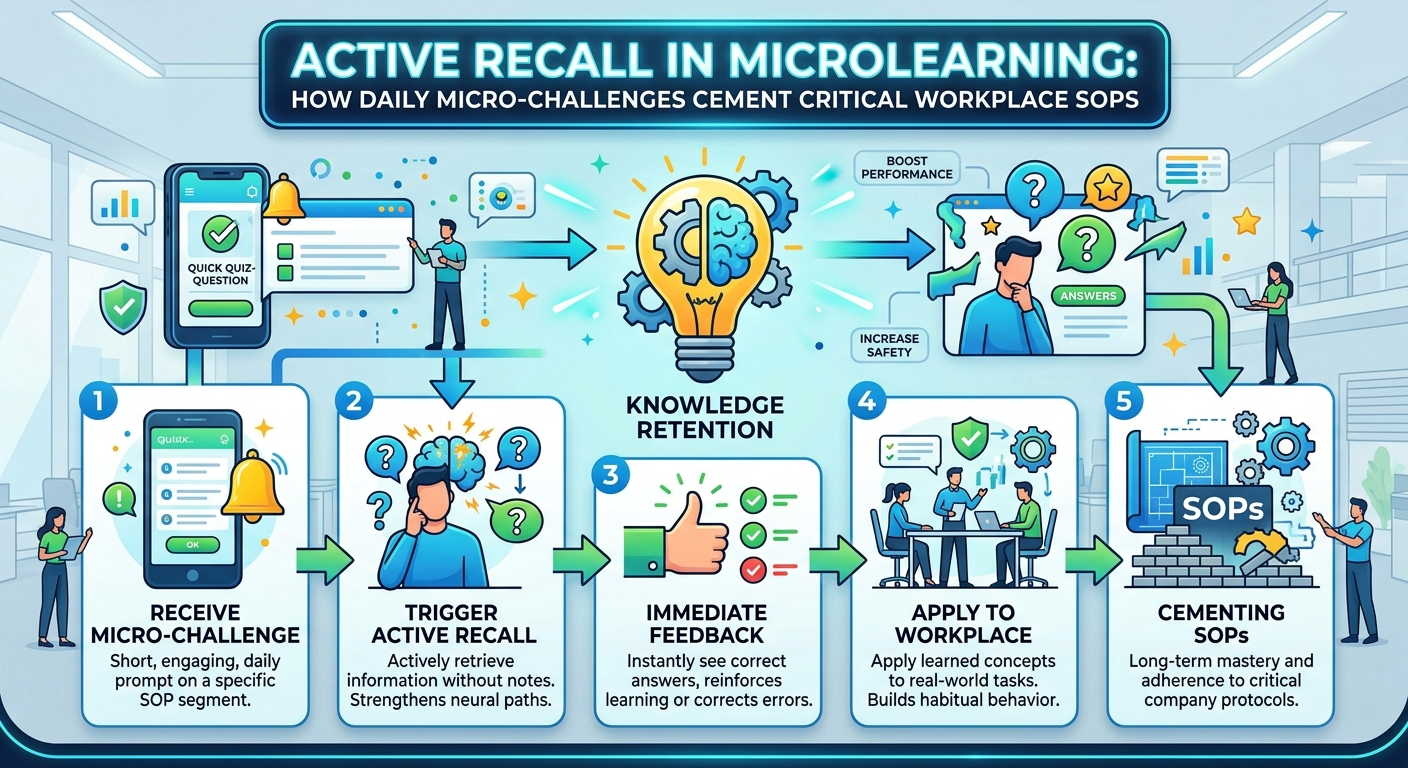
Active Recall in Microlearning: How Daily Micro-Challenges Cement Critical Workplace SOPs
In today's fast-paced corporate world, ensuring that employees not only understand but also consistently apply critical Standard Operating Procedures (SOPs) is paramount. From compliance regulations in banking to safety protocols in mining, the stakes are incredibly high. Yet, traditional training methods often fall short, leading to knowledge decay and operational inconsistencies. This is where the powerful combination of active recall and microlearning steps in, revolutionizing how organizations approach crucial skill and knowledge retention. For Vice Presidents, Directors, and Senior Managers in Learning & Development, harnessing these methodologies represents a strategic imperative for operational excellence.
The Challenge of SOP Retention
Consider the sheer volume of information employees are expected to absorb and retain. A new hire in a financial institution, for instance, must master dozens of compliance guidelines. A frontline worker in healthcare needs to recall precise patient care protocols under pressure. The human brain, however, is not a passive sponge. Without regular engagement, knowledge, especially intricate SOPs, begins to fade. Lengthy classroom sessions or monotonous policy documents often result in information overload, leading to poor recall rates and, ultimately, increased operational risk. The need for an effective Microlearning LMS becomes evident when traditional learning management solutions fail to deliver sustained retention.
Enter Microlearning
Microlearning breaks down complex information into bite-sized, digestible modules, typically lasting a few minutes. This approach aligns perfectly with modern attention spans and busy work schedules. Instead of hours of training, employees engage with focused content whenever and wherever they need it. This could be a short video explaining a new software feature, an infographic summarizing a safety procedure, or an interactive quiz on a customer service protocol. For any organization looking for an efficient learning management system, microlearning offers unparalleled flexibility and engagement, making the MaxLearn LMS a viable option for a modern learning content management system.
The Power of Active Recall
Active recall is a learning strategy that involves retrieving information from memory without external cues. Instead of passively re-reading or re-watching material, active recall forces the brain to work harder, strengthening neural pathways and improving long-term retention. Think about trying to remember a fact before looking it up, or completing a practice test. This "retrieval practice" is significantly more effective than mere recognition. When applied to SOPs, it means employees aren't just told the procedure; they are prompted to actively demonstrate their understanding and recall the steps themselves. This is a core component of effective Adaptive Learning strategies.
Micro-Challenges: The Synergy of Microlearning and Active Recall
The magic happens when microlearning and active recall converge in the form of daily micro-challenges. These are short, frequent, and often interactive tasks designed to prompt employees to actively retrieve and apply specific SOPs. Imagine a sales professional starting their day with a two-minute scenario-based question testing their knowledge of a product's compliance disclaimer, or a healthcare worker completing a quick drag-and-drop exercise on the correct PPE donning sequence. This isn't just about testing; it's about continuous, low-stakes practice that reinforces learning organically.
Practical Examples Across Industries:
- Banking & Finance: A daily micro-challenge might present a customer interaction scenario, requiring the employee to identify the correct regulatory disclosure to provide.
- Pharma & Healthcare: A short quiz asking for the next step in a specific patient admission protocol, or identifying drug contraindications.
- Retail: A quick simulation where an employee must correctly process a return according to company policy.
- Oil & Gas/Mining: A visual identification task where workers label safety equipment or recall emergency shutdown procedures.
- Sales: A flashcard challenge to recall product features and benefits, or objection handling scripts, supported by a robust lms learning management system.
Implementing Daily Micro-Challenges
For L&D leaders, the implementation of daily micro-challenges requires a strategic approach and the right technological infrastructure. A robust LMS is essential to deliver, track, and manage these challenges efficiently. Modern learning management software can automate the delivery of these challenges, personalize content based on individual performance, and provide insightful analytics. Look for features like Gamified LMS capabilities, which can turn these challenges into engaging, competitive, and rewarding experiences, further boosting participation and retention. An effective enterprise learning management solution should offer such features.
Benefits for L&D Leaders
Adopting active recall through micro-challenges offers significant advantages for L&D departments and the organization as a whole:
- Enhanced Compliance: Consistent reinforcement of regulatory SOPs drastically reduces the risk of non-compliance.
- Reduced Errors & Accidents: Better recall of critical procedures leads to fewer operational mistakes and improved safety.
- Increased Efficiency & Productivity: Employees spend less time searching for information and more time applying it correctly.
- Data-Driven Insights: LCMS platforms provide granular data on knowledge gaps, allowing L&D to target training precisely where it's needed most.
- Improved Engagement: Short, interactive challenges are more engaging than lengthy courses, leading to higher completion rates.
- Cost-Effectiveness: Reduced need for extensive remedial training and fewer costly errors contribute to a healthier bottom line.
Addressing Key L&D Concerns
How can L&D leaders effectively measure the impact of microlearning and active recall strategies on an organization's bottom line?
Measuring the return on investment is crucial for any L&D initiative. For active recall micro-challenges, L&D can track several key metrics. This includes completion rates and accuracy scores of the challenges themselves, which indicate immediate knowledge retention. More importantly, correlate these internal metrics with external business outcomes. For instance, in compliance-heavy industries, track incident rates related to SOP breaches, audit scores, or even customer satisfaction scores linked to procedural adherence. In sales, monitor performance metrics like deal closures, upselling rates, or customer churn reductions, linking them back to engagement with product or policy micro-challenges. Advanced analytics within a cloud based learning management system can help draw these connections, demonstrating the tangible value of the training investment.
Is it feasible to deploy a consistent and effective active recall microlearning program across a globally dispersed workforce, potentially spanning multiple languages and cultural nuances?
Absolutely. Modern Microlearning LMS platforms are designed with global scalability in mind. Key features to look for include multi-language support, allowing content to be localized without extensive re-authoring. An AI Powered Authoring Tool can significantly streamline the localization process, even suggesting culturally appropriate adaptations. The bite-sized nature of microlearning itself is inherently adaptable, as smaller modules are easier to translate and tailor. Additionally, a robust learning content management system can manage various versions of content, ensuring that regional teams receive challenges relevant to their specific operational context and regulatory environment, while maintaining overall consistency in core SOPs.
What essential features should an L&D department prioritize when selecting a learning management system to optimize active recall micro-challenges for critical SOPs?
When evaluating an LMS, L&D leaders should prioritize features that directly enhance active recall and microlearning delivery. First, look for strong assessment capabilities that go beyond simple multiple-choice, supporting diverse question types (e.g., drag-and-drop, scenario-based, fill-in-the-blank) to truly test recall and application. Second, Gamified LMS features are crucial for engagement, including points, badges, leaderboards, and progress tracking. Third, robust analytics are vital for identifying individual and organizational knowledge gaps, allowing for Adaptive Learning paths and targeted interventions. Finally, mobile accessibility is non-negotiable, ensuring employees can complete micro-challenges anytime, anywhere, fostering a culture of continuous learning and Risk-focused Training. The MaxLearn LMS provides these capabilities for comprehensive learning management solutions.
Conclusion
The synergy of active recall and microlearning, delivered through daily micro-challenges, offers a compelling solution to one of L&D's most persistent challenges: cementing critical workplace SOPs. By embracing these methodologies, organizations can move beyond passive consumption to active, sustained learning, leading to a more competent, compliant, and ultimately, a more successful workforce. For L&D leaders, investing in an advanced learning management system that facilitates these approaches is not just a training decision, but a strategic move towards operational excellence and competitive advantage. It's time to empower your workforce to not just know, but truly remember and apply what matters most.
.jpg)


