

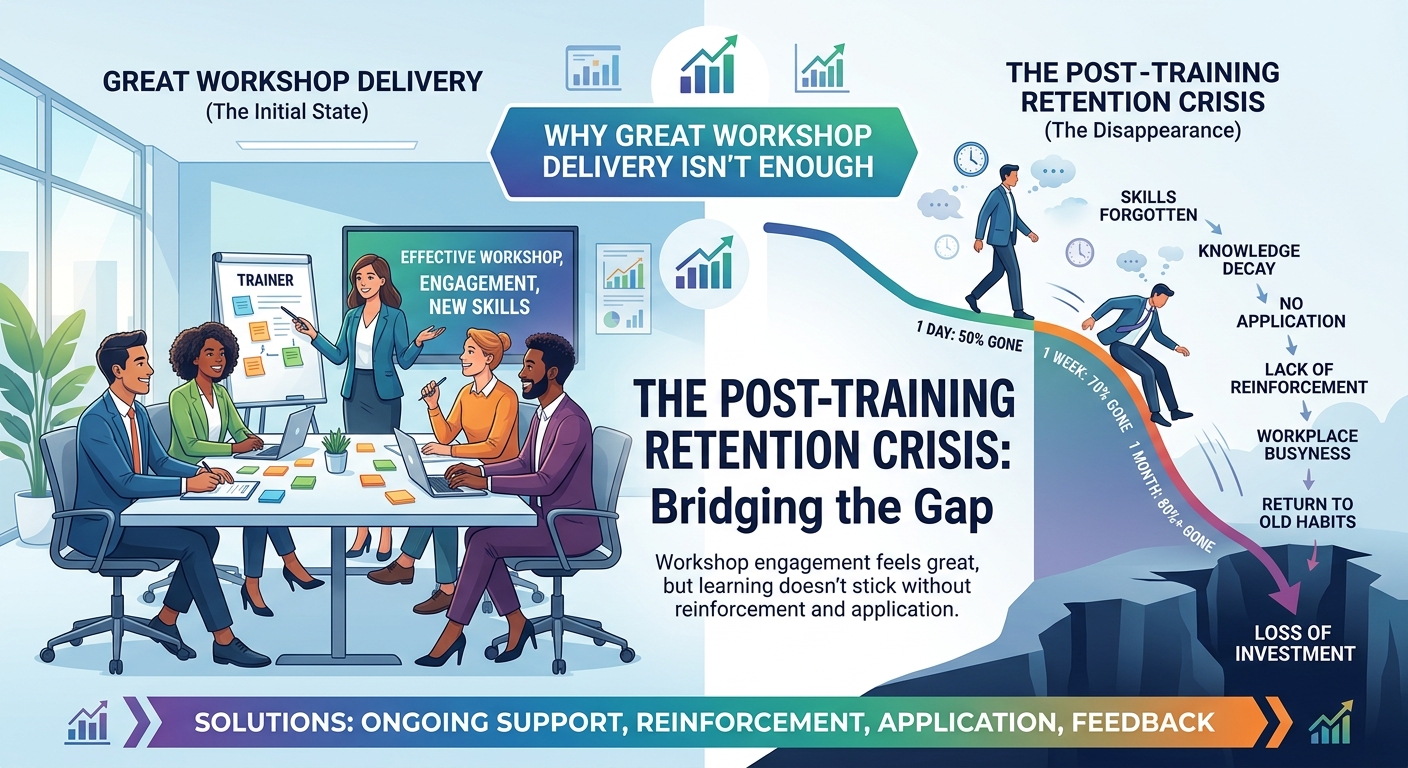
Why Great Workshop Delivery Isn’t Enough: The Post-Training Retention Crisis
In the dynamic world of business, from the rigorous demands of compliance and banking to the fast-paced innovation in pharma and retail, robust training is the bedrock of success. Organizations invest heavily in well-crafted workshops, expert facilitators, and engaging content, believing that a stellar delivery guarantees skilled employees. Yet, for many L&D leaders – Vice Presidents, Directors, Senior Managers, and Managers – a persistent and troubling reality often emerges: even the most impactful workshops frequently fail to translate into sustained knowledge retention and behavioral change. This isn't just a minor oversight; it's a post-training retention crisis that erodes valuable investments and leaves critical skill gaps unaddressed.
The Illusion of Workshop Success
Picture this: a highly engaging workshop on new sales strategies for a retail giant, or perhaps a critical compliance update for a financial institution. Participants are active, discussions are lively, and the feedback forms glow with positivity. Everyone leaves feeling enlightened and empowered. But what happens a week, a month, or six months later? The initial enthusiasm often wanes, and the newly acquired knowledge begins to fade, much like a forgotten email in a crowded inbox.
This phenomenon isn't a reflection of poor training delivery, but rather a fundamental flaw in the traditional approach to learning. The focus has historically been on the 'event' of training, rather than the ongoing 'process' of learning and application. While the workshop itself might be a masterclass in engagement, it often lacks the crucial follow-up mechanisms necessary to embed learning deeply and ensure long-term retention across all industries, from healthcare to oil and gas.
The Forgetting Curve: A Persistent Challenge
Hermann Ebbinghaus’s Adaptive Learning research on the "forgetting curve" is as relevant today as it was over a century ago. It posits that people forget a significant portion of what they learn very quickly if there isn't continuous reinforcement. In a corporate setting, this means that even after a fantastic training session on new software for a hospitality chain or safety protocols in mining, employees can lose 50-80% of what they learned within a few days or weeks without active recall and application.
This isn't merely about recalling facts; it's about skill atrophy and a failure to translate knowledge into practical competence. For an organization investing in an Microlearning LMS or a comprehensive LMS, this data highlights the need for a strategic shift from event-based training to continuous learning ecosystems.
Beyond the Classroom: The Retention Gap
The gap between successful workshop delivery and sustained knowledge retention is often a vast chasm. It's where the investment in a top-tier learning management system falls short if not complemented by robust post-training strategies. This gap manifests in several ways across diverse sectors:
- Reduced ROI: Training budgets are substantial. When knowledge fades, the return on investment diminishes drastically.
- Performance Decline: New skills aren't applied effectively, leading to errors, inefficiencies, or missed opportunities, whether in a sales pitch or a complex engineering task.
- Compliance Risks: Especially in heavily regulated industries like finance, pharma, and healthcare, forgetting critical compliance updates can lead to severe penalties. This underscores the importance of Risk-focused Training.
- Employee Frustration: Employees may feel frustrated if they can't remember how to apply new learning, impacting morale and productivity.
- Waste of Resources: Time, money, and effort spent on training are essentially wasted if the learning doesn't stick.
What’s at Stake? The Business Impact
For L&D leaders, understanding the severity of this crisis is paramount. It’s not just about losing a few facts; it's about significant business impact. In sales, it means missed quotas. In banking, it could mean regulatory non-compliance. In healthcare, it might impact patient care protocols. In manufacturing, it can lead to safety hazards. Across the board, poor retention equates to a direct hit on an organization’s bottom line and competitive edge.
This realization demands a re-evaluation of how organizations perceive and manage their learning initiatives. It necessitates moving beyond merely excellent delivery and focusing on the ecosystem that supports and reinforces that delivery. A truly effective learning management software must facilitate this ongoing process.
Bridging the Gap: Strategies for Lasting Impact
Overcoming the post-training retention crisis requires a multifaceted approach that extends beyond the initial training event. It’s about building a continuous learning culture supported by advanced technology and pedagogical strategies. Here’s how L&D leaders can make learning stick:
Embrace Microlearning and Spaced Repetition
Break down complex topics into bite-sized, digestible modules delivered over time. Microlearning LMS platforms are designed precisely for this, allowing learners to absorb information in short bursts and then revisit key concepts at optimal intervals. This combats the forgetting curve directly and is incredibly effective for busy professionals in any industry.
Leverage Personalization and Adaptive Learning
Not all learners are alike. An Adaptive Learning system adjusts the learning path based on an individual's existing knowledge, learning style, and performance. This ensures that reinforcement is targeted, addressing specific weaknesses and building on strengths, making the learning experience more relevant and effective for each employee.
Infuse Gamification for Engagement
Make learning fun and interactive. A Gamified LMS uses elements like points, badges, leaderboards, and challenges to motivate learners, encourage participation, and foster a healthy competitive spirit. This can significantly boost engagement and voluntary revisiting of content, crucial for knowledge retention in areas like sales training or new product launches.
Implement Continuous Reinforcement and Follow-Up
Learning shouldn't end when the workshop does. Incorporate regular quizzes, short assignments, discussion forums, and practical application exercises. A robust learning content management system (LCMS) allows for easy deployment and tracking of these follow-up activities, ensuring that knowledge is consistently refreshed and applied.
Utilize Data-Driven Insights
Modern enterprise learning management platforms offer powerful analytics. Track learner progress, identify areas of common difficulty, and measure the impact of post-training interventions. This data is invaluable for refining strategies and proving the ROI of your learning initiatives.
Advanced Insights: Intelligent Solutions for Learning Retention
The integration of intelligent systems is revolutionizing how organizations approach post-training retention. For L&D leaders looking to maximize their impact, considering how these systems can support ongoing learning is key.
Question: How can intelligent systems support ongoing learning and prevent knowledge decay across diverse teams and locations?
Answer: Intelligent systems, especially those integrated within a cloud based learning management system, can use algorithms to personalize learning paths, recommend relevant content based on performance gaps, and schedule automated refreshers. They can even adapt content delivery based on real-time performance data. For a multinational corporation, this ensures consistent, relevant learning regardless of geographical location or cultural context, providing a unified learning experience for everyone.
Question: What advanced analytics can help pinpoint specific areas of learning weakness post-workshop and recommend targeted interventions?
Answer: Advanced analytics within a sophisticated lms learning management system can go beyond simple completion rates. These systems analyze learner interactions, assessment scores, time spent on modules, and even sentiment analysis from forums to identify struggling individuals or common areas of misunderstanding. Based on these insights, the system can automatically suggest supplementary AI Powered Authoring Tool generated content, peer mentoring, or facilitator check-ins, creating a truly responsive learning environment.
Question: Where are the most effective points for deploying smart technology to sustain learning outcomes and impact business objectives?
Answer: Smart technology can be deployed effectively at multiple touchpoints:
- Pre-training: For diagnostics and personalized foundational learning.
- During training: For interactive simulations and immediate feedback.
- Post-training: Critically, for spaced repetition, performance support, and contextual reminders. Integrating intelligent systems with performance management tools allows for 'learning in the flow of work,' where relevant content is triggered precisely when an employee needs it to complete a task, cementing knowledge through practical application. This continuous feedback loop directly links learning to business objectives.
The Future of Learning: Smart Solutions
The post-training retention crisis is a significant hurdle, but not an insurmountable one. By understanding its roots and embracing modern learning technologies, L&D leaders can transform their organizations' approach to skill development. A robust MaxLearn LMS, powered by microlearning, gamification, and intelligent adaptive pathways, offers a comprehensive solution to this challenge.
It's no longer enough to deliver a great workshop; the true measure of success lies in what happens long after the attendees have left the room. Investing in a holistic learning ecosystem that fosters continuous engagement and intelligent reinforcement is the only way to ensure that training translates into lasting knowledge, improved performance, and tangible business growth across all industries.
.jpg)


