

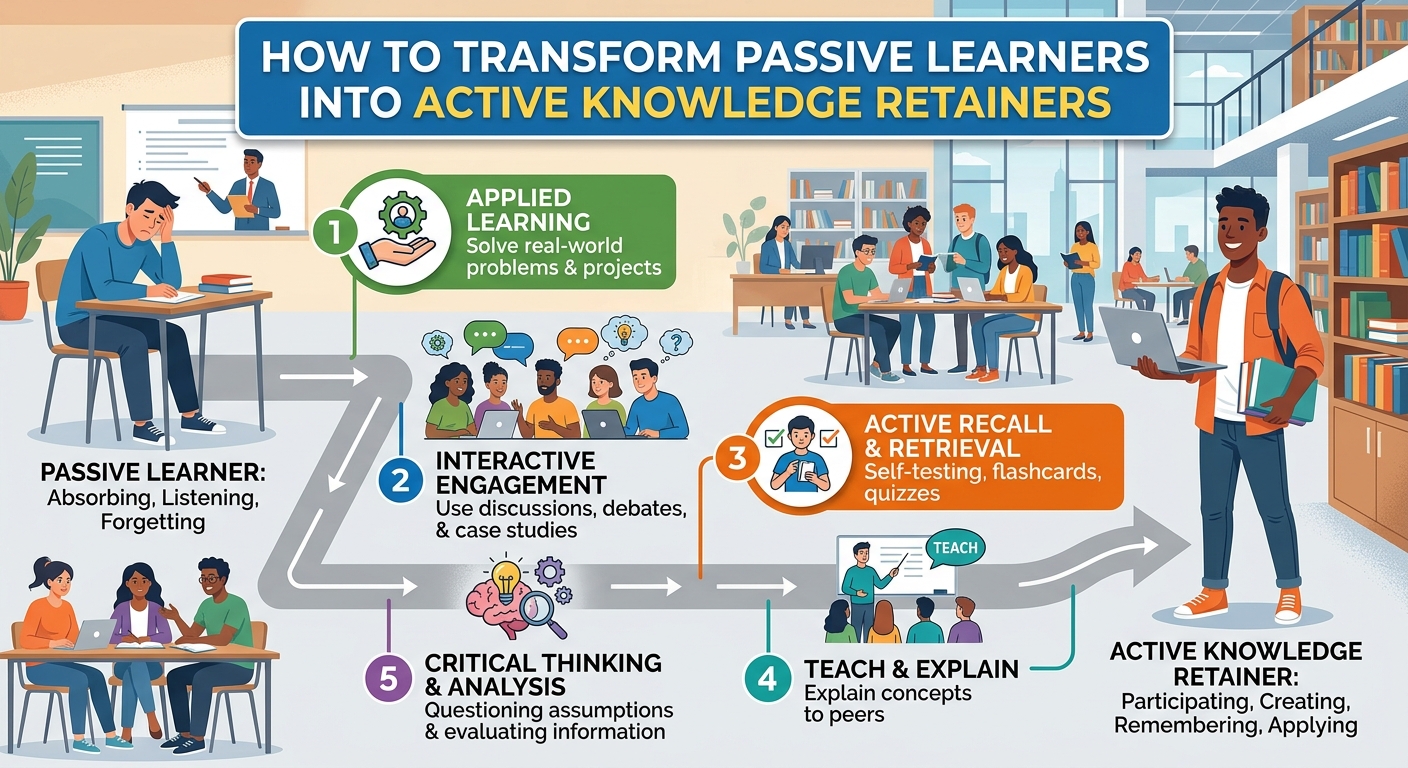
How to Transform Passive Learners into Active Knowledge Retainers
In the dynamic landscape of corporate learning, L&D leaders across industries—from Compliance, Sales, Banking, Finance, Insurance, and Retail to Pharma, Healthcare, Hospitality, Oil and Gas, and Mining—continually face the challenge of moving beyond mere training completion rates to genuine knowledge retention and application. The traditional model of lengthy, passive learning modules often results in disengaged employees who forget crucial information almost as quickly as they consume it. This scenario not only wastes valuable resources but also poses significant risks, particularly in highly regulated sectors like banking or healthcare, or high-stakes environments such as oil and gas.
For Vice Presidents, Directors, Senior Managers, and Managers of L&D, the imperative is clear: transform passive learners into active knowledge retainers. This article explores strategic approaches and leverages modern eLearning advancements to cultivate a learning culture where employees are not just recipients of information, but active participants in their own development, integrating knowledge into their daily roles effectively.
The Pitfalls of Passive Learning in the Enterprise
Passive learning, characterized by one-way information delivery through lectures, long videos, or static text, often creates a significant disconnect between content and application. Learners might complete mandatory modules, especially in compliance training, but without active engagement, the information rarely sticks. This leads to a detrimental "forgetting curve," where a substantial portion of learned material is lost within days. For an enterprise relying on critical knowledge for operational efficiency, risk mitigation, and competitive advantage, this passive approach is simply unsustainable. It hinders skill development, impacts decision-making, and ultimately affects bottom-line performance.
Shifting the Paradigm: From Consumption to Retention
To cultivate active knowledge retention, L&D strategies must embrace methodologies that demand interaction, critical thinking, and immediate application. This involves a fundamental shift in how learning content is designed, delivered, and reinforced. The goal is to create an immersive and continuous learning journey that adapts to individual needs and reinforces information effectively.
Microlearning and Spaced Repetition: The Building Blocks of Retention
One of the most effective strategies for battling the forgetting curve is the implementation of microlearning. By breaking down complex topics into bite-sized, easily digestible modules, employees can engage with content more frequently without feeling overwhelmed. This approach is particularly effective when combined with spaced repetition—a technique where information is revisited at increasing intervals. A robust Microlearning LMS can deliver these short bursts of content, quizzes, and refreshers at optimal times, ensuring critical knowledge, whether about new sales strategies or compliance updates, is cemented over time.
Gamification and Interactive Elements: Igniting Engagement
Engagement is the cornerstone of active learning. Integrating gamification elements like points, badges, leaderboards, and challenges transforms mundane training into an exciting experience. Imagine sales teams competing to master product knowledge through interactive quizzes, or banking professionals earning badges for excelling in fraud prevention simulations. A sophisticated Gamified LMS provides the framework for these interactive elements, making learning not just informative but genuinely enjoyable and competitive, fostering a desire to learn more and perform better.
Personalized and Adaptive Learning Paths
Every learner is unique, possessing different prior knowledge, learning styles, and paces. One-size-fits-all training modules often fail to address these individual differences, leading to disengagement for those who find content too easy, too hard, or irrelevant. Adaptive Learning tailors the learning experience to each individual. Powered by data and algorithms, an adaptive system can assess a learner's current knowledge, identify gaps, and then deliver personalized content and activities. This ensures that every moment spent learning is productive and relevant, accelerating skill acquisition and retention across all segments, from healthcare to hospitality.
AI-Enhanced Content Creation and Delivery
The burden of creating engaging and effective learning content can be immense for L&D teams. This is where artificial intelligence steps in. An AI Powered Authoring Tool can dramatically accelerate content development by automating tasks such as drafting quiz questions, suggesting relevant multimedia, or even localizing content for global teams. This frees up L&D professionals to focus on instructional design and strategic initiatives, ensuring that the content is not only rich and engaging but also delivered efficiently through an advanced Learning content management system.
Real-world Application and Case Studies
Knowledge becomes truly active when learners can apply it to real-world scenarios. Incorporating case studies, simulations, and role-playing exercises allows employees to practice new skills in a safe environment. For instance, risk managers in finance can simulate market downturns, or pharma sales reps can practice pitching new drugs. Emphasizing Risk-focused Training, especially in industries like oil and gas or insurance, means directly tying learning outcomes to critical operational decisions, making the learning immediately relevant and reinforcing its importance.
Feedback and Continuous Improvement
Active learners thrive on feedback. Providing immediate, constructive feedback on assessments and activities helps reinforce correct understanding and corrects misconceptions swiftly. Furthermore, a robust learning management software should allow L&D teams to gather data on learner performance, engagement, and retention rates. This data-driven approach enables continuous improvement of training programs, ensuring they remain effective and aligned with evolving business needs.
AI's Role in Fostering Active Learning: Your Questions Answered
How can modern learning platforms significantly boost employee knowledge retention?
Modern learning platforms, particularly a cutting-edge lms learning management system, leverage a blend of advanced technologies and instructional design principles to drastically improve retention. They incorporate microlearning for digestible content, spaced repetition algorithms for timely refreshers, and interactive simulations that require learners to actively apply knowledge. Furthermore, capabilities like Adaptive Learning personalize pathways, ensuring content is always relevant and appropriately challenging, keeping learners engaged and reinforcing critical concepts effectively.
What advanced tools are available to help L&D teams create highly effective and engaging training content?
L&D teams can now access powerful tools that streamline content creation and enhance engagement. Key among these are AI Powered Authoring Tool, which automates content generation, streamlines multimedia integration, and suggests interactive elements. These tools transform the arduous process of content development, allowing L&D professionals to focus more on strategic instructional design and less on manual creation. Paired with a comprehensive learning management system, they ensure that the content is not only rich but also perfectly tailored for delivery across diverse devices and learning styles.
Where can organizations find comprehensive learning management solutions that cater to diverse industry needs globally?
Organizations seeking a holistic learning management system (LMS) that addresses specific needs across sectors like compliance, sales, healthcare, or finance can find solutions from leading providers like MaxLearn LMS. These advanced cloud based learning management system platforms offer robust features such as flexible content delivery, powerful analytics, and scalable infrastructure designed for enterprise learning management. Whether you require a specialized learning content management system for global training rollouts or an LCMS for meticulous content versioning, premier providers offer tailored solutions that ensure effective knowledge transfer and retention worldwide.
Implementing the Change with a Robust Learning System
To successfully transform passive learners into active knowledge retainers, organizations need more than just strategies; they need the right tools. A comprehensive LMS is the backbone of this transformation. It serves as the central hub for delivering Microlearning LMS modules, hosting Gamified LMS experiences, managing Adaptive Learning paths, and integrating content from an AI Powered Authoring Tool. Such a learning management system ensures seamless delivery, robust tracking, and continuous optimization of all training initiatives, including crucial Risk-focused Training.
Choosing an enterprise learning management system that is not only powerful but also intuitive is critical. It must support various content formats, provide detailed analytics on learner engagement and performance, and be scalable to meet the evolving demands of a growing workforce. A cloud based learning management system offers the flexibility and accessibility required for today's distributed teams.
Conclusion
The journey from passive consumption to active knowledge retention is paramount for modern enterprises. For L&D leaders, embracing a holistic approach that integrates microlearning, gamification, personalized learning, and AI-driven tools is no longer optional but essential. By fostering an environment where learning is engaging, relevant, and continuously reinforced through a powerful learning management software, organizations can empower their employees to not only absorb information but to truly master and apply it. Investing in an advanced learning management system is an investment in human capital, organizational resilience, and sustained competitive advantage across every industry segment.
.jpg)


