

How Continuous Micro-Interventions Reduce Operational Error Rates
In today’s fast-paced business environment, operational excellence isn't just a goal; it's a necessity. For leaders in Learning & Development across industries like Compliance, Sales, Banking, Finance, Insurance, Retail, Pharma, Healthcare, Hospitality, Oil and Gas, and Mining, the consistent reduction of operational error rates is a critical challenge. These errors, whether minor procedural missteps or significant compliance breaches, erode profitability, damage reputation, and can even pose serious safety risks. The solution isn't always more training; often, it's smarter, more frequent, and precisely targeted interventions. This is where the power of continuous micro-interventions truly shines.
The Pervasive Cost of Operational Errors
Every operational error carries a tangible cost. In banking, a single misprocessed transaction can lead to financial penalties and customer churn. In healthcare, a procedural error can have life-threatening consequences. For pharmaceutical companies, non-compliance due to human error can result in massive fines and product recalls. Retail faces inventory discrepancies and customer dissatisfaction, while the oil and gas sector battles the high stakes of safety and environmental incidents. Traditional training, often delivered in lengthy, infrequent sessions, struggles to keep pace with evolving regulations, complex procedures, and the natural decay of knowledge over time. This gap leaves organizations vulnerable to an unacceptable level of operational risk.
Beyond Traditional Training: A New Paradigm
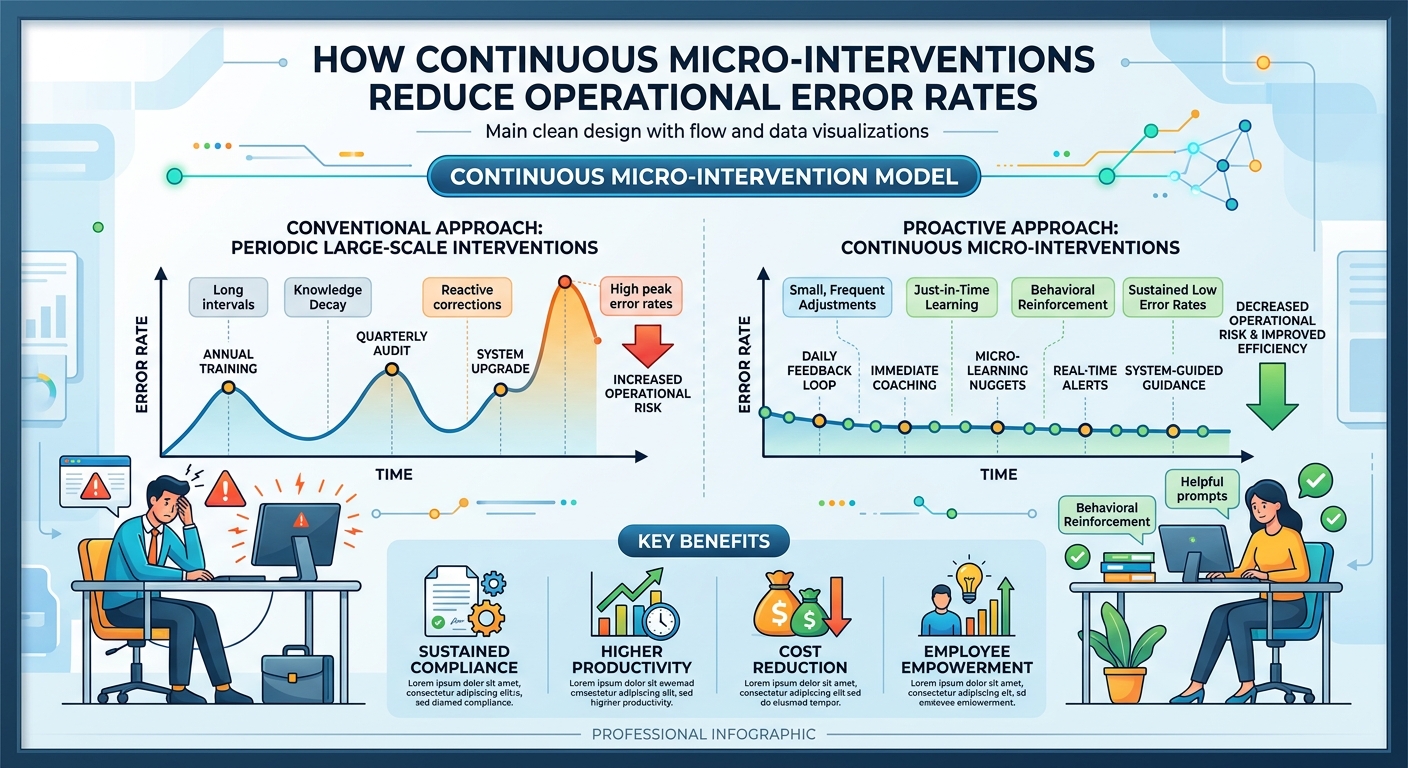
For decades, the go-to strategy for skill gaps and error prevention has been comprehensive, classroom-style training or lengthy e-learning modules. While these have their place for foundational knowledge, they often fall short in maintaining peak performance and addressing real-time operational challenges. Information overload, lack of immediate relevance, and the forgetting curve quickly diminish their effectiveness. What’s needed is a mechanism that delivers knowledge and reinforcement precisely when and where it's most needed – a continuous stream of support embedded within the daily workflow.
Introducing Continuous Micro-Interventions
Continuous micro-interventions are bite-sized, highly focused learning activities or reminders delivered frequently and contextually to employees. Unlike traditional training, these are not meant to impart entirely new complex skills but rather to reinforce critical knowledge, correct misconceptions, update procedures, or provide timely performance support. They are designed to be consumed quickly, often in just a few minutes, making them less disruptive to daily tasks while maximizing retention and application.
Key Principles for Effective Micro-Interventions:
- Timeliness & Relevance: Delivered at the point of need or shortly before a critical task, ensuring the information is immediately applicable.
- Bite-Sized Content: Focusing on one specific learning objective or a single piece of information, preventing cognitive overload.
- Repetition & Reinforcement: Spaced repetition helps combat the forgetting curve, embedding knowledge more deeply over time.
- Accessibility: Easily available on any device, allowing employees to access information on the go or directly at their workstation.
- Personalization: Tailored to individual roles, performance data, or identified skill gaps for maximum impact.
Leveraging Technology to Drive Error Reduction
Implementing a successful strategy of continuous micro-interventions requires robust technological support. This is where advanced Microlearning LMS platforms become indispensable. These specialized learning content management systems are built to deliver and manage short, targeted learning assets efficiently.
A modern LMS (learning management system) serves as the backbone for such initiatives. It facilitates the creation, deployment, tracking, and analysis of micro-interventions across the enterprise. For L&D professionals seeking to significantly reduce error rates, a comprehensive learning management software solution is paramount. Many organizations are now opting for a cloud based learning management system for its scalability and accessibility, ensuring interventions reach every corner of the operation, from the sales floor to the factory plant.
Engagement is a critical factor in the success of any learning initiative. A Gamified LMS transforms learning into an interactive, rewarding experience. By incorporating elements like points, badges, leaderboards, and challenges, gamification motivates employees to engage consistently with micro-interventions, driving higher completion rates and better knowledge retention, ultimately contributing to a reduction in operational errors.
Furthermore, the ability to personalize learning paths is crucial. Adaptive Learning technologies, often powered by sophisticated algorithms, can dynamically adjust the content and frequency of micro-interventions based on an individual's performance, job role, and existing knowledge. This ensures that employees receive exactly the information they need, when they need it, optimizing the learning process for error prevention.
Creating this vast amount of precise, high-quality micro-content can be a challenge. This is where an AI Powered Authoring Tool proves invaluable. These tools can expedite content creation, automatically generate different formats, and even suggest content based on performance data, significantly reducing the burden on L&D teams while ensuring the content is always fresh and relevant. By focusing on Risk-focused Training, organizations can specifically target areas prone to errors, using data-driven insights to deploy highly effective micro-interventions.
AI and the Future of Error Prevention
Artificial Intelligence is rapidly reshaping the landscape of corporate learning, offering unprecedented opportunities to fine-tune error reduction strategies. For L&D leaders, understanding AI's potential is key to future-proofing their operational integrity.
Frequently Asked Questions about AI in Micro-Interventions:
How can AI optimize the delivery and effectiveness of learning content to maximize its impact on performance and minimize errors?
AI algorithms can analyze vast datasets of employee performance, learning patterns, and operational error reports. Based on this analysis, AI can intelligently schedule and present micro-interventions at optimal times, identify which specific topics require more frequent reinforcement, and even suggest alternative content formats that resonate better with individual learners. This approach ensures that every intervention is strategically placed for maximum impact on reducing critical errors.
Is it possible for AI to tailor learning interventions specifically based on an employee's geographical location or specific regional compliance requirements?
Absolutely. AI can leverage location data and integrate with regional compliance databases to deliver hyper-localized micro-interventions. For instance, a global bank operating across multiple jurisdictions could use AI to ensure employees in different regions receive specific compliance updates or procedural reminders pertinent only to their local regulations, significantly reducing errors related to regional non-adherence. This ensures that relevant information is always front and center, regardless of an employee's operational base.
How does AI personalize micro-interventions to address individual skill gaps, learning styles, and job roles to prevent errors more effectively?
AI excels at creating highly individualized learning experiences. By continuously assessing an employee's interactions with learning content, their assessment scores, and their operational performance data, AI can dynamically identify precise skill gaps. It then recommends or pushes personalized micro-interventions—be it a short video, an interactive quiz, or a quick job aid—that specifically target those weaknesses. This personalized approach, delivered through an intelligent learning management system, ensures that each employee receives exactly the support they need to avoid errors, catering to their unique way of learning and their specific responsibilities.
The Tangible Benefits: Why Micro-Interventions Work
Adopting a strategy of continuous micro-interventions, supported by an advanced enterprise learning management solution, offers a multitude of benefits:
- Reduced Error Rates: The most direct benefit, achieved through constant reinforcement and timely information.
- Improved Compliance: Regular, targeted updates ensure employees are always abreast of the latest regulations and procedures.
- Enhanced Performance & Productivity: Employees gain confidence and efficiency from having readily accessible, relevant information.
- Higher Employee Engagement: Bite-sized, engaging content is less daunting and more appealing than lengthy training, leading to greater participation.
- Cost Savings: Fewer errors mean less rework, fewer fines, reduced waste, and improved operational efficiency.
Implementing Your Micro-Intervention Strategy
For L&D leaders, embarking on this journey involves several key steps. First, identify critical error points and high-risk operational areas within your organization. Next, invest in a robust MaxLearn LMS or similar state-of-the-art lms learning management system that supports microlearning and adaptive capabilities. Develop or curate concise, relevant content focused on single learning objectives. Utilize data analytics from your LCMS (Learning Content Management System) to monitor the effectiveness of interventions and continuously refine your strategy. Remember, this is a continuous process of learning, intervention, and improvement.
Conclusion
The imperative to reduce operational error rates is universal across industries. While traditional training has its place, the dynamic nature of modern business demands a more agile, continuous, and integrated approach. Continuous micro-interventions, powered by intelligent learning management solutions and AI, offer a powerful pathway to achieving this. By embracing this strategy, L&D leaders can transform their organizations, fostering a culture of continuous learning, reducing costly errors, and driving sustained operational excellence. It's time to move beyond reactive error correction to proactive, intelligent error prevention.
.jpg)


