

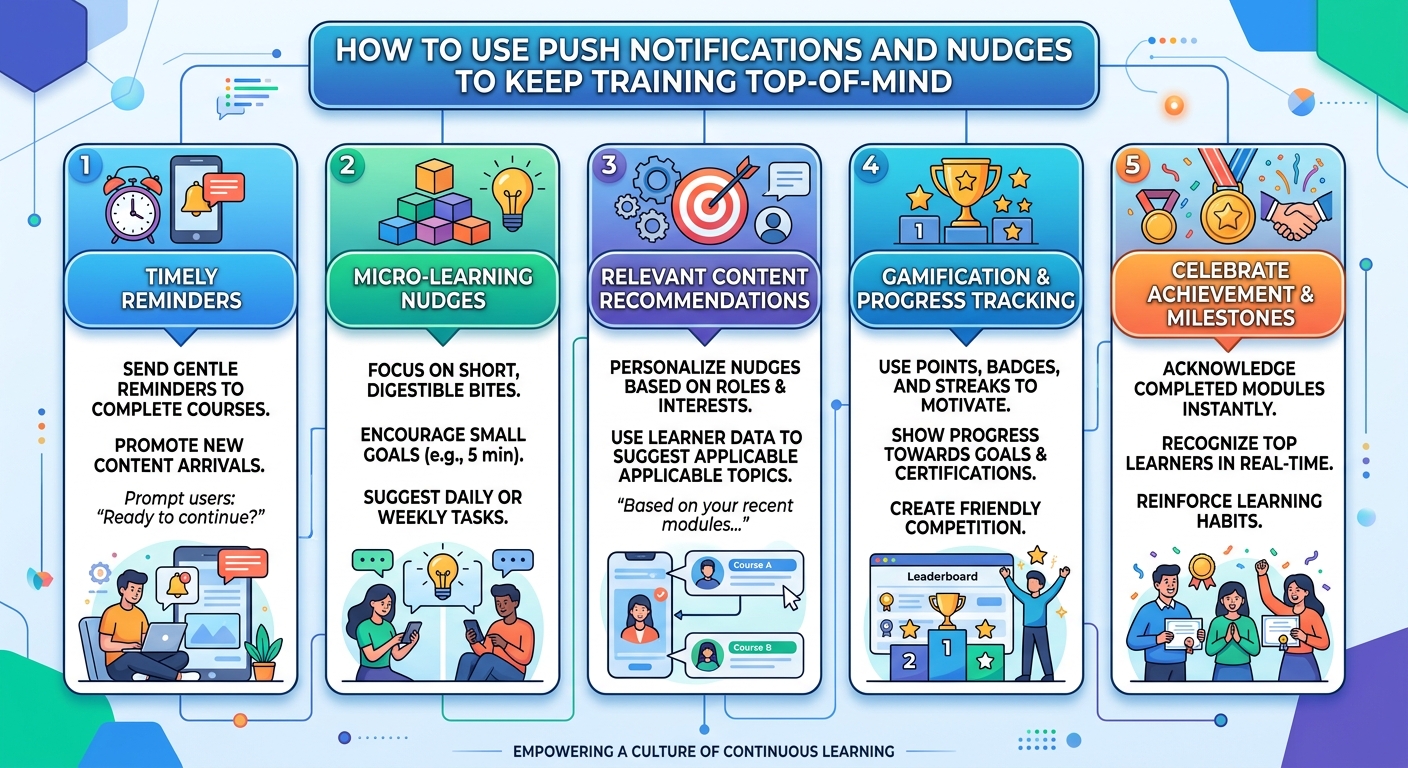
How to Use Push Notifications and Nudges to Keep Training Top-of-Mind
In today's fast-paced corporate environment, where information overload is the norm and attention spans are dwindling, ensuring that critical training sticks and translates into lasting behavioral change is a monumental challenge for Learning & Development (L&D) leaders. From maintaining compliance in highly regulated sectors like banking and pharma to accelerating sales cycles and enhancing customer service in retail and hospitality, the effectiveness of your training programs directly impacts business outcomes. The traditional "fire and forget" approach to learning often falls short, leading to rapid knowledge decay and unmet skill gaps. This is where the strategic deployment of push notifications and nudges within your Microlearning LMS can revolutionize how your organization approaches continuous learning, keeping essential training initiatives consistently top-of-mind.
Organizations often ask, "How can we ensure employees apply what they've learned long after the initial training session?" The answer lies in sustained engagement, facilitated by timely, relevant, and unobtrusive reminders that reinforce learning and encourage practice. This article delves into how L&D professionals can harness these powerful tools to combat the forgetting curve, foster a culture of continuous learning, and drive measurable performance improvements across diverse industries.
The Imperative of Sustained Engagement: Beyond the Classroom
For L&D Vice Presidents, Directors, and Managers, the goal is not just to deliver training, but to embed knowledge and skills into daily operations. This is particularly crucial in areas like compliance, where lapses can lead to significant penalties, or in sales, where consistent application of best practices directly impacts revenue. A common query among L&D leaders is, "What mechanisms effectively bridge the gap between training completion and real-world application?" The solution lies in strategic follow-ups that gently, yet effectively, guide learners.
The human brain is wired for forgetting. Without reinforcement, up to 70% of new information can be lost within days. This necessitates a proactive approach to knowledge retention. A robust Gamified LMS, integrated with intelligent notification systems, can provide the scaffolding needed to support learners long after they've clicked "complete" on a module. These systems act as a continuous learning content management system, ensuring that learning doesn't end with a certificate but evolves into habitual practice.
What are Push Notifications and Nudges in an L&D Context?
- Push Notifications: These are direct, often short, messages sent to a user's device (desktop, mobile, within the learning management software itself) to alert them to new content, remind them of deadlines, or prompt them to take action. Think of a notification saying, "New module on Q3 compliance updates is available!" or "Your module on ethical selling is due in 3 days."
- Nudges: Nudges are subtle cues or interventions designed to influence choices and behaviors in a predictable way, without restricting options. In L&D, a nudge might be a suggestion to review a specific microlearning module related to a task an employee is currently performing, a prompt to practice a newly acquired skill, or a recommendation for further learning based on their performance in an Adaptive Learning path.
Designing Effective Nudges and Notifications for Optimal Impact
The key to successful push notifications and nudges lies in their relevance, timeliness, and user-centric design. Irrelevant or overly frequent messages can quickly lead to notification fatigue, defeating their purpose. So, what makes a notification or nudge truly effective?
Personalization and Contextual Relevance
A critical question often posed by L&D executives is, "How can we ensure our learning prompts resonate with individual employees rather than feeling like generic spam?" The answer lies in deep personalization. A cutting-edge learning management system should leverage learner data – roles, performance metrics, progress, skill gaps, and even real-time work contexts – to deliver highly relevant messages. For instance, a sales professional might receive a nudge about a negotiation tactic micro-lesson just before a client meeting, or a healthcare worker a reminder about a specific protocol related to a patient condition they are handling.
Leveraging an AI Powered Authoring Tool allows L&D teams to create dynamic content that can be tailored on the fly, ensuring that the nudges link directly to actionable, bite-sized learning resources. This makes the enterprise learning management system a proactive partner in skill development.
Timeliness and Frequency
When is the best time to send a reminder or a learning prompt? This is a question that AI can increasingly help answer. A timely nudge can significantly increase engagement. For example:
- Pre-event Nudges: Reminders to complete prerequisite modules before a live training session.
- Post-training Reinforcement: Follow-up questions or scenarios related to a recently completed module to test recall.
- Performance-based Nudges: Suggestions for additional training or resources when an employee struggles with a particular task or metric.
- Critical Information Updates: Immediate alerts for new policies, compliance changes, or safety protocols, especially vital in sectors like Oil and Gas or Mining.
The frequency should be carefully managed. Too many notifications can be disruptive; too few might lead to missed opportunities. A sophisticated cloud based learning management system can utilize analytics to determine optimal delivery times and frequencies for different user groups and learning objectives.
Clear Call to Action
Every notification and nudge should have a clear, concise call to action. Whether it's "Click here to review," "Practice this skill," "Watch this 2-minute video," or "Complete your certification by Friday," the instruction should be unambiguous, guiding the learner directly to the desired behavior or resource. This is especially vital in Risk-focused Training, where clarity can prevent costly errors.
Industry-Specific Applications and Examples
The versatility of push notifications and nudges makes them invaluable across various industries:
- Compliance (Banking, Finance, Pharma): Reminders for annual compliance training deadlines, alerts for policy updates, or quick quizzes on specific regulations to reinforce knowledge.
- Sales (Retail, Automotive, B2B): Nudges suggesting relevant product knowledge modules before a sales call, tips for handling common objections, or prompts to practice pitching new features.
- Healthcare: Notifications about new medical procedures, updates to patient care protocols, or reminders for continuous professional development credits.
- Hospitality: Nudges for best practices in customer service, alerts for new menu items, or reminders about safety procedures in specific areas.
- Oil & Gas/Mining: Critical safety alerts, reminders for equipment maintenance checks, or short bursts of information on new operational procedures.
Leveraging AI and Analytics for Smarter Engagement
A frequent inquiry from L&D innovators is, "How can technology help us move beyond basic reminders to truly intelligent engagement?" The answer lies in integrating artificial intelligence with your learning management system. AI can analyze vast amounts of data – learner performance, engagement patterns, job roles, industry trends – to predict when and what kind of nudge will be most effective. An intelligent learning management software goes beyond simply sending out scheduled messages; it learns and adapts.
For instance, if an employee consistently struggles with a particular module, the system can automatically send a series of targeted nudges, perhaps linking to remedial content or peer support. If an employee is performing exceptionally well, it might suggest advanced modules or leadership training opportunities. This intelligent automation transforms an LMS from a passive content repository into a dynamic, adaptive learning partner.
The Role of Data in Optimizing Nudges:
- Engagement Metrics: Track open rates, click-through rates, and conversion rates of your notifications.
- Learning Outcomes: Correlate nudge engagement with course completion, assessment scores, and on-the-job performance.
- User Feedback: Gather insights directly from learners on the usefulness and frequency of nudges.
This iterative process allows L&D teams to continually refine their strategy, ensuring that push notifications and nudges serve as valuable assets in an organization’s comprehensive learning management solutions, rather than mere distractions.
Conclusion: Cultivating a Culture of Continuous Learning
For L&D leaders, the challenge of keeping training top-of-mind is paramount to business success. By strategically integrating push notifications and nudges into your learning management system, you transform learning from a discrete event into a continuous, embedded process. This isn't just about reminders; it's about fostering a culture where learning is reinforced, contextualized, and personalized, ensuring that critical skills and knowledge are not just acquired, but truly mastered and applied. With the right MaxLearn LMS, equipped with these powerful engagement tools, your organization can move beyond mere compliance to genuine competence, driving performance and innovation across all segments and industries.
.jpg)


