

Why Your Company Is Wasting 80% of Its Training Budget on the Forgetting Curve
As a Vice President, Director, or Senior Manager in Learning & Development, you understand the critical role effective training plays in your organization's success. From ensuring compliance in banking and healthcare to boosting sales performance in retail and refining operational efficiency in oil and gas, robust learning initiatives are non-negotiable. Yet, there's a silent budget killer lurking in plain sight: the Forgetting Curve. If your training programs aren't designed to actively combat it, you could be effectively wasting up to 80% of your precious L&D budget.
This isn't just about lost investment; it's about diminished productivity, increased risks, missed opportunities, and a workforce that struggles to retain vital information. This article will delve into the science behind the Forgetting Curve, expose the pitfalls of traditional training methods, and illuminate how modern, intelligent learning management solutions are transforming retention and delivering tangible ROI across industries.
Understanding the Forgetting Curve: A Silent Budget Drain
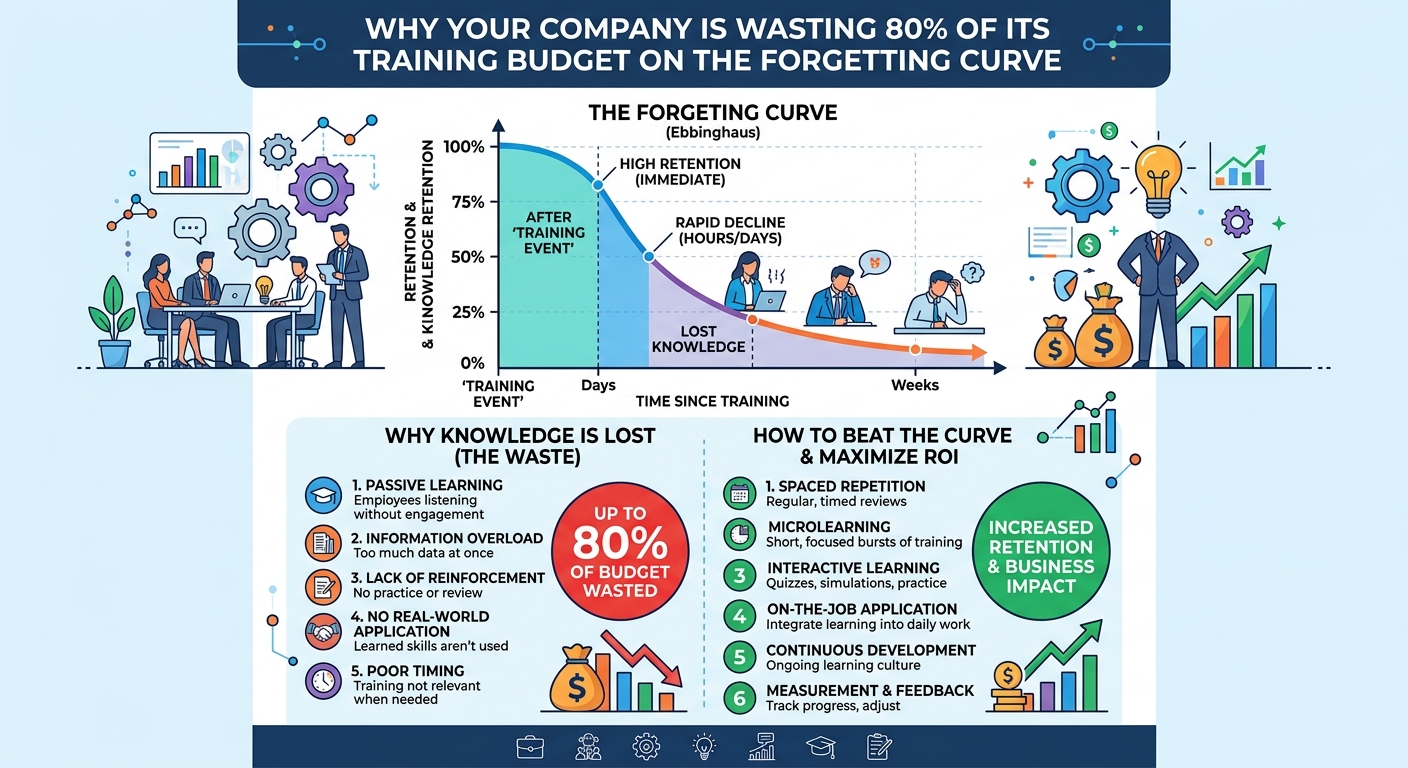
The concept of the Forgetting Curve was first introduced by German psychologist Hermann Ebbinghaus in 1885. His research revealed that without reinforcement, humans forget approximately 50% of newly learned information within an hour, and up to 80% within a month. Think about that for a moment: if your employees attend a full-day training session, by the time they're back at their desks the next day, a significant portion of what they learned has already begun to erode. Within weeks, most of it is gone.
This rapid decline in knowledge retention has profound implications for every sector, from pharmaceutical sales teams needing to recall complex product information to hospitality staff adhering to critical safety protocols, and finance professionals navigating intricate regulatory changes. Each instance of forgotten knowledge translates directly into:
- Compliance Risks: Especially crucial in banking, finance, insurance, and healthcare, where regulatory breaches carry severe penalties.
- Decreased Performance: Sales teams forget crucial pitching techniques, customer service agents struggle to recall product features, and operational staff make preventable errors.
- Operational Inefficiency: Time is wasted relearning tasks or searching for forgotten information, impacting productivity in every industry from retail to mining.
- Wasted Investment: The salaries of trainers, facility costs, development of materials, and employees' time away from their primary duties all go to waste when learning doesn't stick.
Your current LMS might be delivering content, but is it delivering retention? An effective learning management system should be a weapon against forgetfulness, not just a content repository.
Traditional Training's Fatal Flaw: One-and-Done Doesn't Work
For decades, corporate training has largely relied on methods that, while well-intentioned, are inherently vulnerable to the Forgetting Curve. Long, infrequent classroom sessions, extensive manuals, and annual refresher courses often fall short because they fail to incorporate the necessary spaced repetition and active recall crucial for long-term memory consolidation.
Imagine a sales associate in retail or a new hire in pharma undergoing an intense week-long onboarding. They're bombarded with information, from product specifications to company policies. While they might perform well on an immediate post-training assessment, the lack of ongoing reinforcement means that most of this vital knowledge will fade over time. This isn't a failure of the learner; it's a failure of the learning design.
Modern organizations need more than just a place to host courses; they need learning management solutions that are dynamic, engaging, and scientifically designed to combat memory decay. The shift towards smarter, more agile learning content management system approaches is no longer optional; it's imperative for survival and growth.
The Modern Solution: Battling Forgetfulness with Innovation
The good news is that advancements in learning technology offer powerful countermeasures to the Forgetting Curve. By embracing an enterprise learning management strategy that leverages innovation, companies can dramatically improve knowledge retention and maximize their L&D investment. How can organizations implement smart, continuous learning that makes knowledge stick?
Microlearning's Mighty Impact: Small Chunks, Big Retention
One of the most effective strategies against the Forgetting Curve is Microlearning LMS. Instead of overwhelming learners with lengthy modules, microlearning breaks down complex topics into short, digestible bursts of information (typically 3-7 minutes). This approach aligns perfectly with how the human brain processes and retains information, making it ideal for busy professionals in every industry.
- Enhanced Focus: Easier to concentrate on short lessons.
- Flexible Learning: Accessible on-demand, whenever and wherever.
- Targeted Reinforcement: Perfect for spaced repetition to reinforce specific knowledge points.
By delivering learning content management system modules in bite-sized pieces, employees can revisit critical information regularly, reinforcing memory pathways and keeping knowledge fresh. This is particularly effective for continuous compliance training or refreshing sales product knowledge.
The Power of Play: Gamification for Engagement
Engagement is a powerful ally against forgetfulness. A Gamified LMS transforms mundane training into an interactive, motivating experience. By incorporating elements like points, badges, leaderboards, and challenges, gamification taps into intrinsic human motivators, encouraging learners to interact with content more frequently and deeply.
- Increased Motivation: Makes learning fun and competitive.
- Repeat Engagement: Learners are more likely to revisit content to improve their scores or climb leaderboards.
- Immediate Feedback: Quizzes and challenges provide instant feedback, aiding memory recall.
Whether training new hires in hospitality or upskilling technicians in oil and gas, gamification can make learning stick by fostering consistent engagement.
Personalized Paths with Adaptive Learning
Not every learner is the same, and neither should their learning path be. Adaptive Learning systems leverage data and algorithms to tailor the learning experience to each individual's needs, pace, and existing knowledge. This personalized approach is crucial for addressing specific knowledge gaps and optimizing retention.
- Pinpoint Weaknesses: Identifies areas where a learner struggles.
- Dynamic Content Delivery: Provides more focus on challenging topics and less on already mastered ones.
- Optimized Reinforcement: Delivers personalized refreshers precisely when and where they're needed most.
Imagine a cloud based learning management system that automatically customizes content for a finance professional based on their role and previous performance, ensuring they only spend time on what truly needs reinforcement.
The Intelligence Edge: AI in L&D
What technological advancements can profoundly improve the effectiveness of corporate training and prevent knowledge decay? The integration of artificial intelligence (AI) into an lms learning management system represents a paradigm shift. AI can analyze learner data to predict where individuals might struggle, personalize content delivery, and even generate new learning materials. What are the key advantages of integrating artificial intelligence into enterprise-level learning solutions?
- Smart Content Creation: An AI Powered Authoring Tool can rapidly create relevant and engaging microlearning content, quizzes, and simulations, drastically reducing development time.
- Predictive Analytics: AI can identify patterns in learning behavior to anticipate knowledge gaps before they become critical, allowing for proactive intervention.
- Personalized Learning Journeys: Beyond adaptive learning, AI can recommend the next best learning action, curate resources, and even act as an intelligent tutor, guiding learners precisely.
For organizations like those in compliance-heavy industries or complex manufacturing, AI-driven learning ensures that critical safety procedures or regulatory updates are not just delivered but truly understood and retained.
Focusing on What Matters: Risk-focused Training
In industries like healthcare, banking, and mining, some knowledge is more critical than others. Risk-focused Training prioritizes learning that directly mitigates operational, financial, or safety risks. By identifying key risk areas, an LCMS can ensure that essential information is given the necessary emphasis and reinforced regularly.
- Targeted Impact: Focuses resources on high-consequence learning.
- Proactive Mitigation: Addresses potential failure points before they occur.
- Improved Compliance: Ensures critical regulatory knowledge is robustly maintained.
This strategic approach makes your learning management software not just a training tool, but a risk management solution.
Implementing a Future-Proof L&D Strategy
The 80% waste from the Forgetting Curve isn't inevitable. By strategically adopting modern learning management system technologies and methodologies, L&D leaders can transform their departments from cost centers into drivers of performance and risk reduction. It’s about moving beyond simply delivering training to ensuring knowledge retention and application.
Investing in a comprehensive MaxLearn LMS that integrates microlearning, gamification, adaptive learning, and AI capabilities allows your organization to deliver highly effective, engaging, and personalized learning experiences that truly stick. Stop pouring your budget into programs that fail to deliver lasting knowledge. Embrace innovation to build a resilient, knowledgeable workforce ready for any challenge.
Conclusion
The Forgetting Curve is a formidable opponent, but it's not unbeatable. The traditional "one-and-done" approach to training is undeniably wasteful, costing companies billions in lost productivity, compliance failures, and unrealized potential. By leveraging the power of modern learning management solutions—especially those incorporating microlearning, gamification, adaptive learning, and artificial intelligence—L&D leaders can turn the tide.
It's time to stop wasting 80% of your training budget and instead invest in an intelligent, data-driven approach to learning that champions retention, drives performance, and safeguards your organization's future. The technology exists to make your training stick; the question is, will your company seize the opportunity?
.jpg)


