

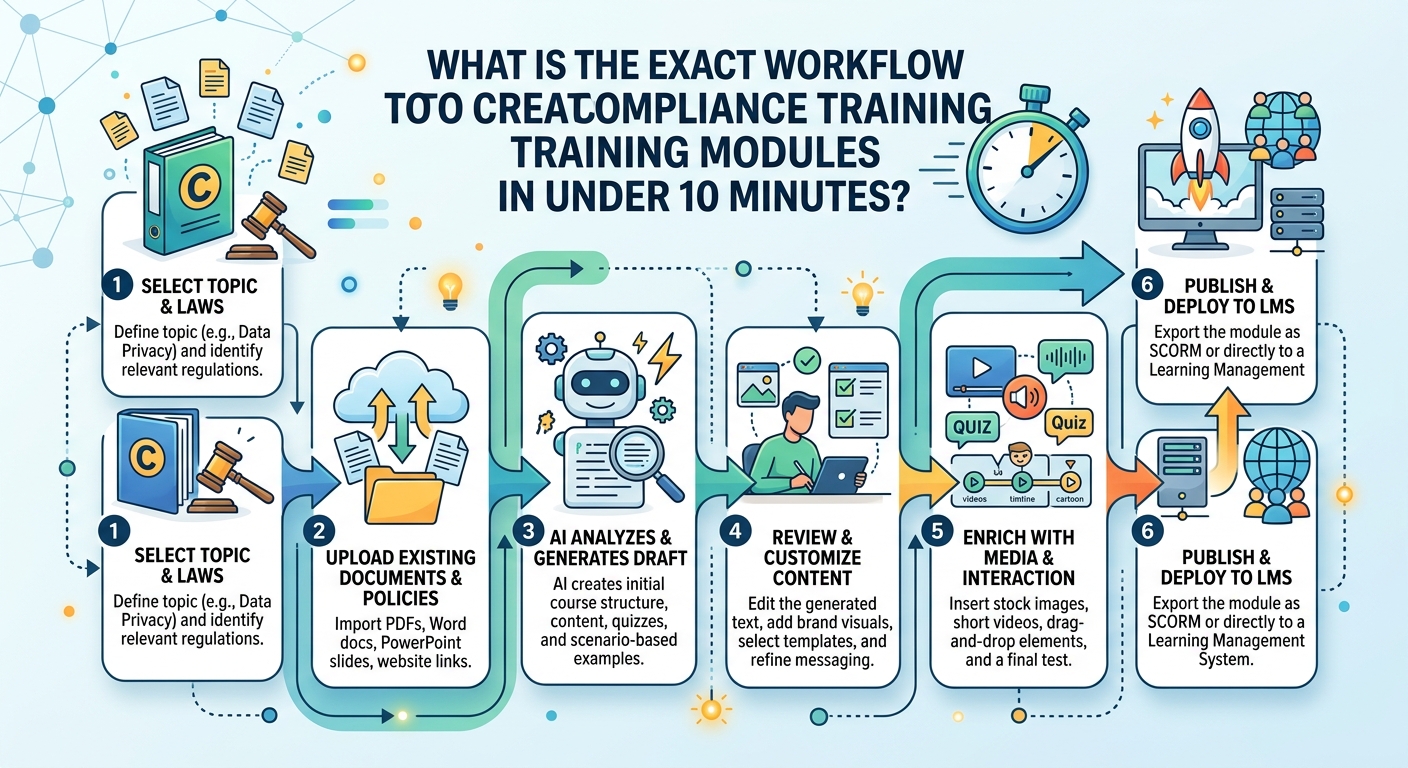
What Is the Exact Workflow to Create Compliance Training Modules in Under 10 Minutes?
For Vice Presidents, Directors, and Senior Managers in L&D, the phrase "compliance training" often conjures images of arduous content creation, lengthy review cycles, and disengaged learners. The traditional approach to developing these critical modules can be a significant drain on resources, time, and budget, especially when regulatory landscapes shift frequently. However, in today's fast-paced corporate environment across industries from Banking and Finance to Pharma and Oil and Gas, speed and efficiency are paramount. What if you could dramatically cut down the development time for effective compliance modules, ensuring your workforce remains informed and compliant without the usual headaches? This article unveils an exact workflow to create compliance training modules in under 10 minutes, leveraging cutting-edge technology and smart strategies that redefine what's possible for enterprise learning management.
The Persistent Challenge of Compliance Training Development
Compliance training is non-negotiable, a cornerstone of risk management for any organization. Yet, its creation often presents a unique set of challenges:
- Time-Consuming Content Development: Researching, writing, designing, and integrating legal nuances into digestible content is a laborious process.
- Rapid Regulatory Changes: Laws and industry standards evolve constantly, rendering existing modules outdated almost as soon as they're published.
- Learner Disengagement: Often perceived as a necessary evil, compliance training can suffer from low retention rates if not delivered engagingly.
- Scalability Issues: Tailoring content for different departments, roles, or geographical regions multiplies the effort exponentially.
These pain points make the prospect of creating new compliance modules feel overwhelming. But what if we told you that with the right learning management software and workflow, this burden could be transformed?
The 10-Minute Myth? Or a Strategic Reality?
To be clear, creating a comprehensive, enterprise-grade compliance course from absolute scratch in 10 minutes is not realistic. However, leveraging modern technology, particularly an advanced Microlearning LMS and AI Powered Authoring Tool, allows L&D teams to generate, adapt, and publish highly effective, relevant training modules in mere minutes, provided a foundation of content or a clear objective exists. This isn't about cutting corners; it's about optimizing every step of the workflow with intelligence and automation. The key lies in shifting from manual creation to intelligent curation, generation, and deployment.
The Exact Workflow: A Step-by-Step Guide to Rapid Compliance Module Creation
Here’s the precise workflow that enables L&D leaders to develop essential compliance training modules with unprecedented speed, ensuring your enterprise learning management system becomes a powerhouse of efficiency.
Step 1: Identify the Core Compliance Need (1 Minute)
Before anything else, pinpoint the exact regulation, policy update, or risk area that requires training. Is it a new data privacy law, an updated anti-money laundering guideline for the banking sector, or a safety protocol change in mining? Clarity here is crucial. The more specific the need, the faster the subsequent steps will be. A modern Microlearning LMS should allow for quick identification and tagging of these needs.
Step 2: Leverage Existing Content & Knowledge Base (1-2 Minutes)
You rarely start from zero. Your organization likely has internal policy documents, legal guidelines, previous training materials, or even FAQs. Input these relevant documents into your Learning content management system or a robust LCMS. The goal is to feed the system with foundational, accurate information that can be repurposed and updated. This initial ingestion is pivotal for the speed of the next step.
Step 3: AI-Powered Content Generation & Curation (2-3 Minutes)
This is where an AI Powered Authoring Tool shines. Using the core need and existing content identified, instruct the AI to draft a microlearning module. For example, "Create a 3-minute microlearning module on the new GDPR consent requirements, tailored for our marketing team, including 3 multiple-choice questions." The AI can rapidly generate text, scenarios, and quiz questions based on the provided inputs, transforming raw data into structured learning content. This capability is at the heart of swift compliance training module creation.
Step 4: Microlearning Design & Chunking (1 Minute)
The AI will naturally chunk content, but a quick human review ensures it aligns with microlearning principles. Are the topics bite-sized? Is each module focused on a single learning objective? Modern MaxLearn LMS solutions are designed to deliver content in short, digestible segments, which is ideal for compliance topics. This helps avoid cognitive overload and boosts retention, especially for complex regulations. The inherent design of a Microlearning LMS makes this step incredibly fast.
Step 5: Rapid Authoring & Customization (1-2 Minutes)
Review the AI-generated content within your AI Powered Authoring Tool. Make any necessary stylistic edits, add specific company examples, or refine the tone to match your brand. Drag-and-drop interfaces and pre-built templates found in leading learning management solutions make this customization phase incredibly efficient. You’re not building from scratch; you’re refining an AI-generated draft.
Step 6: Gamification & Engagement Hooks (30 Seconds)
Quickly add gamified elements. A Gamified LMS allows for the swift integration of points, badges, leaderboards, or simple interactive elements to boost engagement. This quick addition can significantly increase learner participation and the perceived value of the compliance training, turning a mundane requirement into an engaging experience.
Step 7: Quick Review & Publish (30 Seconds)
A rapid sanity check from a subject matter expert (SME) or legal counsel (if necessary, for critical updates) should be streamlined. Given the AI's precision and reliance on existing content, this review can often focus on accuracy rather than grammar or structure. Once approved, publish the module directly to your learning management system for immediate access by employees. A cloud based learning management system ensures instant global deployment.
Step 8: Adaptive Delivery & Feedback Loop (Ongoing)
With the module live, an Adaptive Learning platform monitors learner progress and understanding. If learners struggle with a concept, the system can automatically suggest additional resources or reinforcement. This ongoing optimization, managed by the lms learning management system, ensures the training remains effective and responsive to learner needs, reinforcing the benefits of intelligent learning management solutions.
Integrating Advanced Automation for Optimal Efficiency and Relevance
The true power behind this rapid workflow stems from intelligent automation. As L&D leaders, you're looking for systems that don't just host content but actively contribute to its creation and optimization. Consider these strategic questions:
Q: How can technology ensure our compliance training answers employees' most pressing questions, just as a search engine would predict their needs?
A: Advanced learning platforms with built-in analytical capabilities can analyze common queries, search terms within the MaxLearn LMS, and even support tickets related to compliance. An AI Powered Authoring Tool can then leverage this insight to proactively generate content that directly addresses these frequently asked questions, ensuring the training is highly relevant and anticipatory of learner needs. This effectively "optimizes" the content to deliver exactly what employees are looking for, boosting engagement and understanding.
Q: Can learning platforms adapt compliance content to specific regional regulations or industry nuances without manual overhaul?
A: Absolutely. Modern enterprise learning management systems are increasingly capable of dynamic content delivery. By tagging content with regional or industry-specific metadata, the system can automatically present the appropriate version of a compliance module to learners based on their profile (e.g., employee location, department, role). An Adaptive Learning system can even translate and localize content on the fly, ensuring global consistency with local relevance, all within your learning management software.
Q: Beyond content generation, how does advanced automation truly optimize the entire compliance training lifecycle?
A: Beyond content creation, advanced automation within an LMS optimizes scheduling, reminders, progress tracking, and reporting. It can identify high-risk areas based on assessment results, automate follow-up training for those who struggle, and provide predictive analytics on potential compliance gaps. This holistic optimization of the learning content management system reduces administrative burden, enhances learning effectiveness, and ensures ongoing adherence, making the entire process more efficient and impactful.
The Power of a Modern Learning Management System
Implementing this 10-minute workflow hinges on having the right technology. A cutting-edge MaxLearn LMS acts as the central nervous system for your compliance efforts. It provides the AI Powered Authoring Tool, supports Microlearning LMS delivery, facilitates Gamified LMS experiences, and enables Adaptive Learning paths. This unified platform ensures that your Risk-focused Training is not just fast to create, but also highly effective and easily manageable.
Conclusion
The days of lengthy, laborious compliance training development are giving way to an era of rapid, intelligent, and engaging solutions. By adopting this streamlined, technology-driven workflow, L&D leaders can transform compliance training from a dreaded chore into a swift, strategic advantage. Leveraging an advanced learning management system with AI capabilities empowers your team to respond to regulatory changes faster, keep employees better informed, and significantly reduce the time and resources spent on module creation. It's not just about saving time; it's about elevating your organization's compliance posture and fostering a culture of continuous learning and readiness. Embrace the future of compliance training – it’s faster, smarter, and more impactful than ever before.
.jpg)


