

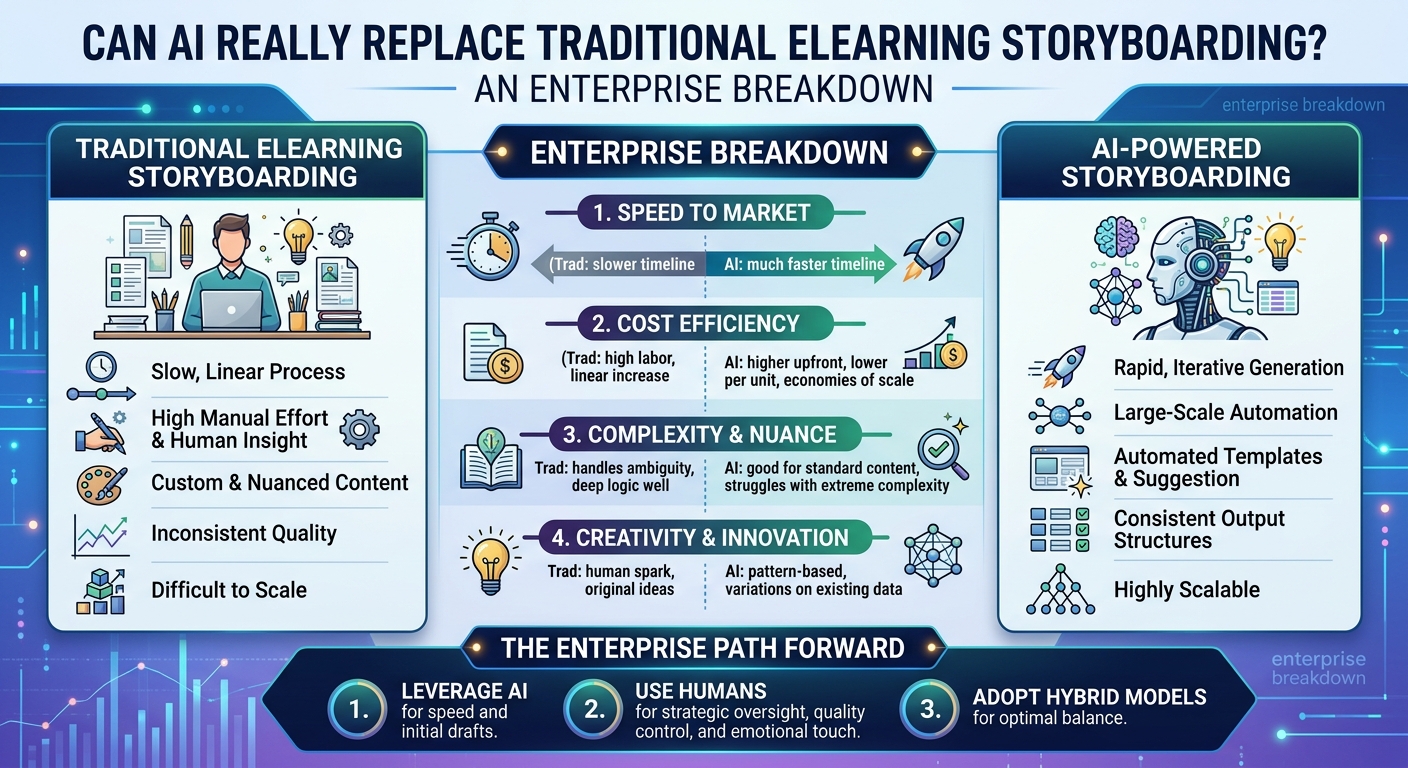
Can AI Really Replace Traditional eLearning Storyboarding? An Enterprise Breakdown
The landscape of corporate learning and development (L&D) is constantly evolving, driven by the twin demands of efficiency and effectiveness. In this era of rapid technological advancement, Artificial Intelligence (AI) has emerged as a disruptive force, promising to revolutionize everything from content creation to delivery. For L&D leaders across industries like Compliance, Sales, Banking, Finance, Insurance, Retail, Pharma, Healthcare, Hospitality, Oil and Gas, and Mining, a critical question arises: can AI truly replace traditional eLearning storyboarding, or is it merely a powerful co-pilot?
Storyboarding has long been the foundational blueprint for effective eLearning, painstakingly crafted to translate learning objectives into engaging, interactive experiences. It's a human-centric process, blending instructional design principles with creativity, empathy, and a deep understanding of the learner. But with the advent of sophisticated AI Powered Authoring Tool capabilities, many are wondering if the days of manual, labor-intensive storyboarding are numbered.
The Enduring Value of Traditional Storyboarding
Before delving into AI's potential, it's essential to appreciate the role traditional storyboarding plays in enterprise L&D. A well-crafted storyboard is more than just a script; it’s a detailed plan that outlines:
- Learning Objectives: Clearly defining what learners should know or be able to do.
- Content Flow and Structure: Organizing information logically and progressively.
- Interactivity: Specifying quizzes, simulations, drag-and-drop activities, and other engagement elements.
- Visuals and Audio: Describing graphics, animations, video clips, and narration.
- Branching Scenarios: Mapping out divergent paths based on learner choices, critical for complex subjects like Risk-focused Training.
- Accessibility Considerations: Ensuring content meets diverse learner needs.
This meticulous planning ensures alignment with business goals, regulatory compliance (especially in Banking, Pharma, and Healthcare), and overall instructional integrity. It's a collaborative effort, often involving instructional designers, subject matter experts (SMEs), and stakeholders.
AI's Disruptive Promise: What Can it Do?
AI's potential in the storyboarding process is undeniably compelling, offering solutions to common L&D pain points such as time constraints, budget limitations, and the need for personalized content. Here’s where AI shines:
- Content Generation: AI can rapidly generate initial drafts of scripts, quiz questions, and even entire module outlines based on provided learning objectives, keywords, and existing content.
- Personalization and Adaptive Learning: By analyzing learner data (performance, preferences, roles), AI can suggest or even create personalized learning paths and adapt content to individual needs, making learning more relevant and efficient.
- Efficiency and Scalability: Automating repetitive tasks—like formatting, checking for consistency, or generating multiple variations of a scenario—frees up instructional designers to focus on higher-order thinking and strategic planning. This is particularly valuable for organizations needing to scale training rapidly, perhaps through a Microlearning LMS.
- Data-Driven Insights: AI can analyze vast amounts of data to identify content gaps, predict learner struggles, and recommend optimal instructional strategies, moving beyond intuition to evidence-based design.
- Translation and Localization: For global enterprises in Hospitality, Oil and Gas, or international Banking, AI can significantly speed up the translation and localization of storyboards into multiple languages, ensuring cultural relevance.
The Enterprise Breakdown: Augmentation, Not Replacement
While AI offers incredible capabilities, the notion of it fully replacing traditional human storyboarding—especially in complex enterprise environments—is a significant leap. Most L&D leaders recognize that the future lies in a symbiotic relationship, where AI augments human expertise rather than supersedes it.
The Irreplaceable Human Element
For industries dealing with nuanced human interactions (Sales, Healthcare), high-stakes compliance (Banking, Pharma), or complex operational safety (Oil and Gas, Mining), human instructional designers bring:
- Empathy and Emotional Intelligence: Crafting narratives that resonate emotionally, build motivation, and address sensitive topics requires a human touch that AI currently lacks.
- Nuance and Contextual Understanding: Interpreting subtle shifts in policy, understanding corporate culture, or grasping the unwritten rules of an industry demands human contextual awareness.
- Critical Thinking and Creativity: While AI can generate options, true instructional innovation, creative problem-solving, and the ability to think outside predefined parameters remain distinctly human strengths. This is especially true for creating engaging elements like those found in a Gamified LMS.
- Subject Matter Expertise (SME) Validation: AI can process information, but it cannot intrinsically understand or validate the deep, specialized knowledge required in fields like Pharma R&D or advanced Financial derivatives. SMEs are crucial for accuracy and credibility.
- Ethical and Bias Considerations: Humans are essential in scrutinizing AI-generated content for potential biases, ensuring fairness, and maintaining ethical standards, particularly in sensitive areas like hiring or performance management training.
The Hybrid Model: Best of Both Worlds
The most effective strategy for enterprises integrating AI into their L&D processes will likely be a hybrid model. Imagine a workflow where:
- AI as the First Draft Engine: An AI-powered authoring tool rapidly generates initial storyboard outlines, content suggestions, and quiz questions based on inputs from SMEs and L&D teams.
- Human Refinement and Strategic Input: Instructional designers then review, refine, and enrich the AI's output, infusing it with human creativity, emotional depth, and strategic instructional choices. They ensure alignment with enterprise learning management goals and brand voice.
- Iterative Improvement: AI can then assist in reviewing the human-edited storyboard for consistency, grammar, and even suggesting alternative phrasing or visual ideas.
- Data-Driven Optimization: Post-deployment, AI can analyze learner performance within the learning management system (LMS) to provide insights, helping designers iterate and improve future storyboards.
This approach maximizes efficiency while preserving the critical human elements that make learning truly impactful. It leverages AI for what it does best – processing, generating, and analyzing – and humans for what they do best – creating, empathizing, and strategizing.
Addressing Key Enterprise Questions on AI and Storyboarding
Are organizations embracing artificial intelligence for their content development?
Yes, leading enterprises across various sectors are increasingly exploring and adopting AI tools to enhance their content development processes. This isn't about wholesale replacement, but rather using AI to accelerate content creation, improve personalization, and free up human designers for more complex, creative tasks. The goal is to make the entire learning content management system more efficient.
What considerations are there for deploying AI-driven storyboarding across different regions?
Deploying AI in a global context requires careful consideration of cultural nuances, language variations, and local regulations. While AI can aid in translation and localization, human oversight is crucial to ensure content is culturally appropriate, avoids unintended biases, and adheres to regional compliance standards. A robust LCMS (Learning Content Management System) with AI integration can help manage these complexities.
How does artificial intelligence enhance the instructional design process itself?
AI enhances instructional design by automating repetitive tasks, providing data-driven insights for improvement, and enabling a higher degree of personalization. It allows instructional designers to focus more on strategic thinking, creative problem-solving, and developing engaging learning experiences, rather than getting bogged down in manual content generation or formatting. This leads to more dynamic and effective learning management software implementations.
The Future is Collaborative
For L&D professionals, VPs, Directors, Senior Managers, and Managers, the critical takeaway is this: AI is not coming to take over storyboarding; it's coming to collaborate. The true power of AI in enterprise eLearning lies in its ability to amplify human capabilities, driving unprecedented efficiency and personalization in a cloud based learning management system. By embracing a hybrid approach that marries AI's speed and analytical prowess with human creativity and empathy, organizations can build more impactful, engaging, and scalable learning solutions.
The strategic deployment of AI in storyboarding will be a differentiator for enterprises seeking to stay competitive, agile, and effective in their talent development. It’s about leveraging advanced learning management solutions to empower L&D teams to deliver higher quality, more relevant training than ever before. Explore how platforms like MaxLearn LMS are integrating these capabilities to transform your lms learning management system experience.
.jpg)


