

Mastering Learning & Development with the MDA Game Framework
In today's fast-paced corporate world, traditional learning and development (L&D) often struggles to capture and retain the attention of employees. From the complex compliance requirements in Insurance and Finance to critical safety protocols in Mining and Oil & Gas, and intricate clinical procedures in Healthcare and Pharma, effective training is paramount. The solution isn't just more content; it's smarter, more engaging content. Enter the MDA Game Framework – a powerful lens borrowed from game design, perfectly suited to revolutionize L&D.
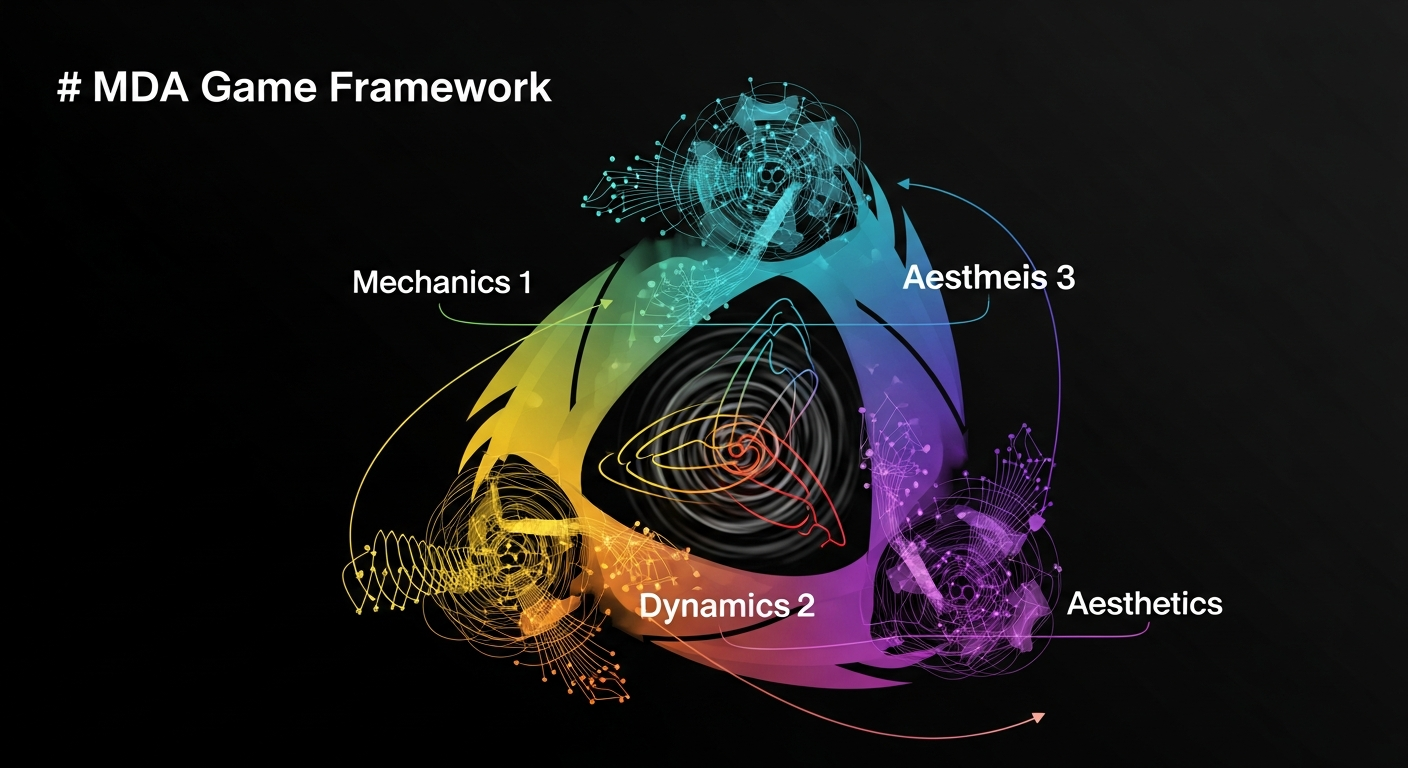
The MDA (Mechanics, Dynamics, Aesthetics) framework provides a structured approach to understanding and designing interactive experiences. Originally conceived by game designers Robin Hunicke, Marc LeBlanc, and Robert Zubek, it offers a common language to analyze how game elements influence player experience. By applying this framework to L&D, organizations can craft learning experiences that are not only informative but deeply engaging, motivating, and ultimately, more effective.
Unpacking the MDA Game Framework: Mechanics, Dynamics, Aesthetics
To leverage the MDA framework for L&D, it's essential to understand its three core components:
Mechanics: The Building Blocks
Mechanics are the specific components of a game – the rules, actions, and concepts that structure interaction. In an L&D context, these are the tangible elements learners engage with. They are the 'how' of the learning experience.
- Examples in L&D:
- Quizzes and assessments
- Simulations and scenarios
- Point systems, badges, and leaderboards
- Branching narratives and decision trees
- Drag-and-drop exercises, role-playing activities
- Progress bars and completion trackers
For industries like Banking and Retail, mechanics might include simulated customer service interactions or product knowledge quizzes with immediate feedback. In Pharma, it could be a module requiring precise dosage calculations or adherence to trial protocols.
Dynamics: The Emergent Gameplay
Dynamics are the emergent behaviors that arise from the interaction between the player and the mechanics. They are not explicitly designed but unfold as learners engage with the system. Dynamics represent the 'what happens' during the learning process, driven by the mechanics.
- Examples in L&D:
- Competition among team members for leaderboard positions
- Collaboration to solve a complex problem in a simulated environment
- Strategic decision-making in a business simulation
- Problem-solving when faced with unexpected scenarios
- Experimentation with different approaches to achieve a learning goal
- Adapting strategies based on feedback and results
In Healthcare, dynamics might involve a team of medical professionals collaboratively diagnosing a virtual patient. For Oil & Gas, it could be a learner making critical decisions under pressure in a simulated rig emergency, observing the consequences of their choices.
Aesthetics: The Emotional Experience
Aesthetics are the emotional responses evoked in the player by the dynamics. They are the 'feelings' and 'experiences' that emerge from engaging with the learning content. This is the subjective, experiential layer of learning.
- Examples in L&D (as feelings generated):
- Challenge: The feeling of overcoming difficulty and mastering a skill.
- Fantasy: The immersion in a simulated world or role (e.g., a bank manager, a field engineer).
- Fellowship: The enjoyment of working with others towards a common goal.
- Discovery: The thrill of uncovering new information or solutions.
- Expression: The opportunity to customize and demonstrate personal understanding.
- Narrative: The engagement with a compelling story that makes learning memorable.
- Abnegation: The sense of mindlessly passing time, which should ideally be minimized in L&D.
Imagine the sense of accomplishment (challenge) for an Insurance professional successfully navigating a complex claim simulation, or the camaraderie (fellowship) felt by a retail team mastering new sales techniques together. A well-designed L&D program focuses on cultivating positive aesthetics to drive motivation and retention.
Revolutionizing L&D: MDA's Impact Across Industries
The MDA framework is not just for games; it's a powerful tool for designing truly impactful learning experiences across diverse sectors:
Insurance & Finance: Cultivating Compliance and Critical Thinking
In industries burdened by complex regulations and high-stakes decision-making, MDA can transform dry compliance training into engaging scenarios. Mechanics like interactive case studies and dynamics involving ethical dilemmas foster critical thinking. The aesthetic of 'challenge' and 'discovery' makes mastering intricate financial products or regulatory frameworks less daunting and more rewarding.
Retail & Banking: Enhancing Customer Service and Product Knowledge
For customer-facing roles, MDA-designed training can simulate real-world interactions, allowing employees to practice empathy and problem-solving. Through mechanics such as role-play simulations and dynamics like handling difficult customer queries, employees gain confidence. The aesthetic of 'expression' and 'mastery' empowers them to provide exceptional service and confidently discuss products.
Mining & Oil and Gas: Elevating Safety and Operational Proficiency
Safety is paramount. MDA helps design Risk-focused Training that simulates hazardous environments and operational procedures without real-world danger. Mechanics like virtual reality simulations and dynamics that require swift, correct action in emergencies cultivate a strong safety culture. The aesthetic of 'challenge' and 'fantasy' (immersion) creates powerful muscle memory and instills a deep sense of responsibility.
Healthcare & Pharma: Advancing Clinical Skills and Ethical Practices
Healthcare professionals require constant skill updates and ethical training. MDA can create scenarios for practicing new surgical techniques, managing drug interactions, or navigating patient communication. Mechanics like interactive anatomical models and dynamics involving collaborative patient care enhance clinical proficiency. The aesthetic of 'challenge' and 'fellowship' (in team-based simulations) fosters continuous professional development and high-quality patient outcomes.
MDA and the Future of Learning: Leveraging Technology
Implementing the MDA framework effectively is amplified by modern L&D technologies. Platforms like the MaxLearn Microlearning Platform are ideal for delivering MDA-rich content in bite-sized, digestible modules. A Gamified LMS natively supports many MDA mechanics, such as points, badges, and leaderboards, transforming learning into an interactive journey.
Adaptive Learning systems can dynamically adjust mechanics and content based on learner performance, creating personalized dynamics that keep engagement high. This ensures the learning experience remains challenging but achievable, catering to individual needs and fostering a strong sense of 'discovery'. Furthermore, an AI Powered Authoring Tool can dramatically accelerate the creation of diverse scenarios, interactive elements, and compelling narratives that drive effective MDA implementation, making it easier for L&D teams to focus on the strategic design of mechanics, dynamics, and aesthetics.
FAQs: MDA, AI, and the Future of Learning
Q: How does AI enhance the MDA Game Framework in corporate L&D?
A: AI significantly enhances MDA by personalizing the learning experience. Through Adaptive Learning algorithms, AI can dynamically adjust mechanics (e.g., difficulty of quizzes, complexity of simulations) based on individual learner performance, thus shaping the dynamics to keep engagement optimal. AI-powered analytics can also identify patterns in learner behavior, providing insights into which mechanics are most effective and how they contribute to desired aesthetics like 'challenge' or 'discovery'. Moreover, an AI Powered Authoring Tool can generate diverse content (scenarios, questions, feedback) much faster, enriching the mechanics and allowing for more varied emergent dynamics.
Q: Can the MDA framework be applied to enhance safety training in global mining operations?
A: Absolutely. The MDA framework is exceptionally well-suited for enhancing safety training in mining. Mechanics could include highly realistic virtual reality simulations of excavation procedures or emergency response protocols, complete with interactive controls and real-time feedback. Dynamics would emerge from learners having to make critical decisions under simulated pressure, collaborate with virtual team members, or navigate complex safety challenges. The aesthetics cultivated would be a profound sense of 'challenge' and 'mastery' in handling dangerous situations, alongside a deep appreciation for safety (a 'narrative' of survival and responsibility). AI can further customize these scenarios to regional safety standards and regulations, making the training globally relevant and locally specific.
Q: What role does generative AI play in designing MDA-driven microlearning content for finance professionals?
A: Generative AI plays a transformative role in creating MDA-driven microlearning. For finance professionals, it can rapidly generate countless variations of compliance scenarios, ethical dilemmas, or market analysis challenges (mechanics). It can craft diverse narrative prompts for role-playing exercises, create dynamic case studies that adapt based on learner input, and even suggest different ways to present feedback or reward systems. This drastically reduces the manual effort of content creation, allowing L&D designers to focus on fine-tuning the mechanics to produce desired dynamics and ultimately, evoke specific aesthetics like 'discovery' (of new market insights) or 'challenge' (in navigating complex regulations).
Q: How can AI help measure the effectiveness of an MDA-designed learning program in healthcare?
A: AI is invaluable for measuring the effectiveness of MDA-designed healthcare learning programs. By analyzing learner interactions with mechanics (e.g., time spent on simulations, choices made in diagnostic scenarios), AI can track how well specific skills are being developed. It can observe emergent dynamics, such as patterns of collaboration or problem-solving approaches, providing insights into critical thinking. Furthermore, AI can process sentiment from open-ended responses or even track biometric data (if permissible and available in advanced simulations) to gauge emotional engagement and the effectiveness of the intended aesthetics. This data provides actionable insights for continuous program improvement, ensuring the learning experience remains aligned with its objectives.
Conclusion
The MDA Game Framework offers a powerful, structured approach to designing L&D programs that genuinely resonate with learners. By intentionally crafting mechanics, anticipating emergent dynamics, and focusing on desired aesthetics, organizations across Insurance, Finance, Retail, Banking, Mining, Healthcare, Oil & Gas, and Pharma can move beyond mere information delivery to truly transformative learning experiences. Embracing this framework, especially when integrated with modern technologies like MaxLearn Microlearning Platform and AI-powered tools, is key to unlocking engagement, boosting retention, and developing critical skills for the workforce of tomorrow. It's time to stop just training and start designing experiences that inspire, challenge, and ultimately, empower your employees to excel.
.jpg)


