

Visual-Spatial vs. Logical-Mathematical Learners: Optimizing Bite-Sized Content Formats for L&D Success
In the dynamic landscape of corporate learning and development, L&D Vice Presidents, Directors, Senior Managers, and Managers face the constant challenge of engaging a diverse workforce. Your teams, whether in Compliance, Sales, Banking, Finance, Insurance, Retail, Pharma, Healthcare, Hospitality, Oil and Gas, or Mining, are composed of individuals with unique cognitive preferences. Understanding these preferences is not just beneficial; it's critical for maximizing the impact of your training initiatives. This article delves into the distinct learning styles of Visual-Spatial and Logical-Mathematical learners and how to optimize Microlearning LMS content formats to resonate with both, ensuring higher engagement, retention, and performance across your enterprise.
Understanding Your Learners: A Foundation for Effective Training
Effective training begins with a deep appreciation for how different people process information. While individuals rarely fit neatly into a single category, recognizing dominant learning preferences allows L&D leaders to craft more targeted and impactful content.
The Visual-Spatial Learner: Seeing the Big Picture
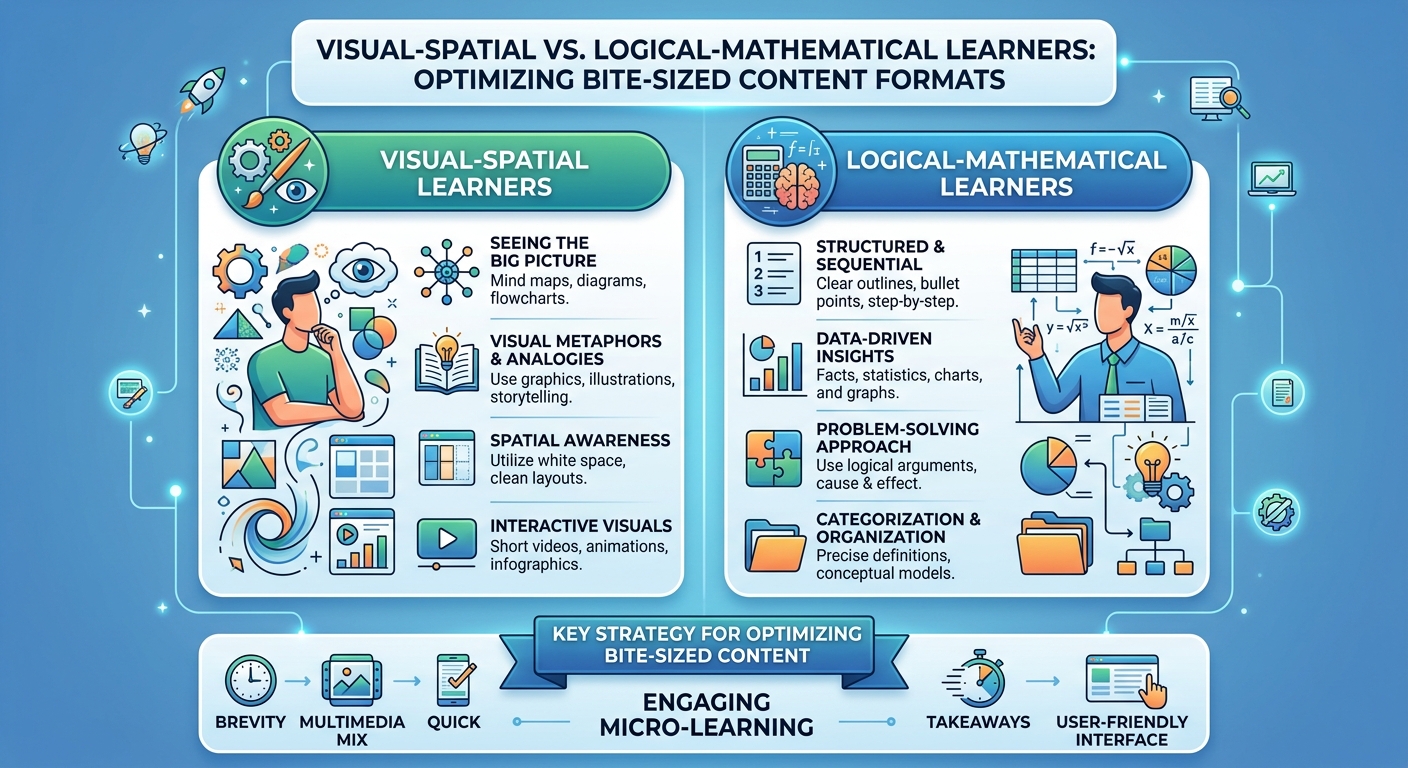
Visual-Spatial learners thrive on imagery, patterns, and understanding concepts through visual representation. They often think in pictures and find it easier to grasp complex ideas when presented graphically. For these learners, traditional text-heavy modules can be disengaging and lead to poor retention. They excel with:
- Diagrams, charts, and graphs
- Videos, animations, and simulations
- Interactive maps, flowcharts, and mind maps
- Visual metaphors and storytelling through images
These learners are often strong at problem-solving if they can visualize the problem and its potential solutions. They often prefer to see how parts fit into a whole before diving into specifics.
The Logical-Mathematical Learner: Analyzing and Problem-Solving
Logical-Mathematical learners are driven by reason, structure, and data. They prefer to understand the "why" behind concepts and thrive on sequential information, patterns, and logical relationships. For these individuals, abstract or purely visual content without a clear underlying structure can be frustrating. They excel with:
- Data analysis, statistics, and logical proofs
- Sequential problem-solving tasks and case studies
- Deductive reasoning, algorithms, and process flows
- Quizzes and challenges that require critical thinking
These learners typically appreciate clear objectives, step-by-step instructions, and opportunities to apply rules and principles. They often enjoy breaking down problems into manageable, logical components.
The Power of Bite-Sized Content in Modern L&D
Regardless of learning style, the modern professional operates with limited time and attention. This is where bite-sized content, or microlearning, shines. Delivering information in short, focused bursts (typically 3-7 minutes) significantly improves engagement and knowledge retention. This approach is highly effective for just-in-time learning, performance support, and continuous professional development across all industries, from critical Risk-focused Training in Banking to product knowledge updates in Retail.
A robust learning content management system designed for microlearning can house a diverse library of such content, ensuring learners can access what they need, when they need it, in formats that suit them best. The best learning management solutions empower L&D teams to deploy adaptive, flexible, and highly engaging training experiences.
Optimizing Bite-Sized Content for Visual-Spatial Learners
For your visual-spatial teams, emphasize content formats that leverage their natural inclination to "see" information:
- Short Explainer Videos: Crisp, animated videos demonstrating processes, product features, or compliance procedures.
- Infographics: Condense complex data or step-by-step guides into visually appealing infographics.
- Interactive Simulations: Allow learners to virtually manipulate objects or navigate scenarios, especially useful for equipment training in Oil & Gas or customer service role-plays in Hospitality.
- Visual Storytelling: Use compelling images and short narratives to explain concepts, making abstract ideas more concrete.
- Flowcharts and Diagrams: Clearly map out decision trees, workflows, or organizational structures.
Incorporating a Gamified LMS can further boost engagement by adding visual rewards, progress bars, and leaderboard elements that appeal to their desire for visual feedback and achievement.
Optimizing Bite-Sized Content for Logical-Mathematical Learners
To cater to your logical-mathematical thinkers, structure content to highlight patterns, data, and cause-and-effect relationships:
- Problem-Solving Scenarios: Present bite-sized challenges that require logical deduction, e.g., identifying a compliance breach based on provided data, or troubleshooting a sales objection.
- Data Mini-Cases: Offer a small dataset and ask learners to analyze it to draw conclusions relevant to their role, such as financial risk assessment in Banking or clinical trial data interpretation in Pharma.
- Decision-Tree Quizzes: Use interactive quizzes that follow a logical path, providing immediate feedback based on reasoned choices.
- Structured Summaries: Offer bullet-point summaries that outline key facts, principles, and their implications.
- Process Walkthroughs: Provide clear, sequential guides for procedures, emphasizing the "if this, then that" logic.
Adaptive Learning platforms are exceptionally effective here, as they can tailor the sequence and depth of content based on a learner's demonstrated understanding, guiding them through a logical progression of knowledge.
Bridging the Gap: Content Strategies for Both Learning Styles
The most effective enterprise learning programs will seamlessly integrate elements that appeal to both learning styles. This ensures inclusivity and maximizes reach across your diverse workforce:
- Visuals with Explanations: Pair infographics and diagrams with concise, logical explanations. Show the process visually, then explain the underlying principles.
- Interactive Scenarios: Design scenarios that require both visual interpretation (e.g., analyzing a dashboard) and logical deduction (e.g., deciding the next best action based on the data).
- Case Studies with Mixed Media: Present a real-world problem using a short video clip (visual) followed by a data table and questions requiring logical analysis.
- Annotated Screenshots/Walkthroughs: For software training or system usage, use screenshots with clear, sequential annotations and explanations.
An AI Powered Authoring Tool can be instrumental in creating and managing this blended content, allowing L&D teams to quickly adapt and personalize learning paths. This is particularly valuable for complex subjects like compliance, where both visual clarity of regulations and logical application of rules are crucial.
AI-Driven Insights for Enhanced Learning Personalization
As L&D leaders, you're constantly seeking ways to make training more intelligent and impactful. Artificial intelligence and machine learning are transforming how we understand and cater to individual learning needs.
How can artificial intelligence personalize learning paths for diverse learners?
AI analyzes learner engagement data, performance metrics, and preferred content formats. By identifying patterns unique to each learner, AI can dynamically recommend specific bite-sized modules, even suggesting whether a video, infographic, or problem-solving quiz would be most effective for a given topic.
What role does machine learning play in optimizing content delivery based on individual learning styles?
Machine learning algorithms continuously learn from interactions. If a learner consistently performs better after watching animated explainers, the system can prioritize visual content for them. Conversely, if another learner excels with data-driven challenges, the platform will offer more of that specific format, truly optimizing content delivery.
Can intelligent systems predict which content format will be most effective for a particular learning objective or learner profile?
Absolutely. By leveraging vast amounts of historical data—including learner demographics, past performance, and content engagement—intelligent systems can build predictive models. These models can anticipate the optimal content format for achieving specific learning outcomes, especially valuable for time-sensitive training in areas like Sales or critical updates in Healthcare.
How do cutting-edge analytics assist in evaluating the impact of different content formats on various learner types across global teams?
Advanced analytics platforms, often integrated into modern enterprise learning management systems, track granular data points: completion rates, time spent, quiz scores, and content preferences. This allows L&D to compare the effectiveness of visual versus logical content across different regions, roles, or industries (e.g., comparing Pharma sales reps' engagement with product videos versus detailed data sheets), ensuring strategies are regionally and culturally optimized.
How can AI-driven platforms help us identify skills gaps and recommend specific, bite-sized modules to address them?
By constantly monitoring learner performance and progress, AI can pinpoint precise skill deficiencies. Once a gap is identified, the system can instantly suggest highly targeted, bite-sized learning modules—in the most suitable format for that individual learner—to close that specific gap, providing hyper-relevant and efficient reskilling or upskilling.
Implementing an Effective Learning Management System
To truly optimize for both Visual-Spatial and Logical-Mathematical learners using bite-sized content, you need a powerful LMS. A modern lms learning management system like MaxLearn LMS offers the flexibility, scalability, and features necessary to deliver engaging training across your organization. Look for a cloud based learning management system that supports a wide array of multimedia formats, offers robust analytics, and preferably includes AI-driven capabilities for personalization. An effective LCMS ensures that content creation, delivery, and management are streamlined, allowing your L&D team to focus on strategic impact rather than administrative burden.
Conclusion
Empowering your workforce means meeting them where they are, cognitively speaking. By understanding the distinct needs of Visual-Spatial and Logical-Mathematical learners and strategically deploying optimized, bite-sized content, L&D leaders can transform corporate training from a one-size-fits-all approach to a personalized, highly effective experience. Leveraging advanced learning management software and the power of AI to create and deliver diverse content will not only boost engagement and retention but also directly contribute to improved performance and business outcomes across your entire organization.
.jpg)


