

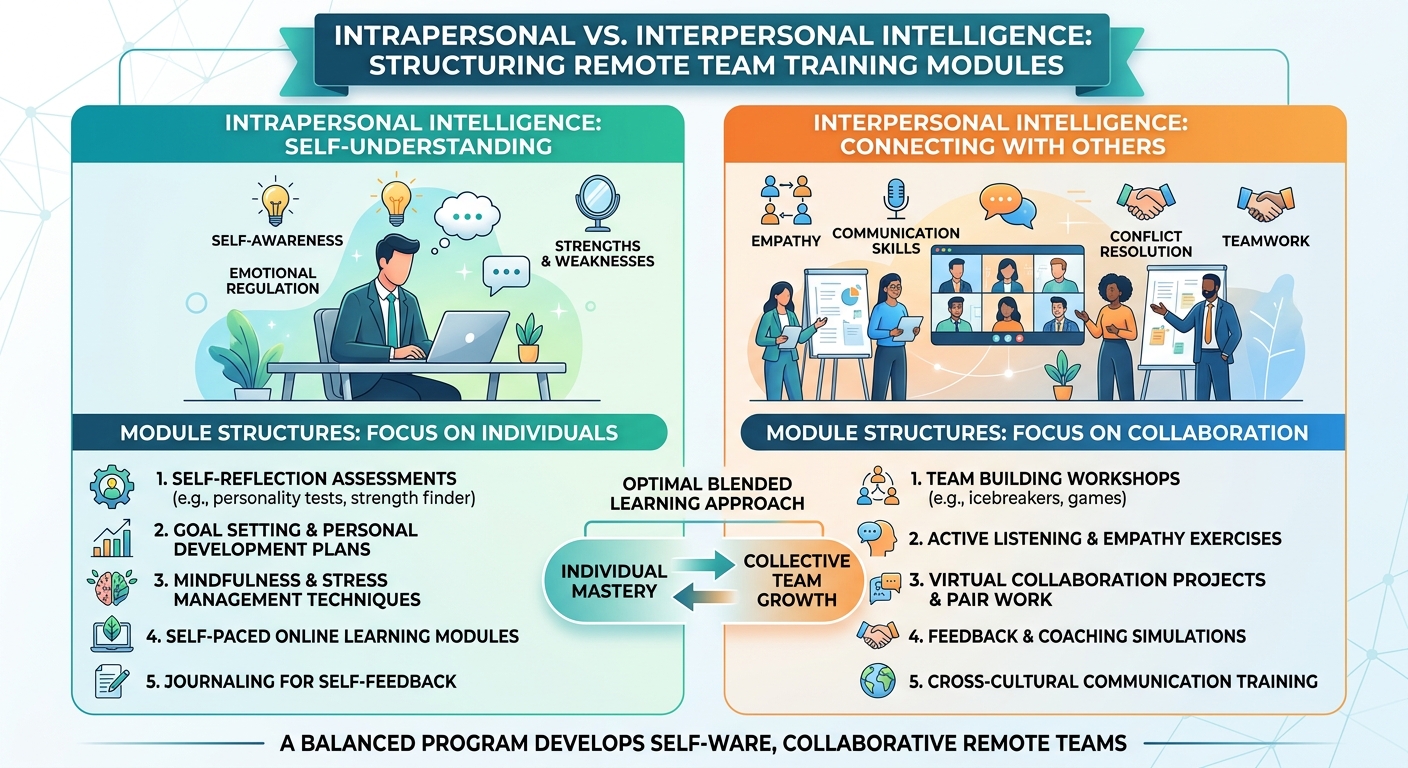
Intrapersonal vs. Interpersonal Intelligence: Structuring Remote Team Training Modules
In the evolving landscape of remote work, the dynamics of team collaboration and individual productivity have shifted dramatically. For L&D leaders, understanding and nurturing both intrapersonal and interpersonal intelligence is not just beneficial—it's critical for building resilient, high-performing virtual teams. As Vice Presidents, Directors, and Senior Managers of Learning & Development, you face the unique challenge of designing training modules that effectively bridge the gap between individual efficacy and collective synergy, all within a distributed environment.
This article delves into the nuances of intrapersonal and interpersonal intelligence, exploring their distinct roles in remote settings and outlining how to structure robust remote team training modules that cater to both. We’ll also examine how cutting-edge eLearning solutions, including a sophisticated Microlearning LMS, can empower your organization to foster these crucial competencies across diverse industries, from Compliance and Banking to Sales and Healthcare.
Understanding Intrapersonal Intelligence in a Remote Context
Intrapersonal intelligence, often referred to as 'self-smart,' encompasses an individual's capacity for self-awareness, self-reflection, self-motivation, and self-regulation. It's the ability to understand one's own emotions, motivations, and goals, and to use this understanding to guide behavior. In a remote work setting, strong intrapersonal intelligence becomes paramount.
Challenges and Opportunities Remotely:
- Increased Autonomy: Remote work often demands higher levels of self-discipline and initiative. Individuals must manage their time, tasks, and energy without constant oversight.
- Managing Isolation: The absence of daily office interactions can lead to feelings of isolation. Intrapersonally intelligent individuals are better equipped to manage their emotional states and maintain motivation.
- Self-Directed Learning: A robust intrapersonal foundation supports individuals in taking ownership of their professional development, making the most of self-paced learning content management system modules.
For L&D, fostering intrapersonal intelligence means equipping employees with tools for personal effectiveness, resilience, and growth. This can involve training on time management, stress reduction, goal setting, and emotional regulation, all delivered through engaging learning management software.
Understanding Interpersonal Intelligence in a Remote Context
Interpersonal intelligence, or 'people-smart,' involves the ability to understand, interact, and work effectively with others. It includes skills like empathy, communication, collaboration, conflict resolution, and leadership. In remote teams, where physical cues are absent and communication is often mediated by technology, strong interpersonal intelligence is more vital than ever.
Challenges and Opportunities Remotely:
- Communication Gaps: Remote teams frequently struggle with misinterpretations due to a lack of non-verbal cues. Clear, empathetic, and concise virtual communication is essential.
- Building Trust: Establishing and maintaining trust among remote team members requires intentional effort and strong interpersonal skills from every individual.
- Virtual Collaboration: Effective collaboration on shared projects demands an understanding of team dynamics and the ability to contribute constructively in a digital space.
Training for interpersonal intelligence remotely involves creating scenarios that mimic real-world interactions, encouraging peer feedback, and utilizing collaborative learning management solutions to facilitate group activities. An enterprise learning management system can be instrumental in delivering these complex modules.
The L&D Imperative: Tailoring Training for Both
Neither intrapersonal nor interpersonal intelligence can be effectively developed in isolation, especially in a remote context. A holistic approach is crucial. Your remote team training modules must be designed to enhance individual self-mastery while simultaneously bolstering collaborative capabilities. This is where a strategic approach to elearning, powered by a flexible and comprehensive learning management system (LMS), truly shines.
The right Microlearning LMS allows L&D teams to create tailored learning paths that address both dimensions. For instance, a Compliance officer needs strong intrapersonal skills to maintain integrity and focus on complex regulations, alongside excellent interpersonal skills to explain policies and collaborate on investigations. Similarly, a Sales professional needs self-motivation (intrapersonal) to hit targets and empathy (interpersonal) to understand customer needs. A modern cloud based learning management system can deliver this dual focus effectively.
Key Strategies for Structuring Remote Team Training Modules
Personalized Learning Paths with Adaptive Technology
To cater to individual needs for intrapersonal growth, deploy Adaptive Learning technologies. These systems analyze a learner's performance and preferences, adjusting content difficulty and pace accordingly. This ensures each employee receives training that is most relevant to their development areas, fostering greater self-awareness and self-improvement.
Interactive and Collaborative Tools
For interpersonal skill development, utilize features within your learning management system that promote interaction. This includes virtual breakout rooms, discussion forums, and collaborative project simulations. A Gamified LMS can also boost engagement in team challenges, encouraging healthy competition and cooperation.
Self-Reflection and Mindfulness Exercises
Integrate modules focused on mindfulness, journaling, and self-assessment to cultivate intrapersonal intelligence. These can be short, guided exercises accessible through the LMS, encouraging employees to regularly reflect on their emotional states, decision-making processes, and goal progression.
Scenario-Based and Risk-focused Training
Many industries, particularly Banking, Finance, Insurance, Pharma, and Oil and Gas, require robust training around complex scenarios and potential risks. Scenario-based training, enhanced with realistic simulations, allows employees to practice interpersonal skills like negotiation, de-escalation, and ethical decision-making in a safe environment. This is also vital for Compliance and Healthcare, where the stakes are incredibly high.
Leveraging Advanced Authoring and AI
An AI Powered Authoring Tool can significantly streamline the creation of diverse and engaging content. From interactive quizzes to branching scenarios and personalized feedback mechanisms, AI can help L&D teams rapidly develop high-quality learning content that targets specific intrapersonal and interpersonal competencies. This efficiency is key for managing a comprehensive learning management system (LCMS).
Addressing Key Questions in eLearning for Remote Teams
As L&D leaders navigate the complexities of remote learning, several strategic questions emerge:
How can advanced algorithms personalize learning experiences to cater to individual strengths and weaknesses in remote teams?
Intelligent systems can analyze performance data, learning styles, and job roles to dynamically curate content. By identifying gaps in intrapersonal skills (e.g., self-motivation) or interpersonal skills (e.g., virtual collaboration), these systems can recommend specific modules, resources, or even peer-coaching opportunities, ensuring each learner's journey is optimally structured for their unique needs. This level of personalization is a hallmark of an advanced LMS learning management system.
What strategies can be employed to ensure training content resonates across diverse global remote teams, accounting for cultural differences and varying access levels?
Developing culturally sensitive content, offering multilingual options, and ensuring accessibility across various devices and internet speeds are crucial. Intelligent platforms can also adapt content delivery based on geographical location, providing relevant case studies or examples that resonate with local contexts. Establishing clear, universal communication protocols within the training itself also helps bridge cultural divides, fostering stronger interpersonal connections.
In what ways can intelligent systems analyze performance data to provide targeted interventions, enhancing both individual and team effectiveness in a virtual environment?
By tracking completion rates, quiz scores, interaction patterns, and simulation outcomes, intelligent platforms can pinpoint areas where individuals or teams struggle. For instance, if a team consistently underperforms in collaborative virtual projects, the system can flag it and recommend targeted interpersonal communication modules. On an individual level, if a learner shows low engagement with self-paced modules, the system might suggest intrapersonal strategies for motivation or time management. This data-driven approach allows for precise and timely interventions, maximizing the impact of your MaxLearn LMS investment.
Conclusion
Structuring remote team training modules that effectively cultivate both intrapersonal and interpersonal intelligence is a complex yet rewarding endeavor for L&D professionals. By embracing a balanced approach and leveraging the power of modern eLearning platforms, organizations can empower their remote workforce to thrive. A robust learning management system, particularly one offering Microlearning LMS capabilities, Gamified LMS features, and AI Powered Authoring Tool integration, is no longer a luxury but a strategic necessity. It enables the delivery of Adaptive Learning and Risk-focused Training crucial for industries from Retail to Mining.
Investing in a comprehensive learning management system not only enhances individual capabilities but also strengthens team cohesion and overall organizational resilience in the remote era. For L&D leaders committed to excellence, the path forward involves intelligently designed training that nurtures both the inner world of the individual and their interactions with the collective, all facilitated by state-of-the-art eLearning technology like the MaxLearn LMS.
.jpg)


