

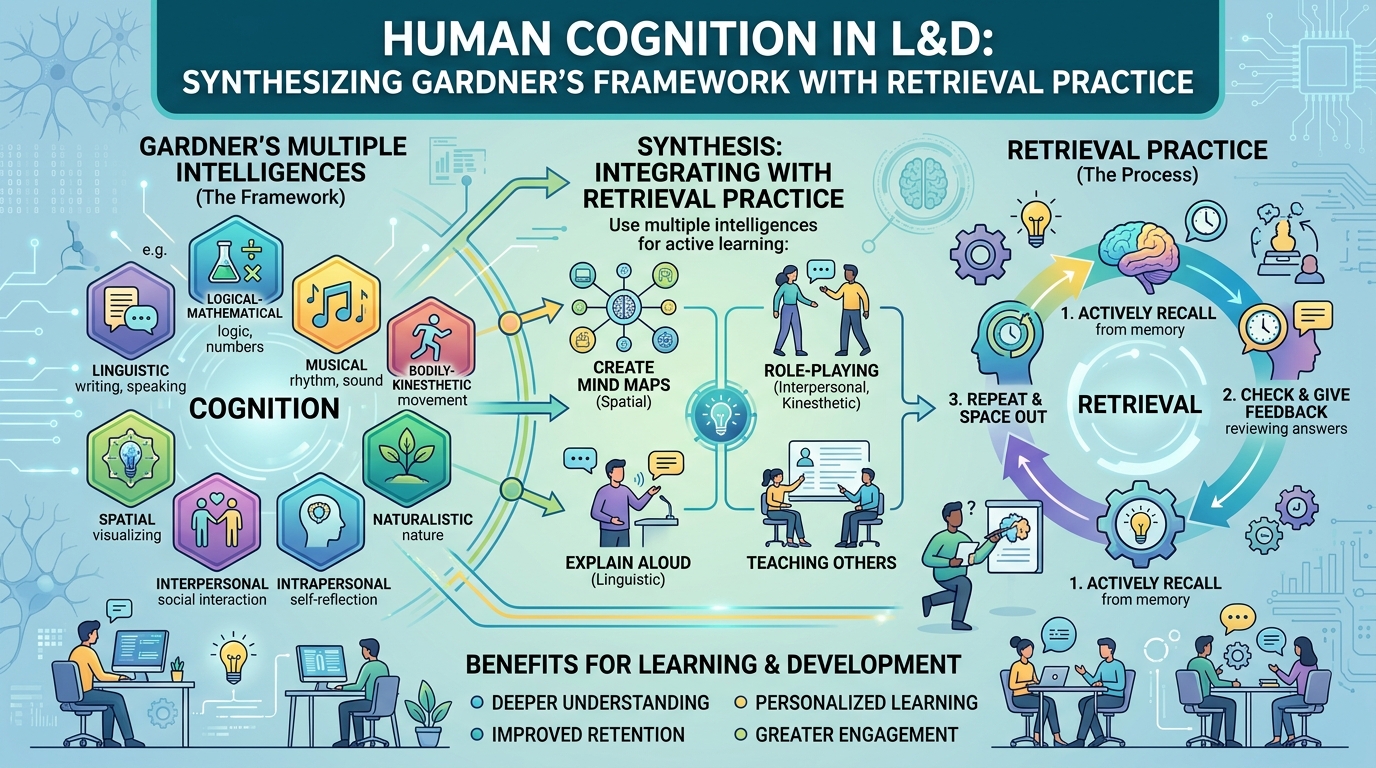
Human Cognition in L&D: Synthesizing Gardner's Framework with Retrieval Practice for Enhanced Learning Outcomes
As L&D leaders, you navigate a complex landscape of evolving skill requirements, technological advancements, and a diverse workforce. The core challenge remains constant: how do we ensure effective learning that sticks, driving tangible business results? The answer lies not just in what we teach, but how we understand the very mechanics of human learning. This article delves into the powerful synergy between Howard Gardner's Theory of Multiple Intelligences and the scientifically-backed strategy of Retrieval Practice, offering a blueprint for crafting more engaging, effective, and inclusive learning experiences.
In today's fast-paced environment, merely delivering content is insufficient. To truly impact performance in sectors like compliance, sales, banking, finance, insurance, retail, pharma, healthcare, hospitality, oil and gas, and mining, L&D strategies must be deeply rooted in cognitive science. By understanding how individuals process information and retain knowledge, we can move beyond generic training to create impactful, personalized journeys.
The Foundation: Understanding Diverse Ways of Knowing
Gardner's Theory of Multiple Intelligences in the Workplace
Howard Gardner’s groundbreaking theory posits that intelligence is not a single, monolithic entity, but rather a collection of distinct, independent intelligences. While often discussed in educational contexts, its implications for workplace learning are profound. Traditional L&D often leans heavily on verbal-linguistic and logical-mathematical intelligences, assuming a one-size-fits-all approach. However, a workforce is a tapestry of varied strengths, and recognizing these can unlock unprecedented learning potential. Consider:
- Verbal-Linguistic Intelligence: Proficient with words, language, and communication. These learners thrive with written materials, lectures, and discussions.
- Logical-Mathematical Intelligence: Excel at reasoning, problem-solving, and abstract thinking. They prefer data analysis, puzzles, and structured challenges.
- Spatial Intelligence: Strong visualizers, comfortable with maps, diagrams, and physical space. They learn best through graphics, simulations, and virtual environments.
- Bodily-Kinesthetic Intelligence: Learn by doing, through movement and physical activity. Role-playing, hands-on tasks, and practical simulations are key.
- Interpersonal Intelligence: Skilled at understanding and interacting with others. Group projects, peer coaching, and collaborative exercises resonate deeply.
- Intrapersonal Intelligence: Self-aware, reflective, and independent learners. They benefit from self-study, journaling, and goal-setting.
Ignoring these diverse intelligences can lead to disengagement and ineffective learning outcomes for a significant portion of your employees.
Retrieval Practice: The Brain's Workout for Lasting Knowledge
On the other side of the cognitive spectrum lies Retrieval Practice – the act of intentionally recalling information from memory. This isn't just about testing knowledge; it's a powerful learning strategy in itself. Unlike passive review, actively pulling information out strengthens neural pathways, making that knowledge more accessible in the future. The benefits are numerous:
- Enhanced Long-Term Retention: Repeated retrieval dramatically improves memory consolidation.
- Deeper Understanding: The effort of recall forces learners to organize and connect information.
- Identification of Knowledge Gaps: Learners quickly realize what they do and don't know, allowing for targeted review.
- Improved Metacognition: Learners become more aware of their own learning process.
Retrieval practice moves learning from a passive consumption model to an active construction process, making it indispensable for any effective Microlearning LMS strategy.
Bridging Theory to Practice: A Synergistic Approach
Designing for Every Learner: Integrating Intelligences with Active Recall
The true power emerges when Gardner's framework informs the design of retrieval practice opportunities. Instead of generic quizzes, imagine retrieval activities tailored to different intelligences, ensuring every learner has a pathway to active recall and deeper understanding.
- For Verbal-Linguistic Learners: Incorporate frequent, short answer questions; ask them to write brief summaries of key concepts; facilitate structured debates on training topics; or have them explain complex ideas in their own words. A robust AI Powered Authoring Tool can generate varied textual prompts.
- For Logical-Mathematical Learners: Challenge them with problem-solving scenarios requiring application of learned principles; present case studies where they must identify patterns and propose solutions; or ask them to analyze data related to the training material and draw conclusions.
- For Spatial Learners: Use interactive diagrams where they label parts or sequences; ask them to visualize a process and then draw it from memory; employ virtual simulations where they navigate and interact with a digital environment; or provide visually-rich Adaptive Learning modules that require recalling the layout of a system or workflow.
- For Bodily-Kinesthetic Learners: Design role-playing exercises to practice new skills (e.g., customer service scenarios); integrate hands-on drills where they physically manipulate tools or equipment; or use simulations that require physical responses and decision-making in real-time.
- For Interpersonal Learners: Foster group discussions where individuals must explain concepts to peers; encourage reciprocal teaching where learners take turns explaining topics to each other; or implement collaborative projects that necessitate collective recall and application.
- For Intrapersonal Learners: Provide reflective journaling prompts where they connect new learning to personal experiences; encourage self-assessment activities against clear criteria; or ask them to formulate their own questions about the material to test their understanding.
Modern L&D Strategies: Leveraging Technology for Cognitive Engagement
The Role of Advanced Learning Platforms
Modern learning management system (LMS) platforms are instrumental in bringing this synthesis to life. A flexible Microlearning LMS can deliver varied content formats, from videos and interactive infographics to quick quizzes and simulations, catering to multiple intelligences. An advanced learning content management system (LCMS) allows for the creation, storage, and retrieval of diverse learning assets.
Platforms like MaxLearn LMS leverage features that make implementing Gardner-informed retrieval practice seamless. A Gamified LMS, for instance, can introduce elements of competition, reward, and progress tracking, appealing to logical-mathematical, bodily-kinesthetic (through interactive elements), and interpersonal intelligences (via leaderboards and team challenges), all while embedding frequent retrieval opportunities. An AI Powered Authoring Tool further empowers L&D teams to rapidly develop a rich array of retrieval prompts tailored to different intelligences, moving beyond static multiple-choice questions.
With a cloud based learning management system, an organization can provide consistent, high-quality learning management software and learning management solutions across all segments and industries, from compliance to retail. This ensures that every employee, whether in a banking institution or a healthcare facility, benefits from enterprise learning management designed with human cognition at its core. When an lms learning management system intelligently delivers content and assesses recall, the learning experience transcends traditional boundaries.
Industry-Specific Impact: Enhancing Performance and Mitigating Risks
The blend of Gardner's framework and retrieval practice holds immense potential across diverse industries:
- Compliance & Finance: Risk-focused Training can move beyond policy documents. Use logical-mathematical scenarios to assess ethical decision-making, interpersonal simulations for handling sensitive customer data, and verbal-linguistic quizzes to recall complex regulations. Retrieval practice ensures critical compliance knowledge isn't just learned but ingrained.
- Sales & Retail: Role-playing (bodily-kinesthetic, interpersonal) for customer interactions, visual product recall (spatial), and problem-solving scenarios (logical-mathematical) can all be reinforced through frequent, varied retrieval activities.
- Healthcare & Pharma: Case studies (logical-mathematical) requiring diagnostic recall, procedural simulations (bodily-kinesthetic), and visual aids (spatial) for drug mechanisms or anatomical structures benefit immensely from active retrieval, crucial for patient safety and efficacy.
- Oil & Gas & Mining: Spatial intelligence for understanding complex machinery schematics, bodily-kinesthetic for safety procedures, and logical-mathematical for operational troubleshooting are vital. Retrieval practice through interactive simulations and procedural recall drills can significantly enhance safety and efficiency.
Cognition and Learning: Future-Proofing Your L&D Strategy with Smart Technology
Embracing a cognitive-first approach to L&D, particularly by synthesizing Gardner's intelligences with retrieval practice, is not just a pedagogical best practice; it's a strategic imperative. As L&D leaders, you have the opportunity to transform learning from a necessary chore into an empowering, brain-friendly experience that drives business objectives and fosters a culture of continuous growth. Leveraging intelligent technology can further amplify these efforts.
Question: How can learning technology personalize learning paths for diverse cognitive profiles?
Answer: Leveraging machine learning within a modern learning management system helps identify individual strengths and weaknesses, offering tailored content and retrieval opportunities that resonate with specific intelligences, ensuring optimal engagement and knowledge retention.
Question: What is the role of intelligent systems in fostering active recall across a varied workforce?
Answer: Intelligent systems within a cloud based learning management system can dynamically generate diverse retrieval prompts – from scenario-based questions to visual recall tasks – adapting to learner progress and preferred modalities to strengthen memory encoding.
Question: How do advanced authoring tools support the creation of cognitively diverse learning materials?
Answer: Advanced authoring tools, often enhanced with generative artificial intelligence, empower instructional designers to easily create multifaceted content, including interactive simulations, audio-visual aids, and written exercises, catering to various learning management solutions and cognitive styles for effective enterprise learning management.
By investing in strategies that align with how the human brain truly learns and by deploying flexible, intelligent learning management software, L&D departments can elevate their impact, creating a workforce that is not only skilled but truly knowledge-retained and ready for tomorrow's challenges.
.jpg)


