

```html
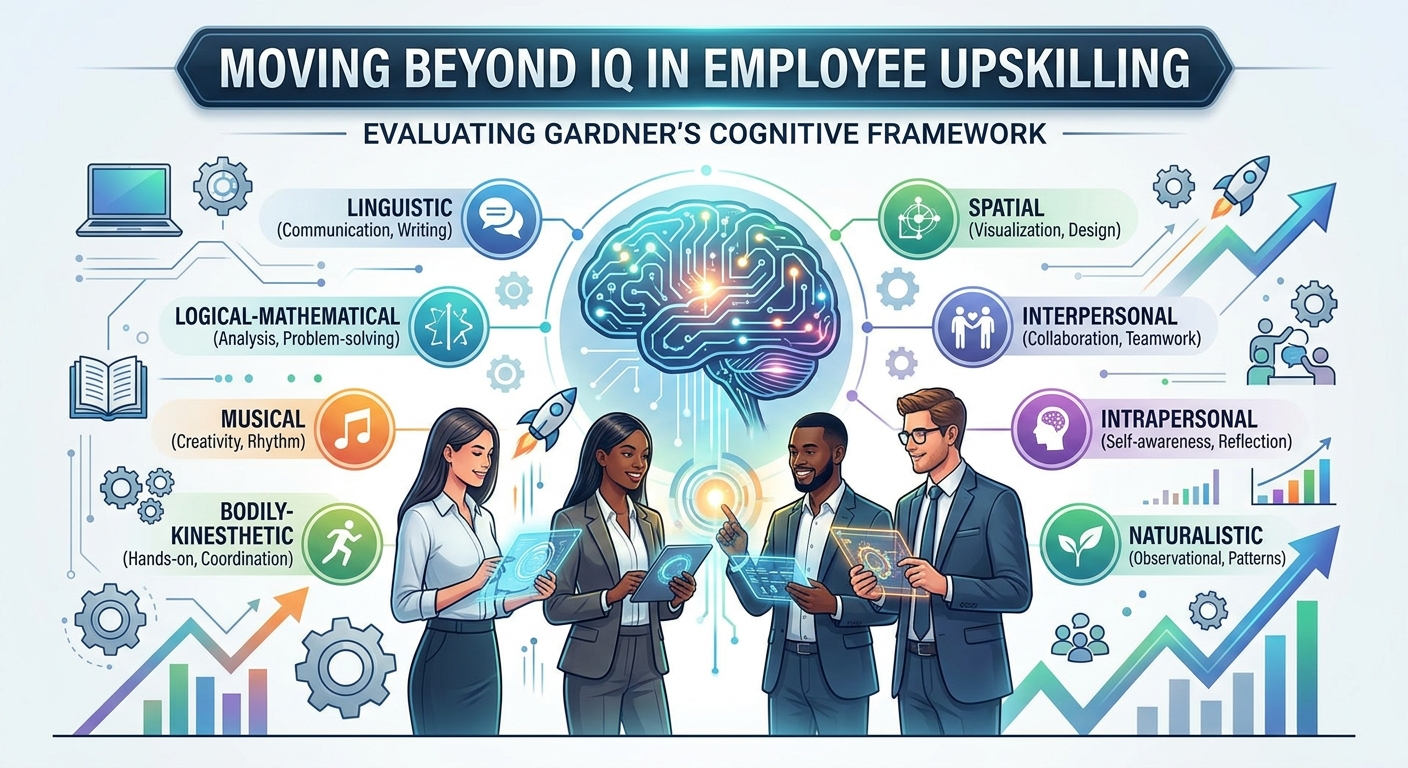
Moving Beyond IQ in Employee Upskilling: Evaluating Gardner's Cognitive Framework
In today's rapidly evolving business landscape, the traditional approach to employee upskilling, heavily reliant on a singular measure of intelligence like IQ, is increasingly proving inadequate. L&D Vice Presidents, Directors, and Senior Managers are grappling with the challenge of fostering a workforce that is not only competent but also adaptable, innovative, and resilient across diverse industries such as Compliance, Sales, Banking, Finance, Insurance, Retail, Pharma, Health care, Hospitality, Oil and Gas, and Mining.
The quest for effective talent development demands a more nuanced understanding of human potential. This is where Howard Gardner's Theory of Multiple Intelligences offers a profound paradigm shift, urging L&D professionals to look beyond the narrow confines of IQ and embrace a holistic view of cognitive strengths. By leveraging this framework, organizations can unlock deeper potential, personalize learning experiences, and ultimately drive superior business outcomes.
The Limitations of a Unidimensional View: Why IQ Falls Short
For decades, IQ tests served as a primary gatekeeper, guiding hiring and development decisions. While useful for measuring certain logical and linguistic abilities, IQ fails to capture the full spectrum of human intelligence crucial for success in modern roles. It overlooks vital skills like emotional intelligence, creativity, practical problem-solving, and interpersonal dexterity—qualities that are paramount in complex client negotiations, collaborative project management, or compassionate healthcare delivery.
An overreliance on IQ can lead to a monochromatic view of talent, resulting in:
- Missed Potential: Overlooking employees with exceptional non-traditional intelligences.
- Ineffective Training: Designing one-size-fits-all programs that cater to only a subset of cognitive styles, leaving others disengaged or struggling.
- Limited Innovation: Failing to cultivate diverse perspectives and problem-solving approaches critical for breakthrough ideas.
- Talent Drain: High-potential employees feeling undervalued because their unique strengths aren't recognized or nurtured.
Gardner's Paradigm Shift: Embracing Multiple Intelligences
Howard Gardner, a developmental psychologist, proposed in 1983 that intelligence is not a single, monolithic entity but rather a collection of distinct "intelligences" that operate somewhat independently. He initially identified seven, later expanding to eight or nine. Understanding these allows L&D leaders to design truly inclusive and effective upskilling initiatives.
Key Intelligences for Corporate Upskilling:
- Linguistic Intelligence: The ability to use language effectively, both orally and in writing. Critical for Sales, Marketing, Legal (Compliance), and Customer Service roles.
- Logical-Mathematical Intelligence: The capacity to analyze problems logically, carry out mathematical operations, and investigate scientifically. Essential in Finance, Banking, Data Analytics, Pharma R&D, and Engineering (Oil and Gas, Mining).
- Spatial Intelligence: The potential to recognize and use patterns of wide space and more confined areas. Important for Architects, Designers, Logistics, and even visualizing complex operational flows in Manufacturing or Mining.
- Bodily-Kinesthetic Intelligence: Expertise in using one’s whole body to express ideas and feelings, and facility in using one’s hands to produce or transform things. Crucial for Surgeons (Health care), skilled Trades, and Hospitality roles requiring physical dexterity and grace.
- Musical Intelligence: The capacity to discern, transform, and express musical forms. While less direct for corporate upskilling, it highlights rhythmic understanding and pattern recognition, which can translate to process optimization.
- Interpersonal Intelligence: The ability to understand the intentions, motivations, and desires of other people. Vital for Leadership, HR, Sales, Customer Relations, and Team-based roles across all industries.
- Intrapersonal Intelligence: The capacity to understand oneself, to appreciate one’s own feelings, fears, and motivations. Key for self-awareness, emotional regulation, and personal development in any role, particularly leadership.
- Naturalistic Intelligence: The ability to recognize and categorize flora, fauna, and other aspects of our environment. Important for industries like Pharma (drug discovery from nature), Agriculture, and Environmental Compliance.
- Existential Intelligence (proposed): The capacity to ponder deep questions about life, death, and existence. Relevant for roles requiring ethical reasoning, long-term strategic vision, and understanding societal impact.
Unlocking Potential: Applying Gardner in Upskilling Initiatives
Implementing Gardner's framework requires L&D to adopt a more diagnostic and diversified approach. Here's how:
Assessment Beyond the CV: Develop methods to identify diverse intelligences, not just academic achievements. This could involve observational assessments, scenario-based evaluations, peer feedback, and self-reflection tools.
Designing Multi-Modal Learning Journeys: Once intelligences are understood, learning content management systems should be utilized to deliver varied pedagogical approaches. For example:
- Linguistic learners: Benefit from case studies, debates, written reports, and storytelling.
- Logical-Mathematical learners: Excel with data analysis, problem-solving simulations, and strategic planning exercises.
- Spatial learners: Respond well to visual aids, diagrams, virtual reality (VR) simulations, and infographics.
- Bodily-Kinesthetic learners: Thrive with hands-on workshops, role-playing, practical demonstrations, and simulations, especially relevant for Risk-focused Training in sectors like Oil and Gas or Healthcare.
- Interpersonal learners: Engage with group projects, collaborative learning, mentoring, and team-based simulations.
- Intrapersonal learners: Benefit from reflective journaling, self-paced study, and goal-setting exercises.
For industries like Compliance, training could involve interactive legal case simulations for logical learners, while sales training might emphasize role-playing for interpersonal and linguistic learners. In Health care, procedural training can be enhanced with virtual simulations for spatial and bodily-kinesthetic intelligences.
The Role of Modern eLearning Platforms in a Multi-Intelligent World
Implementing a comprehensive framework like Gardner's across an enterprise demands robust technological support. A modern LMS (learning management system) is no longer just a content repository; it's a dynamic ecosystem for personalized growth. A truly effective learning management software, like the MaxLearn LMS, is crucial for this transformation.
A sophisticated cloud based learning management system acts as the central nervous system for talent development. By offering features such as:
- Microlearning LMS: Delivers bite-sized content, appealing to varying attention spans and allowing learners to digest information in formats best suited to their intelligence type.
- Gamified LMS: Engages learners through challenges, leaderboards, and rewards, tapping into intrinsic motivation for competitive (logical, interpersonal) and hands-on (bodily-kinesthetic) learners.
- Adaptive Learning: Personalizes learning paths based on individual progress, preferences, and identified intelligences, ensuring optimal engagement and retention.
- AI Powered Authoring Tool: Enables L&D teams to quickly create diverse content formats (videos, interactive simulations, text-based modules) tailored to specific intelligence profiles, making the LCMS truly intelligent.
Such an enterprise learning management solution transforms training from a passive consumption model to an active, personalized development journey.
AI-Driven Insights for a Smarter Workforce
The integration of artificial intelligence further amplifies the power of Gardner's framework within modern L&D. AI can process vast amounts of data to provide unprecedented insights into individual learning dynamics.
Question: How can L&D leaders truly understand and leverage the unique cognitive strengths of their workforce for targeted upskilling?
Answer: By moving beyond traditional metrics like IQ, and adopting frameworks such as Gardner's Multiple Intelligences, organizations can identify varied strengths. An advanced LMS equipped with analytical capabilities can help map these intelligences to learning preferences and skill gaps, facilitating personalized development paths. This allows L&D professionals to create highly effective, customized programs.
Question: What innovative approaches can organizations adopt to identify and nurture diverse talent across various global industries using intelligent platforms?
Answer: Modern talent development strategies increasingly rely on data-driven insights. By implementing a sophisticated enterprise learning management system, L&D departments can gather rich data on learning styles, engagement, and performance. This data, analyzed by intelligent algorithms, allows for the creation of customized content, like through an AI Powered Authoring Tool, that resonates with different cognitive profiles, fostering growth in diverse environments from Pharma to Oil and Gas. This ensures equitable and effective development globally.
Question: How can artificial intelligence tools best support the implementation and evaluation of a multi-faceted upskilling strategy based on individual cognitive profiles?
Answer: AI can revolutionize how we implement and evaluate upskilling. For instance, AI can power an Adaptive Learning system to dynamically adjust content difficulty and format based on an individual's progress and preferred intelligence type. Furthermore, AI can provide granular insights into learning effectiveness, identifying where specific pedagogical approaches (e.g., visual for spatial learners, collaborative for interpersonal learners) yield the best results. A comprehensive learning management software such as MaxLearn LMS offers these capabilities, ensuring that every employee’s potential is maximized, making it the ideal lms learning management system for future-proofing your workforce.
Conclusion: Future-Proofing Your Workforce with Holistic Upskilling
Moving beyond the narrow lens of IQ and embracing Gardner's Cognitive Framework is not merely an academic exercise; it's a strategic imperative for L&D leaders. It empowers organizations to see employees not just for what they lack, but for the rich tapestry of cognitive strengths they possess.
By investing in a robust learning management solutions that supports diverse learning styles and leverages AI for personalization, you can create a dynamic, engaging, and highly effective upskilling ecosystem. This approach fosters a more engaged workforce, drives innovation, reduces attrition, and builds a truly future-proof organization ready to tackle the complexities of any industry. Embrace the spectrum of intelligence within your teams, and watch your talent flourish.
```.jpg)


