

The Complete Guide to the Forgetting Curve: Strategies for Modern L&D Leaders
In the dynamic landscape of modern business, continuous learning is not just an advantage; it's a necessity. From banking and finance to healthcare and oil & gas, organizations across all segments rely on their employees to retain critical information, adapt to new compliance regulations, master sales techniques, and operate complex machinery. Yet, a fundamental challenge persists: the human brain's natural tendency to forget. This phenomenon, known as the Forgetting Curve, can significantly undermine even the most meticulously designed training programs, leading to knowledge gaps, reduced productivity, and increased risk.
For L&D Vice Presidents, Directors, Senior Managers, and Managers, understanding and actively combating the Forgetting Curve is paramount. It’s about ensuring that training investments translate into lasting knowledge and measurable performance improvements. This comprehensive guide delves into the science behind memory decay and provides actionable strategies for modern L&D leaders to build resilient learning ecosystems.
Understanding the Forgetting Curve: The Science of Memory Decay
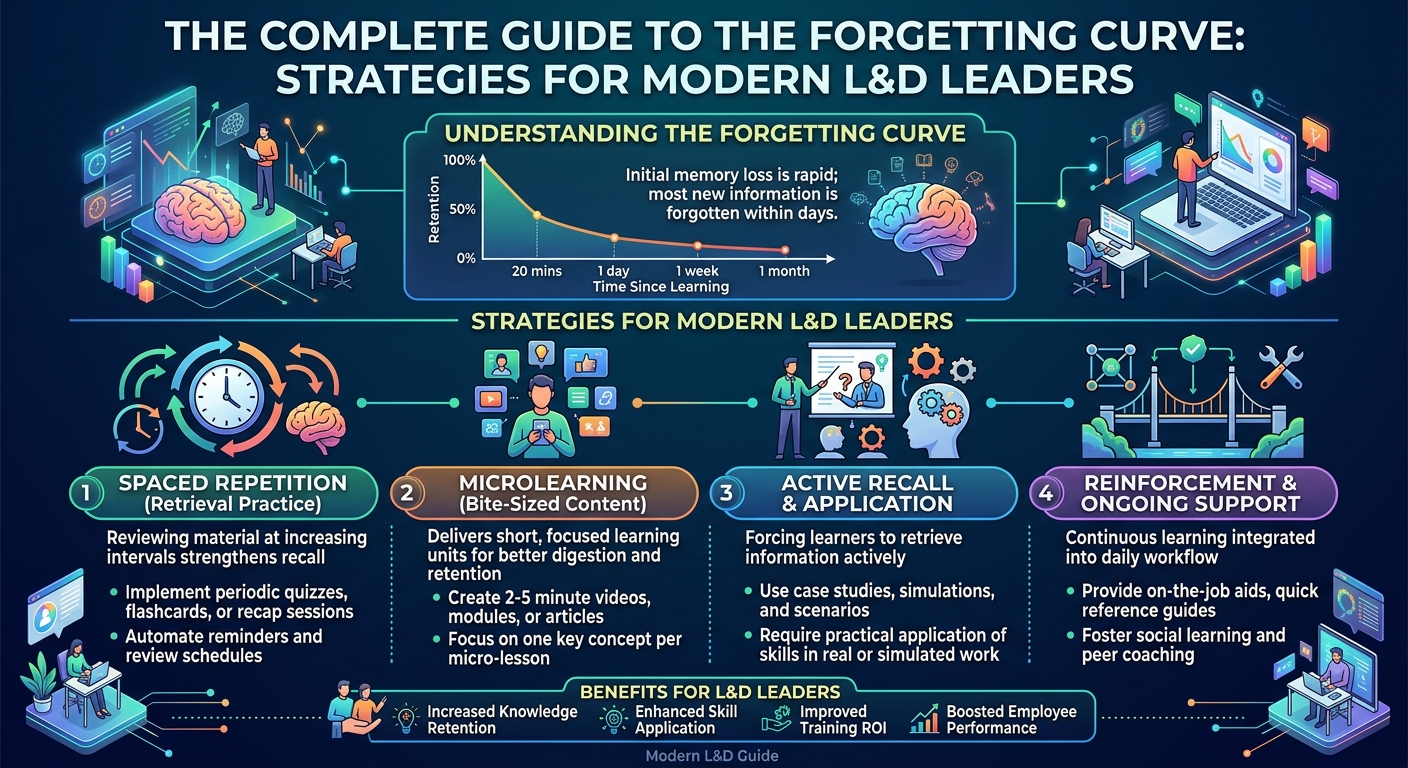
First introduced by German psychologist Hermann Ebbinghaus in 1885, the Forgetting Curve illustrates the rate at which newly acquired information is lost over time if there is no attempt to retain it. Ebbinghaus's groundbreaking research showed that we forget approximately 50% of new information within an hour, and up to 70% within 24 hours, without reinforcement. After a week, this figure can soar to 90%.
Imagine the implications for mandatory compliance training, vital product knowledge for retail staff, or safety protocols in mining. If learners are exposed to information once and then left without reinforcement, a significant portion of that valuable training is lost almost immediately, rendering the initial effort and investment largely ineffective.
What factors accelerate the Forgetting Curve in corporate training?
Several factors contribute to the steepness of the Forgetting Curve:
- Information Overload: Too much information presented in a short period overwhelms cognitive capacity.
- Lack of Relevance: Learners struggle to retain information they perceive as irrelevant to their immediate tasks.
- Passive Learning: Lectures or static content without interaction or application lead to superficial processing.
- Absence of Reinforcement: Without practice, retrieval, or repeated exposure, memories fade rapidly.
- Stress and Fatigue: High-stress environments or fatigued learners have reduced capacity for memory encoding and retention.
The Impact on Modern L&D and Business Outcomes
The Forgetting Curve isn't merely an academic concept; it has tangible, negative consequences for businesses across all industries:
- Reduced ROI on Training: If knowledge isn't retained, the money, time, and resources invested in training yield diminishing returns.
- Performance Gaps: Employees forget critical skills, leading to errors, decreased efficiency, and missed opportunities, particularly in sales and customer service.
- Compliance Risks: In regulated industries like finance, pharma, and healthcare, forgetting compliance protocols can lead to serious legal and financial repercussions. Risk-focused Training is essential to mitigate these issues.
- Slowed Innovation: The inability to retain new knowledge hinders adaptation and innovation in rapidly evolving sectors.
- Employee Frustration: Learners become demotivated when they feel their learning efforts are futile, impacting morale and retention.
Strategies for Modern L&D Leaders to Conquer the Forgetting Curve
Modern L&D leaders must proactively integrate strategies designed to bend, flatten, and ultimately overcome the Forgetting Curve. This requires a shift from event-based training to continuous, reinforced learning.
1. Embrace Microlearning and Spaced Repetition
Instead of lengthy, one-off training sessions, break down content into short, digestible modules. This approach is highly effective because it aligns with how the brain best processes and retains information. Spaced repetition involves re-exposing learners to information at increasing intervals, right before they are likely to forget it. A robust Microlearning LMS is ideal for delivering this.
- Bite-Sized Content: Deliver core concepts in 3-5 minute modules.
- Frequent Reinforcement: Schedule automated quizzes, flashcards, or short videos to revisit key points over days and weeks.
- Contextual Learning: Provide microlearning modules just-in-time, as employees need the information for their tasks, e.g., a quick tutorial for a new software feature in banking or a reminder for a specific hospitality service standard.
2. Implement Adaptive Learning Paths
Not all learners are the same. Some grasp concepts quickly, while others require more practice. An Adaptive Learning system personalizes the learning journey based on individual progress, performance, and preferences.
- Personalized Pace: Learners can move through content at their own speed, ensuring mastery before progression.
- Targeted Review: The system identifies areas where a learner struggles and provides additional resources or exercises specifically for those topics. This is particularly useful for complex subjects in pharma or oil & gas.
- Dynamic Content Delivery: Content adapts based on pre-assessment results, ensuring learners aren't wasting time on what they already know.
3. Leverage Gamification and Interactive Elements
Engagement is key to retention. Incorporating game-like elements can significantly boost learner motivation and knowledge recall. A Gamified LMS transforms learning into an enjoyable and competitive experience.
- Points, Badges, Leaderboards: Encourage friendly competition and provide immediate feedback.
- Challenges and Quizzes: Turn knowledge checks into engaging activities that require active retrieval.
- Simulations: Allow learners to practice skills in a risk-free environment, such as a simulated sales call or a virtual retail scenario.
4. Harness the Power of AI and Analytics
Artificial intelligence is revolutionizing how L&D leaders approach the Forgetting Curve. AI can analyze vast amounts of learner data to identify patterns, predict knowledge decay, and recommend targeted interventions.
- Predictive Analytics: AI can forecast when individual learners are likely to forget specific information, allowing for timely reinforcement.
- Content Curation: An AI Powered Authoring Tool can help generate, update, and recommend relevant content based on learner needs and performance data.
- Intelligent Tutors/Chatbots: Provide on-demand support and answer learner questions, offering instant clarification and reinforcement.
5. Foster a Culture of Continuous Learning
Technology is a powerful enabler, but the organizational culture plays an equally vital role. L&D leaders must champion a mindset where learning is an ongoing process, not a one-time event.
- Peer-to-Peer Learning: Encourage knowledge sharing through forums, mentorship programs, and collaborative projects.
- Managerial Support: Equip managers with the tools and training to reinforce learning in daily work, providing coaching and feedback.
- Integrate Learning into Workflows: Make learning resources easily accessible within the tools and systems employees use daily, whether it's for customer service in hospitality or technical maintenance in manufacturing.
How can learning content management system technologies support these strategies globally?
A modern LMS or LCMS (Learning Content Management System) is the backbone for implementing these strategies effectively across diverse segments like finance, insurance, and retail, and across global teams. A robust learning management software provides a centralized platform for creating, delivering, and tracking all learning activities. Cloud-based learning management systems offer scalability, accessibility, and the ability to deploy training content seamlessly across different geographies and devices, ensuring consistent learning experiences.
For large enterprises, an enterprise learning management solution, such as the MaxLearn LMS, consolidates training initiatives, streamlines administration, and offers powerful analytics. These learning management solutions are designed to manage complex training needs, ensuring that all employees, from frontline staff to senior leadership, have access to the right content at the right time, with built-in mechanisms for reinforcement and progress tracking. Essentially, an advanced lms learning management system becomes the central hub for fighting the Forgetting Curve.
Conclusion: Building a Resilient Learning Future
The Forgetting Curve is a persistent challenge, but it is not an insurmountable one. By understanding its mechanisms and strategically implementing modern L&D approaches, leaders can transform how their organizations learn and retain critical knowledge. Embracing microlearning, adaptive paths, gamification, and AI-powered tools within a comprehensive learning management system empowers L&D professionals to move beyond traditional training paradigms. This proactive approach ensures that learning investments yield lasting results, driving performance, mitigating risk, and fostering a truly knowledgeable and adaptable workforce capable of thriving in any industry, from compliance to healthcare and beyond.
.jpg)


