

How Does Retrieval Practice Improve Long-Term Workplace Learning?
In today's fast-paced corporate environment, knowledge retention isn't just a desirable trait; it's a critical component of business success. Vice Presidents, Directors, and L&D leaders across industries—from Compliance and Sales to Banking, Finance, Healthcare, and Oil and Gas—grapple with the challenge of ensuring that crucial training sticks. Employees attend workshops, complete modules, and engage with new information, yet the 'forgetting curve' often dictates a rapid decline in what they remember and apply. This is where retrieval practice emerges as a powerful, scientifically validated strategy to transform fleeting knowledge into lasting expertise.
Retrieval practice, often misunderstood as mere testing, is a dynamic learning technique that significantly enhances long-term memory and the ability to apply learned information. This article will delve into the mechanisms behind retrieval practice, explore its profound benefits for workplace learning, and provide actionable insights for integrating it into your L&D framework to build a more competent, resilient, and adaptive workforce.
Understanding Retrieval Practice
What is Retrieval Practice?
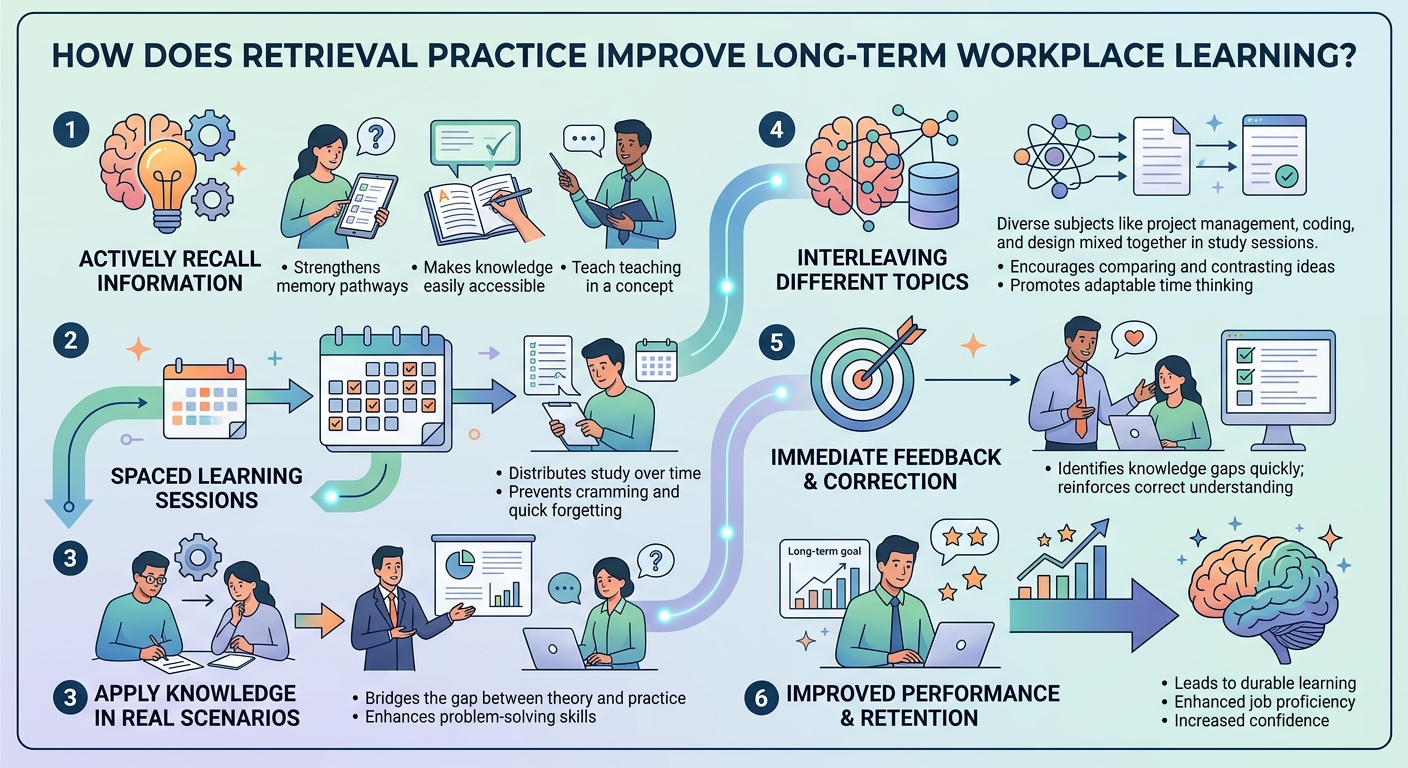
At its core, retrieval practice involves actively recalling information from memory rather than passively re-reading or reviewing it. Instead of simply looking over notes or slides, a learner attempts to retrieve facts, concepts, or procedures from their mind. This act of pulling information out of memory is what strengthens the neural pathways associated with that information, making it easier to recall and apply in the future. It's a low-stakes, high-impact method that shifts the focus from 'input' (receiving information) to 'output' (producing information).
Think of it as exercising a muscle: the more you use it, the stronger it gets. Each successful retrieval effort reinforces the memory trace, making it more robust and accessible. This approach is fundamentally different from traditional study methods like re-reading or highlighting, which often create an illusion of mastery without true understanding or retention.
Why It Works: The Science Behind It
The effectiveness of retrieval practice is backed by extensive cognitive science research, famously known as the "testing effect." This phenomenon demonstrates that the act of testing oneself, even without external feedback, improves memory of the tested material more than simply studying it. The cognitive benefits are multifaceted:
- Strengthens Memory Traces: Every time information is successfully retrieved, the memory pathway becomes stronger and more stable, reducing the likelihood of forgetting.
- Identifies Knowledge Gaps: The act of trying to recall reveals what learners know and, more importantly, what they don't know, guiding them to focus their future learning efforts.
- Improves Metacognition: Learners become better at assessing their own understanding, leading to more effective study strategies and self-regulation.
- Enhances Transfer of Learning: Actively recalling information in varied contexts helps learners transfer that knowledge to new situations and problem-solving scenarios, critical for real-world application.
For L&D professionals, understanding this scientific foundation is key to designing training programs that move beyond mere information delivery to genuine knowledge acquisition and skill mastery.
The Impact on Long-Term Workplace Learning
Enhanced Knowledge Retention
The most immediate and profound benefit of retrieval practice is its ability to combat the forgetting curve. By regularly prompting employees to recall information, organizations can significantly extend the lifespan of learned material. This is particularly vital in industries like Compliance and Healthcare, where retaining vast amounts of regulatory information or critical patient protocols is non-negotiable.
Incorporating retrieval opportunities into an LMS ensures that essential knowledge, from product specifications in Retail to complex financial instruments in Banking, is not just acquired but retained over the long haul. This translates directly into reduced retraining costs and a more consistently informed workforce.
Improved Application and Performance
Retrieval practice isn't just about remembering facts; it's about preparing learners to use those facts effectively. When employees regularly practice recalling information, they develop quicker access to that knowledge, enabling faster decision-making and more agile problem-solving on the job. For Sales teams, this means quicker recall of product benefits and objection handling strategies. For Pharma and Oil and Gas, it ensures immediate access to safety protocols and operational procedures under pressure.
This active engagement with knowledge primes the brain for real-world application, making the transition from learning environment to operational reality smoother and more effective. It fosters a workforce that doesn't just know things, but can *do* things.
Greater Learning Efficiency
By forcing learners to confront their knowledge gaps, retrieval practice makes learning more efficient. Instead of re-studying everything, individuals can pinpoint areas where their understanding is weak and focus their efforts there. This personalized approach to learning is a hallmark of Adaptive Learning.
When combined with a robust learning content management system, retrieval practice allows L&D teams to deliver targeted interventions, saving valuable time and resources that might otherwise be spent on redundant training. It ensures that every minute spent learning is optimized for maximum impact.
Increased Learner Engagement and Motivation
Passive learning can often lead to disengagement. Retrieval practice, by its very nature, demands active participation. This makes the learning process more dynamic and often more enjoyable. The satisfaction of successfully recalling information provides a positive feedback loop, boosting confidence and intrinsic motivation. When integrated into a Gamified LMS, retrieval challenges can transform into engaging competitions, further fueling motivation and adherence to learning pathways.
This active, rewarding experience cultivates a proactive learning mindset, essential for continuous professional development across all sectors, including Hospitality and Mining, where ongoing skill development is crucial.
Adaptability and Resilience
In industries experiencing rapid change, such as Technology and Finance, a workforce's ability to adapt and learn new information quickly is paramount. Retrieval practice builds a stronger cognitive foundation, making it easier for employees to integrate new knowledge with existing understanding. By continually reinforcing core concepts, it creates a resilient knowledge base that can withstand the influx of new information and evolving demands. This prepares employees not just for current roles but for future challenges, fostering a culture of continuous learning.
Integrating Retrieval Practice into Your L&D Strategy
Microlearning and Spaced Repetition
Retrieval practice is a natural fit for Microlearning LMS strategies. Short, focused learning bursts are ideal for quick retrieval challenges. By spacing these retrieval opportunities over time (spaced repetition), L&D professionals can dramatically improve retention rates. Instead of one-off tests, consider embedding mini-quizzes, flashcard exercises, or quick open-ended questions at regular intervals after initial training.
A modern lms learning management system can automate the scheduling and delivery of these spaced retrieval cues, making it easy to implement this powerful combination.
Leveraging Technology
Technology offers boundless opportunities to embed retrieval practice. Online quizzes, interactive simulations, flashcard apps, and scenario-based questions can all serve as effective retrieval tools. A robust MaxLearn LMS, for example, can host a variety of retrieval-focused activities, track performance, and provide immediate feedback. Utilizing a cloud based learning management system ensures these resources are accessible anytime, anywhere, catering to diverse workforces.
Whether you're looking for learning management software to manage sales training or an enterprise learning management solution for global compliance, integrating retrieval tools is crucial.
Designing Effective Retrieval Opportunities
To maximize the impact of retrieval practice, consider these design principles:
- Variety is Key: Use a mix of question types – multiple-choice, fill-in-the-blank, short answer, and true/false – to challenge different aspects of memory.
- Immediate Feedback: Provide instant feedback after retrieval attempts, explaining why an answer was correct or incorrect to solidify learning.
- Low Stakes: Emphasize that these are learning opportunities, not high-pressure evaluations. This encourages participation and reduces anxiety.
- Connect to Real-World Scenarios: Frame retrieval questions in the context of actual workplace situations to enhance relevance and transferability, especially in Risk-focused Training.
An effective LCMS can help L&D teams manage and deploy a diverse range of retrieval content with ease.
AI-Related Questions and Answers
How can Artificial Intelligence enhance retrieval practice in corporate training?
Artificial Intelligence can revolutionize retrieval practice by personalizing the learning journey. AI-driven platforms can analyze a learner's performance data to create dynamic, individualized recall schedules, ensuring content is revisited precisely when needed to prevent forgetting. Using an AI Powered Authoring Tool, systems can automatically generate contextually relevant practice questions, scenarios, and even adaptive quizzes tailored to specific knowledge gaps identified for each employee. This level of customization maximizes efficiency and ensures every retrieval attempt is purposeful.
Where is intelligent retrieval practice most impactful for global teams?
Intelligent retrieval practice offers immense value for global teams by ensuring standardized knowledge and consistent performance across diverse geographical locations. AI can adapt content and retrieval questions to local cultural nuances and regulations while maintaining the core learning objectives, crucial for global compliance and brand consistency. It allows L&D leaders to monitor global knowledge retention patterns, identify regional training deficiencies, and deploy targeted interventions, ultimately fostering a unified, highly capable workforce regardless of their location.
What innovative techniques are emerging from intelligent retrieval systems?
Innovative techniques emerging from intelligent retrieval systems include predictive analytics that anticipate when an employee is likely to forget specific information, triggering timely recall prompts. We're also seeing advanced Gamified LMS elements where retrieval challenges are woven into interactive learning paths, complete with personalized feedback and leaderboards. AI can also facilitate "explainable feedback," where instead of just marking an answer wrong, the system explains *why* it's wrong and points to relevant resources for deeper understanding, transforming errors into powerful learning opportunities.
Conclusion
Retrieval practice is more than just a technique; it's a paradigm shift in how we approach workplace learning. For Vice Presidents, Directors, and Managers of L&D, embracing this evidence-based strategy means moving beyond mere training delivery to cultivating genuine, long-term mastery. By actively engaging employees in the process of recalling information, organizations can significantly boost knowledge retention, improve on-the-job performance, enhance learning efficiency, and foster a highly engaged and adaptable workforce.
The strategic integration of retrieval practice, especially when powered by modern learning management solutions and AI, can transform your L&D initiatives from reactive knowledge delivery to proactive competence building. Invest in retrieval practice, and you invest in a smarter, more capable, and ultimately more successful future for your organization.
.jpg)


