

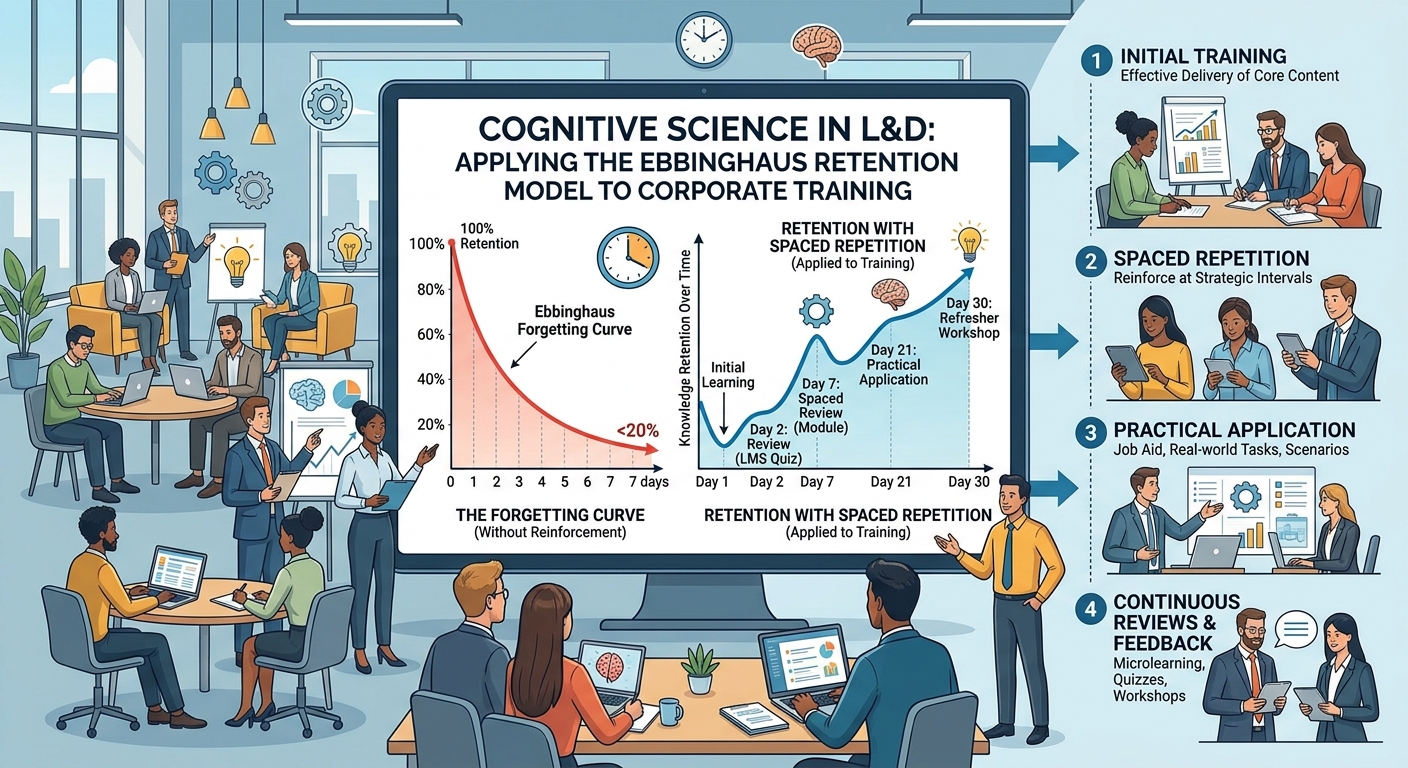
Cognitive Science in L&D: Applying the Ebbinghaus Retention Model to Corporate Training
In the fast-paced corporate world, where continuous learning is not just an advantage but a necessity, the challenge of ensuring knowledge retention is paramount. L&D leaders across industries, from Compliance to Sales, Banking to Healthcare, grapple with the sobering reality that a significant portion of learned information is quickly forgotten. This isn't a failure of effort but often a systemic oversight in how training is designed and delivered. Fortunately, the field of cognitive science offers powerful insights, with the Ebbinghaus Retention Model standing out as a critical framework for revolutionizing corporate training strategies.
This article will delve into the science behind memory and forgetting, exploring how Hermann Ebbinghaus's groundbreaking work can be practically applied to create more effective, lasting learning experiences. We will examine how an advanced LMS, powered by modern learning technologies, can be instrumental in combating the dreaded "forgetting curve" and ensuring that your employees truly retain and apply what they learn.
Understanding the Ebbinghaus Retention Model
In the late 19th century, German psychologist Hermann Ebbinghaus conducted pioneering research on memory. His most famous contribution, the "Forgetting Curve," illustrates the rate at which memories are lost over time when there is no attempt to retain them. Ebbinghaus found that:
- Knowledge decay is steepest shortly after learning. A significant amount of information is forgotten within the first few hours or days.
- The rate of forgetting then slows down, but without reinforcement, retention continues to decline.
- Meaningful, relevant information is generally retained better than abstract or rote information.
- Repetition, especially spaced repetition, can significantly flatten the forgetting curve, leading to stronger, more durable memories.
For L&D professionals, this model is not merely an academic curiosity; it's a stark reminder that traditional, one-off training sessions are inherently inefficient for long-term knowledge retention. Whether it's intricate financial regulations in Banking, complex drug protocols in Pharma, or critical safety procedures in Oil and Gas, the Ebbinghaus model underscores the need for a more scientifically informed approach.
The Problem with Traditional Corporate Training
Many corporate training programs inadvertently set employees up for failure by ignoring the principles of the Ebbinghaus curve. Common pitfalls include:
- **One-Off, Intensive Sessions:** Cramming large amounts of information into a single workshop or seminar, followed by no reinforcement.
- **Information Overload:** Presenting too much new content at once, overwhelming cognitive capacity.
- **Lack of Relevance:** Delivering generic content that doesn't connect with the learner's existing knowledge or job role.
- **Passive Learning:** Relying heavily on lectures or presentations without opportunities for active recall or application.
The result? Employees attend training, pass an immediate assessment, but within weeks, crucial information—especially vital for Risk-focused Training or compliance mandates—has faded significantly. This leads to wasted training budgets, decreased productivity, and increased operational risk across all sectors, from Hospitality to Mining.
Applying Ebbinghaus Principles to Modern L&D
The good news is that by consciously designing training based on Ebbinghaus's findings, L&D can drastically improve retention and transfer of learning to the workplace.
Spaced Repetition: The Cornerstone
Spaced repetition involves reviewing information at increasing intervals over time. Instead of learning everything once, content is revisited strategically. This technique is immensely powerful for strengthening neural pathways and solidifying memories. A sophisticated Microlearning LMS can deliver bite-sized content modules, quizzes, and refreshers at scientifically determined intervals, ensuring key concepts are reinforced just as they begin to fade. This is especially crucial for industries like Healthcare (new medical procedures), Insurance (evolving policy details), and Sales (product updates).
Active Recall: Engaging the Brain
Active recall, or retrieval practice, means deliberately pulling information from memory rather than passively re-reading it. When learners actively retrieve information, they strengthen their memory of it. Incorporating elements like self-testing, flashcards, short quizzes, and scenario-based questions throughout a course can dramatically boost retention. A Gamified LMS can make active recall fun and engaging, turning review sessions into interactive challenges, ideal for motivating employees in Retail and Hospitality to master customer service protocols or product knowledge.
Meaningful Context and Elaboration
Ebbinghaus observed that meaningful information is easier to retain. L&D should focus on connecting new knowledge to learners' existing experiences and job roles. Using real-world case studies, simulations, and problem-solving exercises allows learners to elaborate on the information, integrate it into their existing cognitive frameworks, and understand its practical application. This is particularly effective for complex topics in Finance or Compliance, where understanding the "why" behind regulations is as important as the "what."
Feedback and Personalization
Timely and constructive feedback is essential for correcting misconceptions and reinforcing correct understanding. Furthermore, not all learners forget at the same rate or struggle with the same concepts. An Adaptive Learning approach uses data to tailor the learning path, providing more frequent reviews for difficult topics or less review for mastered content. This personalization ensures optimal cognitive load and efficiency for each individual.
AI's Role in Optimizing the Ebbinghaus Model
The convergence of cognitive science and artificial intelligence offers unprecedented opportunities for L&D.
Question: How can artificial intelligence enhance the effectiveness of spaced repetition schedules in corporate training?
Answer: AI can analyze learner performance data, track mastery levels, and predict individual forgetting points with remarkable accuracy. This allows an intelligent learning management system to dynamically adjust the timing and content of review sessions for each employee, ensuring optimal delivery of refreshers precisely when they are most needed to combat the forgetting curve. This leads to highly personalized and efficient learning paths.
Question: What role do intelligent authoring tools play in creating Ebbinghaus-compliant learning experiences?
Answer: An AI Powered Authoring Tool can significantly streamline the creation of content designed for spaced repetition and active recall. It can help L&D teams break down complex topics into microlearning modules, automatically generate diverse question types for retrieval practice, and even suggest optimal content sequencing based on cognitive principles. This empowers creators to build engaging, effective learning materials more efficiently.
Question: How can AI-driven analytics strengthen knowledge retention for critical compliance and risk-focused training?
Answer: AI platforms can meticulously monitor employee engagement and performance within compliance modules, identifying specific areas of weakness or potential knowledge gaps across a team or organization. By flagging employees who are struggling or those whose knowledge is nearing a predicted forgetting point, AI can trigger targeted interventions, such as mandatory refreshers or additional resources, proactively mitigating compliance risks in heavily regulated industries like Finance, Pharma, and Oil and Gas.
Implementing an Ebbinghaus-aligned LMS Strategy
To truly leverage the Ebbinghaus Retention Model, L&D needs a robust learning management system that supports these cognitive principles. When evaluating a new learning content management system or upgrading your current learning management software, consider features that facilitate:
- **Microlearning Delivery:** The ability to host and deliver short, focused learning modules.
- **Spaced Repetition Scheduling:** Automated systems for delivering content refreshers and assessments at optimal intervals.
- **Adaptive Learning Paths:** Personalization capabilities that adjust learning content and pace based on individual performance.
- **Rich Analytics and Reporting:** Insights into learner progress, retention rates, and areas of struggle.
- **Gamification Features:** Tools to embed quizzes, challenges, and rewards to boost engagement and active recall.
- **AI Integration:** For intelligent content curation, personalized recommendations, and dynamic scheduling.
A cloud based learning management system like MaxLearn LMS, designed as an enterprise learning management solution, offers the sophisticated capabilities needed to operationalize these cognitive science principles. Such an LCMS transforms the traditional lms learning management system into a powerful engine for sustained knowledge growth across all industries.
Conclusion
The Ebbinghaus Retention Model provides a clear, scientifically validated roadmap for L&D leaders aiming to move beyond ephemeral training to lasting knowledge retention. By embracing strategies like spaced repetition, active recall, meaningful context, and personalized feedback—all powered by modern learning management solutions and artificial intelligence—organizations can dramatically improve the efficacy and ROI of their training investments.
For VPs, Directors, and Managers of L&D, the time to innovate is now. Integrating cognitive science into your learning strategy isn't just about optimizing training; it's about building a smarter, more capable workforce that retains critical information, drives performance, and mitigates risk across every segment of your business.
.jpg)


