

Overcoming the Forgetting Curve in Onboarding: Getting New Hires to Competency Faster
For Learning & Development leaders, the initial weeks and months of a new hire's journey represent a critical window of opportunity. It's a time fraught with potential, yet often undermined by a pervasive challenge: the forgetting curve. As VPs, Directors, and Senior Managers, you understand that bringing new talent up to speed isn't just about ticking boxes; it's about rapidly integrating them into the organizational fabric, ensuring they contribute effectively, and ultimately, safeguarding your investment in human capital. But how do you battle the natural human tendency to forget, especially when dealing with a deluge of new information?
This article delves into strategies for not only flattening the forgetting curve but transforming it into a launchpad for faster competency. We'll explore modern LMS approaches, the power of technology, and the game-changing role of artificial intelligence in crafting an onboarding experience that sticks.
Understanding the Forgetting Curve in Onboarding
What is the Forgetting Curve?
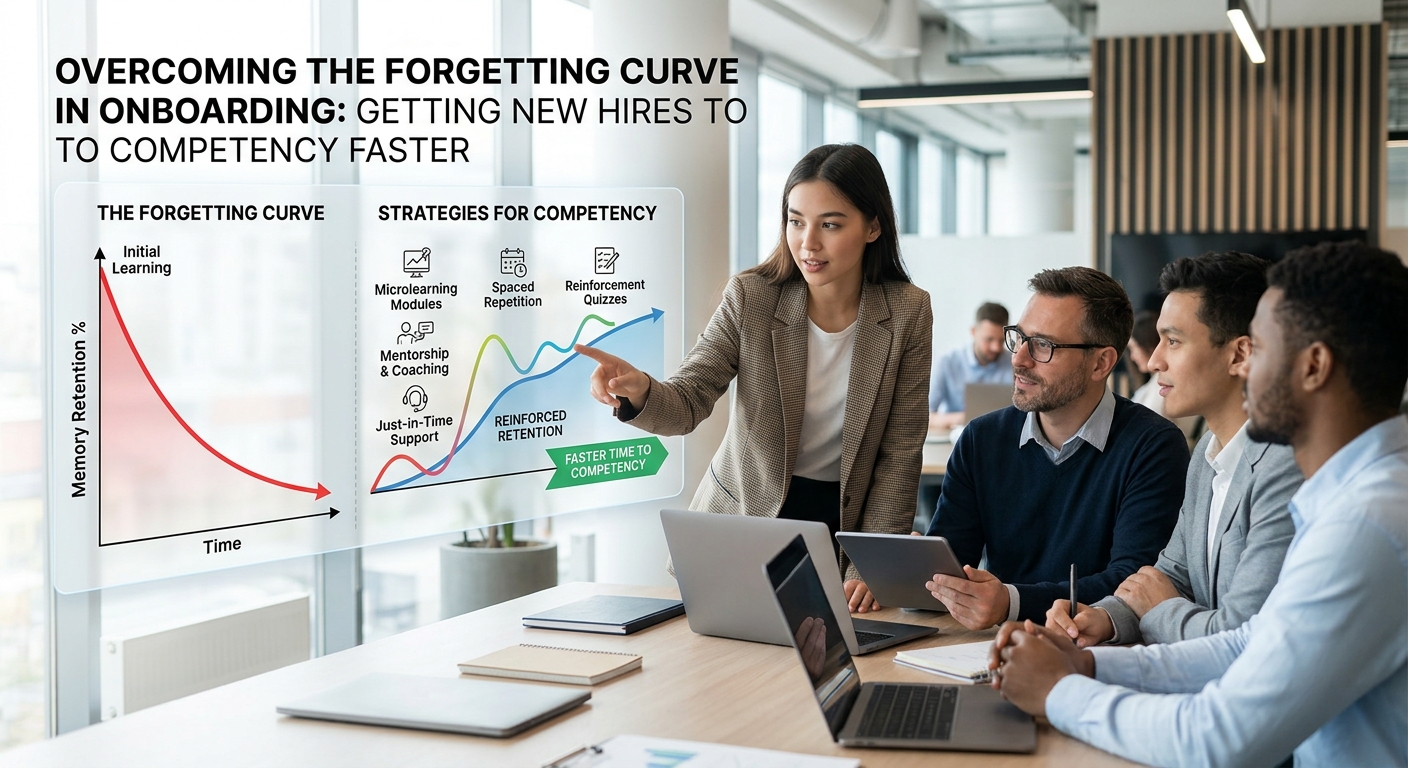
First articulated by psychologist Hermann Ebbinghaus in 1885, the forgetting curve illustrates the rate at which newly acquired information is lost over time if there's no attempt to retain it. In the context of onboarding, this means that without strategic reinforcement, a significant portion of the critical policies, procedures, product knowledge, and cultural nuances taught during initial training can vanish within days or weeks. This isn't a reflection on the new hire's ability, but rather a fundamental aspect of human memory.
The High Stakes of Onboarding Failure
When the forgetting curve goes unaddressed, the repercussions are substantial. New hires struggle to perform their roles efficiently, leading to reduced productivity, increased errors, and a reliance on supervisors and colleagues for constant retraining. This siphons valuable time and resources from experienced staff. Moreover, a frustrating or ineffective onboarding experience can significantly impact employee morale and commitment, contributing to higher turnover rates. The cost of replacing an employee can range from tens of thousands to hundreds of thousands of dollars, making effective onboarding not just an HR concern, but a strategic business imperative for any enterprise learning management initiative.
Strategies to Combat the Forgetting Curve
The Power of Spaced Repetition and Microlearning
The antidote to the forgetting curve lies in deliberate, timely reinforcement. Spaced repetition, the technique of reviewing information at increasing intervals, directly counteracts memory decay. When combined with Microlearning LMS, this strategy becomes incredibly potent. Microlearning delivers content in short, digestible modules (2-5 minutes), making it easy for new hires to absorb, retain, and apply information without feeling overwhelmed. Think of it as delivering knowledge in bite-sized, purposeful chunks, ensuring that key information is revisited before it's forgotten.
Engaging Learners with Gamification
Engagement is a critical factor in memory retention. If learning isn't engaging, it's easily dismissed. Gamified LMS features can transform the onboarding experience from a passive information dump into an interactive, motivating journey. By incorporating elements like points, badges, leaderboards, and challenges, organizations can foster a sense of achievement and friendly competition. This not only makes learning more enjoyable but also encourages repeated engagement with the material, naturally facilitating spaced repetition and deeper understanding. A well-designed gamified experience can turn mundane compliance training or product knowledge acquisition into an exciting quest.
Personalizing Paths with Adaptive Learning
Every new hire arrives with a unique background, existing knowledge, and learning style. A one-size-fits-all onboarding program often fails to address these individual differences, leading to disengagement and inefficiencies. Adaptive Learning tailors the content and pace of training to each individual's needs, identifying knowledge gaps and strengths. By continuously assessing a learner's progress, adaptive systems can dynamically adjust the learning path, providing more support where needed and allowing experienced hires to accelerate through familiar content. This personalized approach not only optimizes learning efficiency but also makes the onboarding process more relevant and impactful for the individual.
Leveraging Technology: The Role of an Advanced LMS
At the heart of any effective modern onboarding strategy is a robust LMS. A comprehensive learning content management system acts as the central hub for all onboarding materials, from policy documents to interactive simulations. Modern learning management software offers intuitive interfaces, powerful tracking capabilities, and integration with other HR systems, providing a seamless experience for new hires and invaluable analytics for L&D teams. A cloud based learning management system ensures accessibility from anywhere, anytime, a crucial feature for today's distributed workforce. Leading learning management solutions, like the MaxLearn LMS, are specifically designed to support these advanced strategies, transforming onboarding from an administrative task into a strategic advantage for talent development.
The AI Advantage in Onboarding
How can intelligent systems accelerate knowledge transfer for new team members?
Intelligent systems, often powered by artificial intelligence, are revolutionizing how organizations approach knowledge transfer during onboarding. They can analyze a new hire's interactions, performance, and even their questions to dynamically recommend relevant learning modules, acting as a personal tutor. AI can identify patterns in learning difficulties, flagging areas where a new hire might struggle before they even realize it, and then proactively suggest remedial or reinforcing content. Furthermore, an AI Powered Authoring Tool can dramatically speed up the creation and updating of learning content, ensuring that onboarding materials are always current, relevant, and personalized for diverse roles like sales teams requiring specialized training.
Where are leading organizations implementing advanced digital instructors for rapid skill acquisition across diverse operations?
Across a multitude of sectors – from the stringent compliance demands of banking and finance, to the critical safety protocols in healthcare and oil and gas, and the dynamic product knowledge in retail and pharma – advanced digital instructors are becoming indispensable. In highly regulated industries, these AI-driven tools ensure new hires grasp complex regulations and company policies, minimizing legal and operational risks. For sales teams, AI can simulate customer interactions, providing real-time feedback that accelerates proficiency. In hospitality and mining, where operational procedures are paramount, AI can offer on-demand guidance and performance support. The ability to deliver consistent, high-quality, and adaptive training across geographically dispersed teams and varied roles makes AI a cornerstone for achieving rapid, risk-focused training and skill acquisition, ensuring new hires are not just competent, but exceptional, faster.
What sophisticated digital tools are available to optimize the onboarding journey and ensure lasting understanding?
Beyond content delivery, sophisticated digital tools offer robust analytics and predictive capabilities. AI can track a new hire's progress with unprecedented granularity, identifying "at-risk" learners who might be falling behind. It can then trigger targeted interventions, such as recommending specific modules, connecting them with mentors, or scheduling live Q&A sessions. AI-driven chatbots can provide instant answers to common questions, freeing up HR and L&D personnel. Furthermore, AI can predict which content formats or delivery methods are most effective for different types of learners, continually refining and optimizing the entire onboarding process for lasting understanding and faster time-to-competency. These tools are transforming the traditional learning management system into an intelligent partner in talent development.
Implementing a Future-Ready Onboarding Program
-
Assess Current Onboarding:
Begin by evaluating your existing onboarding program. Identify pain points, knowledge gaps, and areas where new hires frequently struggle. Gather feedback from recent hires and their managers to understand where the forgetting curve is most prevalent.
-
Integrate a Robust Learning Management System:
Invest in an enterprise learning management solution or upgrade your current learning management software to one that supports microlearning, gamification, adaptive learning, and AI capabilities. A comprehensive learning management system is the backbone of a modern, effective onboarding program.
-
Design Engaging Content:
Leverage an AI Powered Authoring Tool to create engaging, bite-sized content that is relevant, interactive, and aligned with spaced repetition principles. Incorporate quizzes, simulations, and real-world scenarios to promote active learning and application.
-
Leverage Data and Analytics:
Utilize the powerful analytics offered by your LMS. Track learner progress, identify areas of difficulty, and use these insights to continuously refine and improve your onboarding modules. This data-driven approach ensures your program remains effective and responsive to evolving needs, especially for Risk-focused Training where continuous improvement is critical.
Conclusion
Overcoming the forgetting curve in onboarding is no longer an aspirational goal; it's an achievable imperative for L&D leaders. By strategically implementing a modern LMS, embracing principles like microlearning and gamification, personalizing experiences through adaptive learning, and harnessing the transformative power of AI, organizations can ensure new hires not only retain critical information but achieve competency faster. This approach minimizes ramp-up time, boosts productivity, enhances employee satisfaction, and ultimately drives better business outcomes. Investing in a future-ready onboarding strategy is an investment in your people, your productivity, and your competitive edge. The MaxLearn LMS offers the cutting-edge learning management solutions needed to make this vision a reality.
.jpg)


