

The Hidden Drain on Productivity: Why Retraining Costs Double Without Reinforcement
In the dynamic world of business, organizations across diverse sectors—from Compliance and Sales to Banking, Finance, Insurance, Retail, Pharma, Health care, Hospitality, Oil and Gas, and Mining—invest heavily in training. Millions are poured into developing employee skills, ensuring compliance, and fostering innovation. Yet, a pervasive, often overlooked issue continues to erode the value of these investments: the lack of sustained learning reinforcement. This oversight doesn't just reduce the efficacy of initial training; it silently doubles, or even triples, the cost of skill development, creating a hidden drain on productivity.
As Vice Presidents, Directors, and Senior Managers of Learning & Development, you understand the critical role of effective training. But are you truly measuring the cost of knowledge decay? Are you accounting for the need to retrain because initial lessons weren't cemented? This article explores why the absence of reinforcement is a costly oversight and how strategic eLearning solutions can transform your training ROI.
The Forgetting Curve: A Universal Challenge
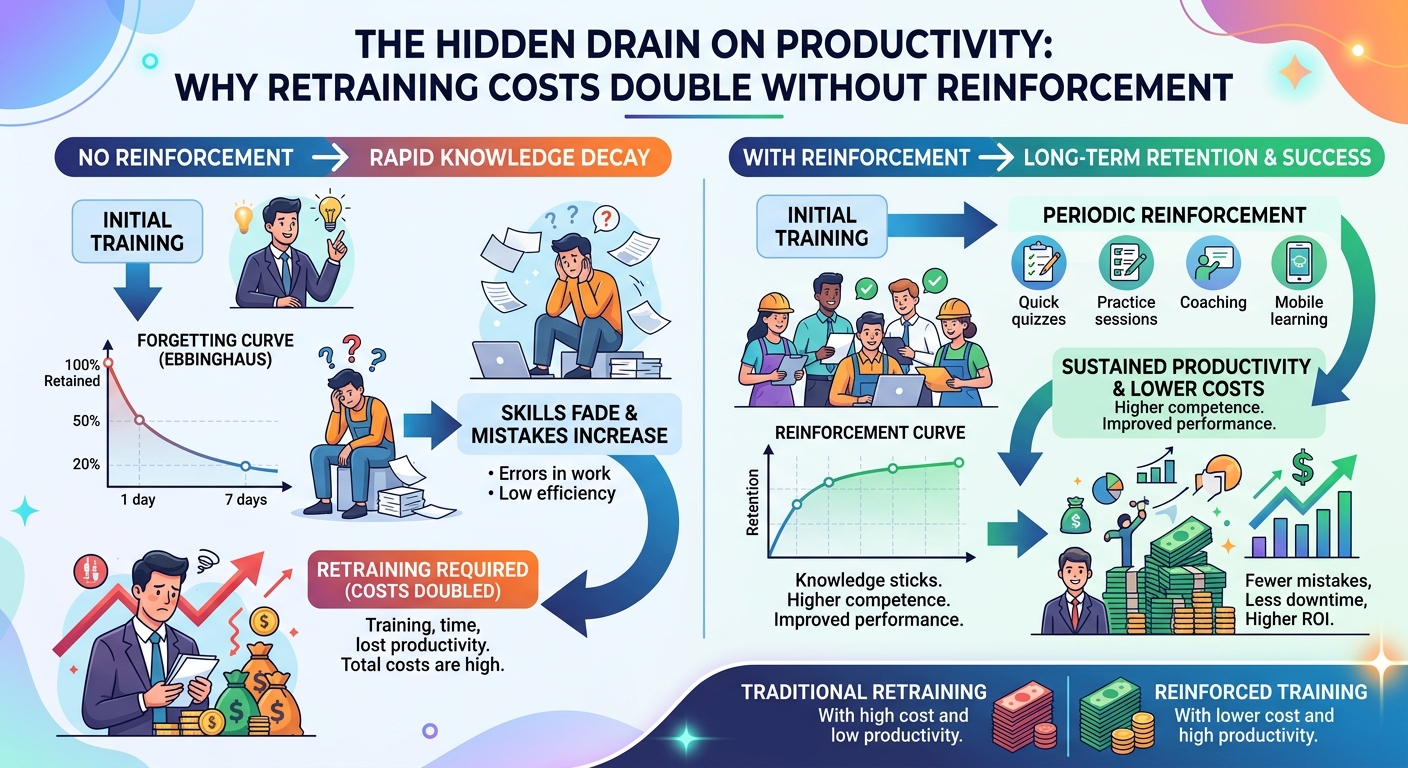
The human brain is a marvel, but it's also prone to the 'forgetting curve' – a concept introduced by Hermann Ebbinghaus. Without reinforcement, learners forget a significant portion of what they've learned within days, sometimes even hours, of completing a training session. Imagine the scenario: your sales team undergoes intensive training on a new product, or your compliance officers learn updated regulations. Weeks later, without follow-up, much of that critical information has faded. This isn't a failure of the initial training; it's a failure of the system to support knowledge retention.
This rapid decay of knowledge means that skills aren't being applied effectively on the job. Employees might revert to old habits, make avoidable errors, or simply lack the confidence to implement new procedures. The ripple effect? Reduced efficiency, increased errors, missed opportunities, and ultimately, a direct impact on the bottom line.
The Double Cost of Unreinforced Learning
When training lacks robust reinforcement, the costs quickly escalate beyond the initial investment. Let's break down the hidden expenses:
- Repeated Training Initiatives: If employees forget what they learned, the only perceived solution is more training. This means re-running courses, re-engaging instructors, and re-allocating resources that could have been used for new skill development. Effectively, you're paying twice for the same learning outcome.
- Lost Productivity & Errors: Unapplied knowledge translates directly into decreased productivity. Employees take longer to perform tasks, make mistakes that require rectification, or fail to capitalize on new strategies. For industries like healthcare or finance, errors due to forgotten compliance procedures can lead to significant financial penalties or even endanger patient safety.
- Employee Frustration & Disengagement: Constantly feeling undertrained or having to relearn information can be incredibly frustrating for employees. This leads to decreased morale, higher turnover rates, and a negative perception of the company's commitment to their professional growth.
- Reduced ROI on Training Investments: The ultimate consequence is a drastically diminished return on your substantial training investments. The initial spend on course development, trainer fees, venue costs (if applicable), and employee time off-task generates minimal long-term value without proper reinforcement.
Strategic Reinforcement: The Key to Unlocking Productivity
The good news is that these hidden drains are entirely preventable. By integrating continuous reinforcement into your eLearning strategy, you can dramatically improve knowledge retention, enhance productivity, and maximize your training ROI. This is where modern learning technologies, especially advanced LMS platforms, become indispensable.
How can learning technology predict and address skill gaps proactively?
Modern learning management software utilizes sophisticated analytics to track learner progress, identify common pitfalls, and even predict areas where individual employees might struggle. By analyzing performance data, engagement levels, and assessment results, a robust learning management system can pinpoint knowledge decay before it becomes a critical issue. This allows L&D teams to intervene with targeted refreshers or additional resources, ensuring that learning is always relevant and timely. This predictive capability transforms reactive training into proactive skill development.
Ensuring Global Consistency and Engagement in Skill Development
For multinational corporations or distributed teams, maintaining consistent skill levels across different regions and cultures is a significant challenge. A centralized cloud based learning management system ensures that all employees, regardless of their geographical location, have access to the same high-quality learning content and reinforcement activities. This global reach, combined with features that adapt to local nuances, fosters a unified skill base. Furthermore, engaging different cultural contexts often requires varied approaches. An enterprise learning management solution can provide tools for localized content delivery and communication, ensuring that reinforcement resonates universally.
What's the most effective way to engage diverse learners and maximize their impact?
Engagement is the cornerstone of effective reinforcement. A one-size-fits-all approach rarely works for diverse workforces. Modern eLearning strategies leverage interactive formats, personalized pathways, and immediate feedback to keep learners invested. For instance, Adaptive Learning tailors the learning experience to each individual's pace and style, serving up content and challenges based on their demonstrated proficiency. This personalized approach not only boosts engagement but also ensures that reinforcement is highly effective, addressing specific learning needs.
Leveraging Modern eLearning for Continuous Reinforcement
Effective reinforcement isn't about repeating full courses; it's about strategic, timely, and engaging nudges that solidify knowledge. Here are key strategies facilitated by advanced LMS learning management system solutions:
Microlearning LMS for Just-in-Time Support
Short, focused bursts of learning content delivered precisely when needed. Microlearning modules can be quick refreshers on a specific policy, a step-by-step guide for a new software feature, or a quick quiz to test understanding. These bite-sized lessons combat the forgetting curve by providing immediate reinforcement without overwhelming the learner. A dedicated Microlearning LMS excels at delivering this type of content.
Gamified LMS for Engaging Practice
Gamification turns reinforcement into an enjoyable experience. Leaderboards, badges, points, and challenges encourage active participation and competitive learning. Whether it's a quiz show to review compliance regulations or a simulation to practice sales pitches, a Gamified LMS transforms mundane practice into an engaging activity that fosters retention and skill mastery.
Adaptive Learning Pathways
Personalized learning paths ensure that reinforcement is tailored to individual needs. Instead of a blanket approach, an adaptive system identifies knowledge gaps and provides targeted content, ensuring learners spend time on what they need most. This efficiency is critical for complex topics like Risk-focused Training, where individual comprehension can vary widely.
AI-Powered Content Creation and Curation
An AI Powered Authoring Tool can dramatically speed up the creation of diverse and engaging reinforcement content. From generating quick quizzes to suggesting relevant follow-up materials, AI streamlines the process, making it easier for L&D teams to maintain a rich library of reinforcement resources within their learning content management system (LCMS).
Choosing the Right Learning Management Solutions
Implementing effective reinforcement starts with selecting the right technology. A modern learning management software platform like MaxLearn LMS offers a comprehensive suite of features designed to combat the forgetting curve. Look for solutions that provide:
- Seamless content delivery, including microlearning and video.
- Robust assessment and analytics capabilities.
- Gamification and social learning features.
- Support for Adaptive Learning.
- An intuitive user experience for both learners and administrators.
Investing in a sophisticated LCMS that prioritizes reinforcement is not an additional cost; it's an investment in the long-term productivity and proficiency of your workforce. It ensures that every dollar spent on initial training yields its maximum potential, transforming sporadic learning into continuous growth.
Conclusion
The hidden drain on productivity caused by a lack of learning reinforcement is a critical challenge for L&D leaders across all industries. By understanding the true costs of knowledge decay and embracing modern eLearning solutions, you can turn this challenge into an opportunity. Strategic reinforcement, empowered by advanced learning management solutions, doesn't just prevent the doubling of retraining costs; it elevates employee performance, boosts engagement, and delivers a superior return on your training investments. It's time to stop the drain and unleash the full potential of your workforce.
.jpg)


