

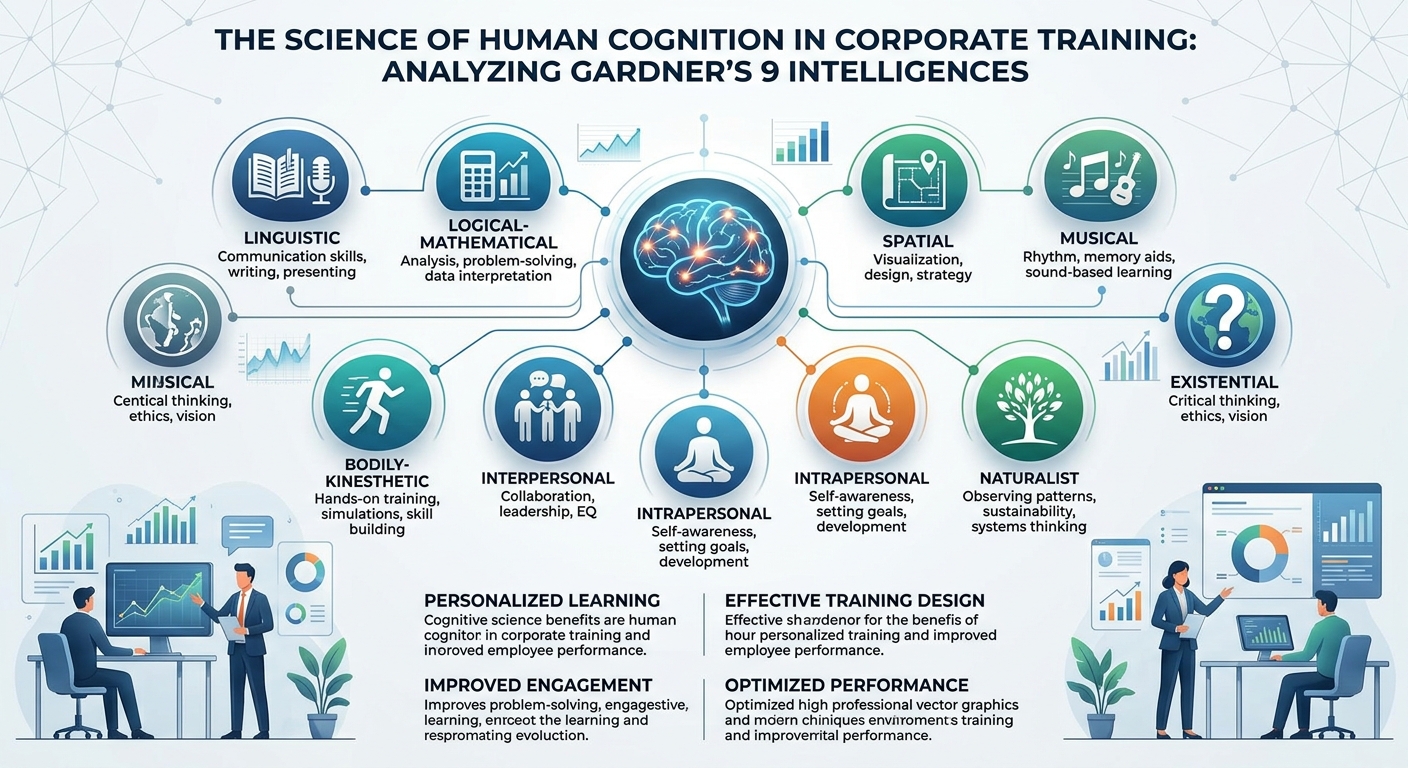
The Science of Human Cognition in Corporate Training: Analyzing Gardner’s 9 Intelligences
In the dynamic landscape of corporate learning and development, the quest for truly effective training solutions is perpetual. L&D leaders, VPs, Directors, and Managers across industries—from Compliance to Sales, Banking to Healthcare, and Pharma to Oil and Gas—are constantly seeking methodologies that resonate deeply with their diverse workforce. The traditional one-size-fits-all approach is becoming increasingly obsolete, as organizations recognize that each individual brings a unique set of cognitive strengths to the learning table. This understanding is precisely where Howard Gardner’s theory of Multiple Intelligences offers a profound framework for revolutionizing corporate training.
By delving into the science of human cognition, specifically through the lens of Gardner’s nine intelligences, L&D professionals can design bespoke learning experiences that not only enhance skill acquisition but also foster deeper engagement and long-term retention. This article explores how embracing these distinct cognitive profiles can unlock unparalleled potential in your training programs, making them more impactful and aligned with individual learner needs.
Understanding Gardner's Theory: A Foundation for Modern L&D
Howard Gardner, a developmental psychologist, challenged the conventional view of intelligence as a singular, quantifiable entity (IQ). Instead, he proposed that intelligence comprises several distinct "intelligences," each representing a different way of processing information and interacting with the world. Initially identifying seven, his theory later expanded to nine, suggesting that individuals possess varying degrees of each intelligence, with certain ones being more dominant. For corporate training, this implies that an employee struggling with a written manual might excel with hands-on simulations, not due to a lack of intelligence, but a difference in cognitive preference.
Recognizing and catering to these diverse cognitive strengths is paramount for building robust, adaptable, and highly skilled teams. It’s about moving beyond simply delivering content to understanding how each learner truly absorbs, processes, and applies knowledge within an enterprise learning management context.
Delving into the 9 Intelligences and Corporate Training Applications
1. Linguistic Intelligence (Word Smart)
Individuals strong in linguistic intelligence thrive with words, language, and communication. They enjoy reading, writing, storytelling, and debates. For corporate training, this translates to success with text-heavy materials, case studies, written assignments, and verbal presentations.
- Application: Provide detailed policy documents in Compliance training, allow for essay-based responses, encourage role-playing sales scripts, and facilitate discussions on best practices.
2. Logical-Mathematical Intelligence (Number/Reasoning Smart)
These learners excel at logical reasoning, problem-solving, patterns, and mathematical concepts. They appreciate structure, data analysis, and cause-and-effect relationships.
- Application: Implement data analytics workshops in Finance, offer problem-solving simulations for operations in Manufacturing, use complex scenarios in Risk-focused Training, and employ critical thinking exercises in strategic planning.
3. Spatial Intelligence (Picture Smart)
Individuals with high spatial intelligence think in images and three-dimensional spaces. They are good at visualizing, navigating, drawing, and understanding maps or diagrams.
- Application: Utilize infographics and flowcharts for process training, employ virtual reality (VR) simulations for equipment operation in Oil and Gas, use blueprints in Hospitality layout planning, and leverage visual aids in marketing presentations.
4. Bodily-Kinesthetic Intelligence (Body Smart)
These learners use their bodies to express ideas and feelings, and they learn best by doing. They have excellent coordination, dexterity, and a tactile understanding of the world.
- Application: Incorporate hands-on workshops, practical demonstrations for Retail product training, role-playing scenarios for customer service, and physical simulations for medical procedures in Healthcare. A Gamified LMS can greatly enhance engagement for these learners.
5. Musical Intelligence (Music Smart)
People with musical intelligence have a strong sensitivity to rhythm, pitch, melody, and tone. They may learn well through songs, jingles, or by associating information with music.
- Application: While less common in traditional corporate settings, this can be integrated by using mnemonic devices with rhythmic elements, background music for focus, or even creating short jingles for key compliance regulations.
6. Interpersonal Intelligence (People Smart)
These individuals are adept at understanding and interacting with others. They are strong in empathy, communication, and collaboration.
- Application: Implement group projects, peer mentoring programs, team-building exercises, and collaborative problem-solving for Sales teams. Workshops on negotiation and leadership development are also highly effective.
7. Intrapersonal Intelligence (Self Smart)
High intrapersonal intelligence indicates a deep understanding of oneself—one's own emotions, motivations, and goals. These learners benefit from self-reflection and independent study.
- Application: Provide opportunities for self-paced learning, reflective journaling after modules, goal-setting exercises, and personalized feedback sessions. Coaching and mentorship programs can also cater to their needs.
8. Naturalist Intelligence (Nature Smart)
Individuals with naturalist intelligence have an affinity for the natural world, recognizing patterns and relationships in nature.
- Application: While seemingly niche, this can be leveraged by using ecological metaphors for business processes, connecting sustainable practices in Pharma or Manufacturing to training, or using outdoor team-building activities to illustrate business concepts.
9. Existential Intelligence (Life Smart)
Often considered "cosmic smart," individuals with existential intelligence ponder deep questions about life, death, and existence. They are drawn to philosophical discussions and big-picture concepts.
- Application: Integrate discussions on organizational purpose, ethical dilemmas in Finance or Compliance, and the broader impact of business decisions on society, encouraging a deeper understanding of corporate values.
Leveraging Technology for Intelligent Training Design
Implementing a training strategy that caters to nine distinct intelligences might seem daunting, but modern eLearning technologies make it not only feasible but highly efficient. A robust LMS or a sophisticated learning management system is the cornerstone for this personalized approach.
What tools exist for tailoring learning content to diverse employee strengths? Contemporary learning management software offers advanced capabilities. Platforms with Microlearning LMS capabilities can deliver content in bite-sized, easily digestible formats, appealing to varying attention spans and learning preferences. For kinesthetic and logical learners, a Gamified LMS transforms learning into an engaging, interactive experience with points, badges, and leaderboards.
How do we ensure training adapts to each individual’s unique learning pathway? The answer lies in Adaptive Learning technologies. These systems analyze learner performance and preferences, then dynamically adjust the content, pace, and sequence of modules. This ensures linguistic learners get ample reading material, while spatial learners receive more visual aids.
Creating such varied content can be time-consuming. What solutions simplify the development of diverse training materials? An AI Powered Authoring Tool significantly streamlines content creation, allowing L&D teams to quickly develop interactive videos, quizzes, simulations, and text-based modules tailored to different intelligences. This kind of cloud based learning management system facilitates comprehensive learning content management system for all needs.
Consider the measurable impact of such intelligent training across different sectors. For Sales, personalized training powered by an lms learning management system can boost performance significantly. In Banking, tailored Risk-focused Training reduces errors. In Pharma, customized modules lead to better adherence to complex protocols. This holistic approach, facilitated by robust learning management solutions and an advanced LCMS like MaxLearn LMS, allows L&D professionals to make data-driven decisions and demonstrate clear ROI.
Conclusion: The Future of Cognitive-Centric Training
The science of human cognition, especially Gardner’s nine intelligences, provides a powerful blueprint for L&D leaders aiming to elevate corporate training from a mere necessity to a strategic advantage. By moving beyond generic programs and embracing individualized learning pathways, organizations can foster a culture of continuous growth, maximize employee potential, and drive unparalleled business success across all segments and industries.
Embracing a cognitive-centric approach means designing training that speaks to every learner's inherent strengths, making the learning journey more engaging, effective, and ultimately, transformative. The tools and platforms exist to make this vision a reality. It's time for L&D to harness the full spectrum of human intellect to build the skilled workforce of tomorrow.
.jpg)


