

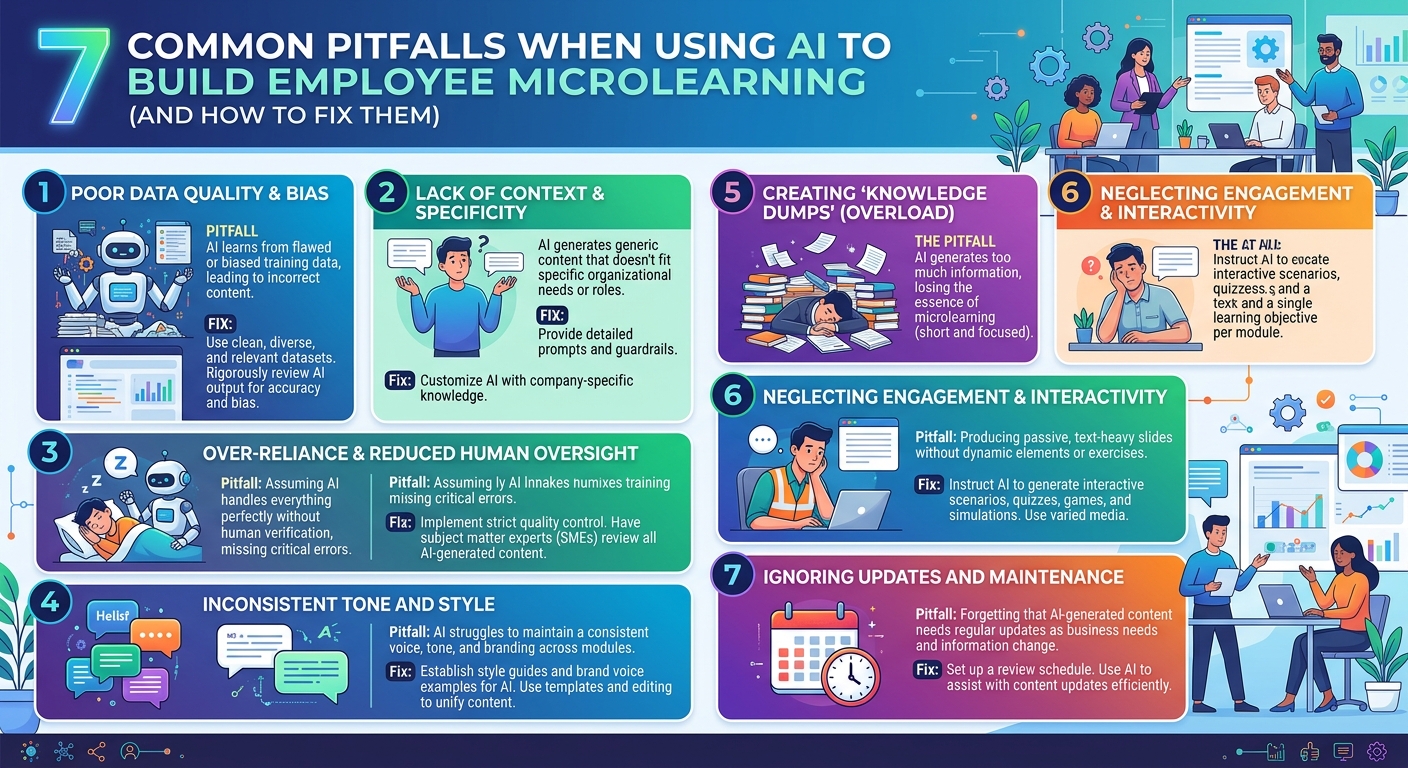
7 Common Pitfalls When Using AI to Build Employee Microlearning (And How to Fix Them)
The landscape of corporate learning and development is experiencing a transformative shift, driven by the dual forces of microlearning and Artificial intelligence (AI). For Vice Presidents, Directors, and Senior Managers in L&D, the promise of AI to streamline content creation, personalize learning paths, and enhance engagement for bite-sized, impactful training is incredibly compelling. Imagine rapidly deploying essential compliance updates, sales strategies, or banking protocols with unprecedented efficiency. However, as with any powerful tool, wielding AI effectively requires foresight and a clear understanding of potential challenges. Failing to navigate these can lead to ineffective training, wasted resources, and missed opportunities.
This article delves into seven common pitfalls L&D leaders encounter when leveraging AI to build employee microlearning programs across diverse industries like compliance, sales, banking, finance, insurance, retail, pharma, healthcare, hospitality, oil and gas, and mining. More importantly, we'll provide actionable strategies to overcome them, ensuring your investment in AI truly elevates your organization's learning capabilities.
The Promise and Peril of AI in Microlearning
AI's capacity to analyze vast datasets, generate content, and adapt to individual learning styles offers a significant advantage for creating dynamic microlearning modules. It can accelerate the development of a Microlearning LMS content, allowing for quicker responses to evolving industry standards or market demands. Yet, the rush to adopt AI can sometimes overshadow critical considerations, leading to pitfalls that undermine the very goals L&D aims to achieve.
Frequently Asked Questions for AI-Powered Microlearning Development:
- How can AI enhance microlearning development? AI can automate content generation, personalize learning paths, provide real-time feedback, and analyze learner performance to optimize future content. It allows L&D teams to scale their efforts, particularly in rapidly changing sectors like finance or healthcare, making any learning management system more powerful.
- What are the key considerations when implementing AI for global training initiatives? When deploying AI-driven microlearning across different regions, L&D leaders must consider language localization, cultural nuances, data privacy regulations (like GDPR or CCPA), and potential algorithmic biases that might affect diverse employee groups.
- What are the optimal AI integrations for corporate learning platforms? Optimal integrations involve AI-powered content creation tools, intelligent recommendation engines, sentiment analysis for feedback, and analytics dashboards. A robust learning management system (LMS) with capabilities for an AI Powered Authoring Tool is crucial for seamless operation.
7 Common Pitfalls and Their Fixes
1. Over-Reliance on AI for Content Generation (Lack of Human Oversight)
The Pitfall: While AI can generate text, quizzes, and even scenarios rapidly, simply letting it run unsupervised often results in content that is generic, factually incorrect, or lacks the nuanced context critical for effective learning. This is particularly dangerous in highly regulated industries like banking or pharma, where precision is paramount. A learning content management system needs human intelligence to guide it.
The Fix: Treat AI as a powerful assistant, not a replacement for human expertise. Implement a rigorous human review process involving subject matter experts (SMEs), instructional designers, and compliance officers. Use AI for initial drafts, ideation, or repetitive tasks, but always ensure human editors refine, verify, and infuse the content with the necessary depth, accuracy, and brand voice. This ensures the output is not just coherent, but truly valuable for any learning management software strategy.
2. Generic Content that Lacks Personalization
The Pitfall: Many L&D teams assume AI automatically personalizes learning. However, if not configured correctly, AI can produce one-size-fits-all content that fails to resonate with individual learners, their roles, or their existing knowledge levels. This leads to disengagement, especially in a diverse workforce spanning roles from sales to compliance to hospitality.
The Fix: Leverage AI's true potential for Adaptive Learning. Instead of just generating content, use AI to analyze learner data (performance, preferences, roles, pre-assessments) to dynamically recommend specific modules, adjust difficulty, or offer supplementary resources. A sophisticated learning management system can track these interactions, allowing AI to continually fine-tune the learning journey for each employee. This approach transforms a generic learning management system into a truly personalized experience through smart learning management solutions.
3. Ignoring Compliance and Ethical Considerations
The Pitfall: AI models can inadvertently perpetuate biases present in their training data, leading to unfair or discriminatory content. Additionally, the use of employee data by AI raises significant privacy concerns, especially with global teams or sensitive sectors like healthcare and finance. Neglecting these aspects can lead to legal issues, reputational damage, and a loss of employee trust.
The Fix: Prioritize Risk-focused Training and ethical AI guidelines from the outset. Conduct regular bias audits on AI-generated content and algorithms. Implement robust data privacy protocols compliant with GDPR, CCPA, and other relevant regulations. Ensure transparency with employees about how their data is used and anonymized. Involve legal and HR teams in the AI strategy to mitigate risks and build trust in your LCMS environment.
4. Poor Integration with Existing Systems
The Pitfall: AI tools often operate in silos, making it challenging to integrate them seamlessly with an existing enterprise learning management, HRIS, or content libraries. This can create fragmented workflows, data inconsistencies, and hinder the overall effectiveness of your microlearning strategy. An effective learning management system requires synergy.
The Fix: Choose AI solutions and platforms that offer robust API capabilities and adhere to open standards. Prioritize an Microlearning LMS that acts as a central hub, capable of integrating with various AI Powered Authoring Tools and data sources. Plan for integration early in the process, involving IT stakeholders to ensure smooth data flow and avoid compatibility issues. A cloud based learning management system often offers greater flexibility for such integrations, making MaxLearn LMS a strong contender.
5. Neglecting the Learner Experience (Engagement)
The Pitfall: Automated content, no matter how accurate or personalized, can fall flat if it's not engaging. Simply delivering information via AI-generated text or video isn't enough to capture and retain attention, especially in a microlearning format. The human element of connection and motivation is easily lost.
The Fix: Design for engagement. Incorporate interactive elements, simulations, and scenarios that AI can help create but human instructional designers optimize. Explore how a Gamified LMS can leverage AI to provide personalized challenges, badges, and leaderboards, boosting motivation. Use AI to analyze engagement metrics and iterate on content, ensuring it remains fresh, relevant, and compelling. MaxLearn LMS often excels in delivering a rich user experience, setting a new standard for lms learning management system effectiveness.
6. Data Overload and Analysis Paralysis
The Pitfall: AI generates vast amounts of data on learner performance, content effectiveness, and engagement. While valuable, L&D teams can become overwhelmed by raw data, struggling to extract meaningful, actionable insights. This leads to analysis paralysis, where the benefits of data-driven decision-making are lost.
The Fix: Focus on key performance indicators (KPIs) relevant to your learning objectives. Utilize AI's analytical capabilities to distill complex data into clear, actionable reports and visualizations. A good learning management system should offer intelligent dashboards that highlight trends, identify knowledge gaps, and suggest areas for content improvement. Define what success looks like upfront and configure AI to report on those specific metrics, transforming raw data into strategic intelligence for your learning management solutions.
7. Scoping Issues and Scalability Challenges
The Pitfall: Many organizations jump into AI for microlearning with an overly ambitious scope or without considering the long-term scalability of their chosen solutions. What works for a small pilot project might not scale effectively for a global workforce of thousands, leading to performance bottlenecks, prohibitive costs, or a brittle system.
The Fix: Start small with a pilot program, define clear objectives, and iterate. Choose AI tools and a cloud based learning management system that are inherently scalable, designed to handle growing volumes of users and content. Plan for infrastructure, integration, and ongoing maintenance costs. A phased rollout allows for continuous learning and adjustment, ensuring that your AI-powered microlearning initiative can grow seamlessly with your organization's needs. Invest in a robust LCMS that can evolve as your enterprise learning management strategy matures.
Conclusion
AI offers an unparalleled opportunity for L&D leaders to revolutionize employee microlearning, delivering highly effective, personalized, and engaging training across industries. From crucial compliance training in banking and insurance to dynamic sales enablement in retail and pharma, the potential is immense. However, realizing this potential demands a strategic, informed approach.
By understanding and proactively addressing these seven common pitfalls – from ensuring human oversight and prioritizing personalization to embedding ethical considerations and planning for scalability within your learning management software strategy – you can harness AI's power to build truly impactful learning experiences. Embrace AI as a strategic partner, and watch your organization’s learning culture thrive, driving performance and fostering continuous growth with a reliable LMS.
.jpg)


