

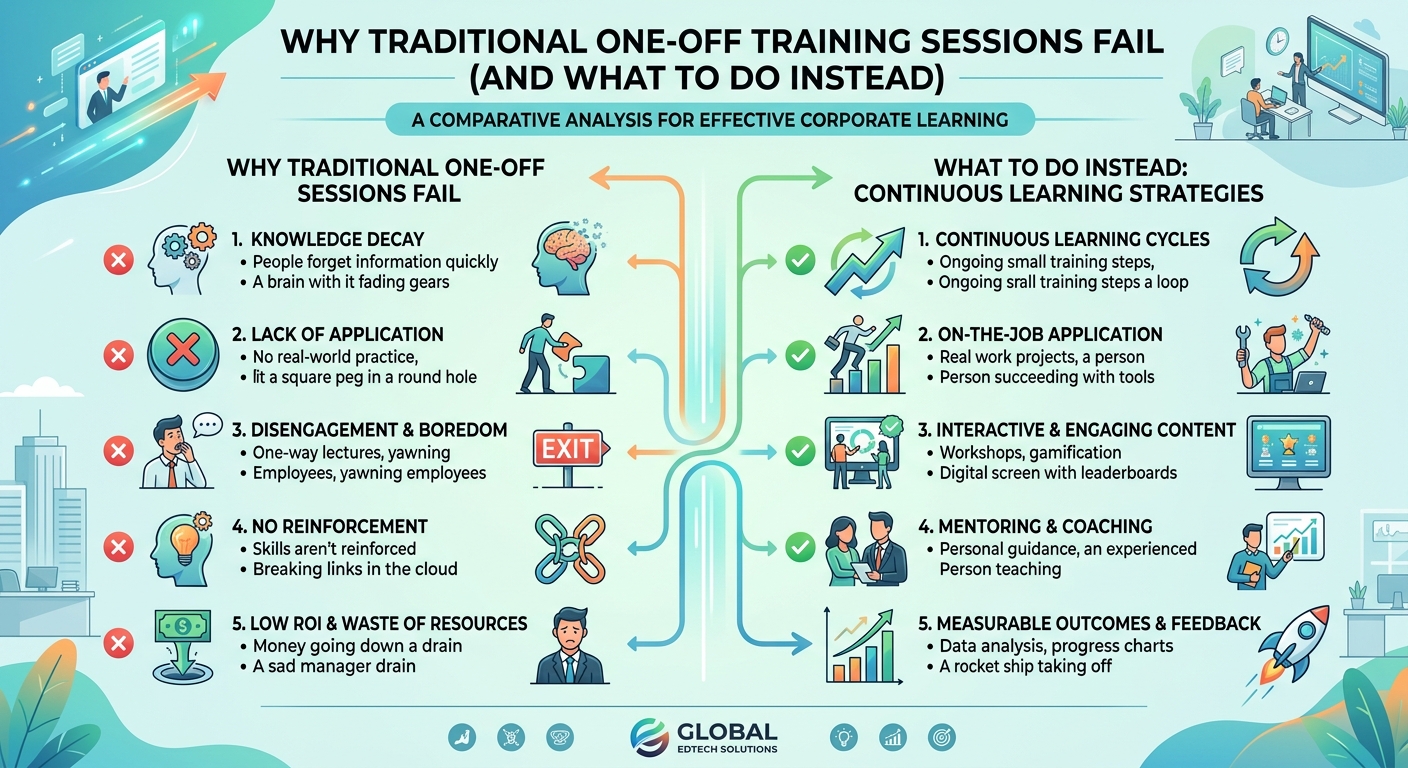
Why Traditional One-Off Training Sessions Fail (And What to Do Instead)
In the dynamic corporate landscape of today, continuous learning isn't just a perk; it's a strategic imperative. Yet, many organizations, from multinational corporations in
Compliance
andSales
to critical sectors likeBanking
,Finance
,Insurance
,Retail
,Pharma
,Health care
,Hospitality
,Oil and Gas
, andMining
, continue to rely on a traditional approach to employee development: the one-off training session. These standalone workshops, often hailed as quick fixes, frequently fall short of their intended goals, leaving L&D leaders, VPs, Directors, and Senior Managers frustrated with limited impact and an underwhelming return on investment.The core issue isn't the intention behind these sessions, but their fundamental design. A single event, no matter how engaging, struggles to cultivate lasting knowledge, skill proficiency, or behavioral change. It's akin to watering a plant once and expecting it to thrive indefinitely. For true growth, a more sustained, integrated, and intelligent approach is required.
Why Traditional Training Falls Short: The Root Causes of Failure
To understand why a different strategy is crucial, we must first dissect the inherent flaws of the conventional one-off training model:
The Forgetting Curve: A Relentless Reality
Perhaps the most significant challenge is the human brain's natural tendency to forget. Hermann Ebbinghaus's forgetting curve demonstrates that within days of a learning event, a substantial portion of information is lost if not reinforced. A single workshop provides an initial knowledge boost, but without spaced repetition and practical application, that knowledge rapidly erodes. This makes the investment in a one-time event highly inefficient for long-term retention.
Lack of Context and Relevance: A Disconnect from Daily Work
Traditional sessions often deliver generic content that may not directly align with an individual's specific job role, challenges, or immediate needs. Employees struggle to connect the theoretical concepts to their day-to-day tasks, particularly in highly specialized fields like
Pharma
research orOil and Gas
operations. This perceived irrelevance diminishes motivation and the likelihood of applying new skills.Passive Learning & Engagement Issues: The "Sit-and-Get" Trap
Many one-off trainings are lecture-based, promoting passive consumption rather than active participation. While some workshops incorporate activities, the overall format often fails to sustain high levels of engagement. Learners become disengaged, distracted, and their capacity for deep learning is severely limited. This is especially problematic in industries requiring critical decision-making, such as
Banking
andHealth care
, where active problem-solving is paramount.Difficulty in Measuring Impact: The Elusive ROI
Measuring the true impact of a single training event on performance or business outcomes is notoriously difficult. Without mechanisms for follow-up, ongoing assessment, and integration into performance metrics, L&D departments struggle to justify the investment. How do you quantify the long-term benefits of a two-hour session on compliance regulations or new sales techniques months after it concluded?
One-Size-Fits-All Mentality: Ignoring Individual Needs
A single training module rarely caters effectively to the diverse learning styles, prior knowledge, and skill gaps present within any group of employees. What's foundational for one might be redundant for another, leading to boredom or overwhelm. This "average learner" approach inevitably leaves some learners behind and under-challenges others, limiting overall effectiveness.
The Path Forward: A Modern Approach to Learning
Instead of relying on isolated events, L&D leaders must embrace a holistic, continuous, and integrated learning ecosystem. This involves shifting from an event-centric to a process-centric view of development.
Continuous, Integrated Learning: The Workflow Advantage
Effective learning should be woven into the fabric of daily work, not a separate disruption. This means providing easily accessible, bite-sized learning opportunities that can be consumed "just-in-time" when an employee needs to solve a problem or acquire a specific skill. A robust Microlearning LMS is essential for delivering these frequent, targeted reinforcements that combat the forgetting curve and foster ongoing skill development. This is particularly vital for dynamic environments like
Sales
orRetail
.Personalized & Adaptive Learning: Tailoring the Journey
Leverage technology to create individualized learning paths. An Adaptive Learning system can assess a learner's current knowledge and adjust the content and pace accordingly, ensuring relevance and maximizing efficiency. This approach ensures that every employee, from a new hire in
Hospitality
to a seasoned executive inMining
, receives the precise training they need.Engaging & Interactive Experiences: Learning by Doing
Modern learning platforms prioritize engagement through interactive content, simulations, and challenges. Implementing a Gamified LMS, for instance, can transform mundane compliance training or product knowledge modules into motivating experiences. This active engagement enhances retention and skill application, crucial for areas like
Compliance
andInsurance
.Data-Driven Insights & ROI: Proving the Value
Modern learning solutions, particularly an advanced
LMS
, offer robust analytics capabilities. This allows L&D professionals to track engagement, completion rates, skill progression, and even link learning activities to business outcomes. By understanding what’s working and what isn’t, organizations can continuously optimize their strategies and clearly demonstrate the return on investment of their enterprise learning management efforts.Leveraging Technology for Transformative Learning
The right learning technology is the cornerstone of this modern approach. A comprehensive
learning management system
goes beyond simple course delivery; it’s a strategic platform for talent development.- Microlearning Platforms: For continuous reinforcement and just-in-time support, a specialized Microlearning LMS delivers short, focused content modules. This is ideal for quickly updating employees on new regulations in
Compliance
or product features inSales
. - Gamified Experiences: To boost motivation and active participation, integrate elements of game design. A Gamified LMS can incorporate points, badges, leaderboards, and challenges, making learning more enjoyable and effective, especially for complex topics in
Finance
orHealth care
. - Adaptive and Personalized Paths: Utilize Adaptive Learning technologies to tailor content delivery based on individual performance and preferences. This ensures that training is always relevant and impactful, reducing wasted time and improving outcomes.
- AI-Powered Content Creation: Accelerate the development of high-quality, relevant learning materials with an AI Powered Authoring Tool. This not only streamlines the content development process for your
learning content management system
but also ensures that the content is optimized for engagement and retention across various industries. - Strategic and Risk-Focused Training: For industries like
Banking
,Insurance
, andMining
, identifying and mitigating potential operational and compliance risks is paramount. Integrating Risk-focused Training into your learning management software ensures that critical areas are continuously addressed and reinforced, protecting the business from significant liabilities.
MaxLearn LMS offers a cloud based learning management system that empowers organizations across all industries with these advanced capabilities, transforming traditional training into a strategic advantage.
AI-Driven Learning: Answering Your Critical Questions
As L&D leaders navigate this transformation, questions naturally arise about the role of advanced technologies.
Q: How can artificial intelligence personalize training for individual employee needs?
Artificial intelligence analyzes vast amounts of data on a learner's performance, preferences, and knowledge gaps. It can then dynamically recommend specific content, adjust the difficulty of modules, and even suggest optimal learning paths tailored to each individual. This ensures that every employee receives the most relevant and impactful training experience, accelerating skill development.
Q: What's the best approach for deploying advanced learning solutions across geographically dispersed global teams?
For global teams, a centralized, cloud-based learning management software is crucial. AI-enhanced platforms can automatically localize content, track progress across different time zones, and provide consistent, high-quality training regardless of location. This ensures equitable access to learning resources for everyone, from an offshore rig worker to a corporate executive, maintaining a unified standard of excellence. An integrated
LCMS
becomes vital here.Q: Beyond engagement, what tangible business benefits can advanced learning solutions deliver?
Beyond boosting engagement, advanced learning solutions translate directly into measurable business benefits. They significantly reduce compliance risks, accelerate time-to-competency for new hires, improve sales performance, enhance customer satisfaction, and foster a culture of continuous innovation. By providing data-driven insights, these solutions allow organizations to link learning investments directly to key performance indicators and strategic objectives, demonstrating a clear return on investment for your
lms learning management system
initiatives.Conclusion: Moving Beyond the One-Off
The era of the one-off training session as a primary development strategy is rapidly fading. L&D professionals, VPs, Directors, and Senior Managers must recognize its limitations and pivot towards continuous, personalized, and engaging learning experiences. By adopting a modern learning management system, integrating
Microlearning LMS
,Gamified LMS
, Adaptive Learning, and leveraging an AI Powered Authoring Tool for content creation, organizations can build a resilient, skilled workforce ready to meet the challenges of tomorrow.Don't let your training investments fall victim to the forgetting curve. Embrace a future where learning is an ongoing journey, not a single destination. With an advanced
learning management solution
like MaxLearn LMS, you can transform your L&D strategy from reactive to proactive, ensuring sustained growth and competitive advantage across all industries..jpg)


