

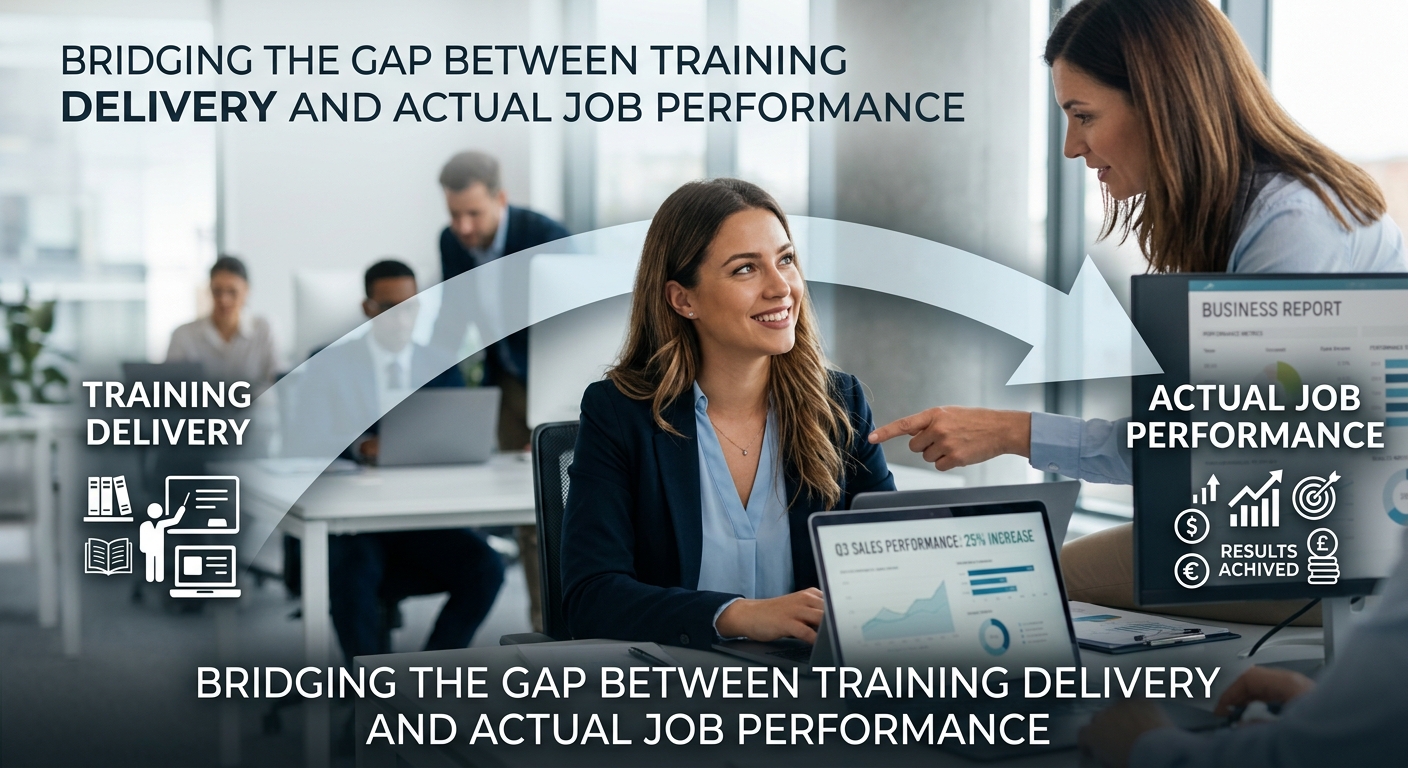
Bridging the Gap Between Training Delivery and Actual Job Performance: Strategies for L&D Leaders
For Vice Presidents, Directors, and Senior Managers in Learning & Development, few challenges are as persistent or as critical as ensuring that delivered training translates directly into tangible improvements in job performance. The investment in eLearning solutions, whether for compliance, sales, banking, finance, insurance, retail, pharma, healthcare, hospitality, oil and gas, or mining, is substantial. Yet, the chasm between completing a course and demonstrating enhanced skills or changed behaviors on the job remains a significant hurdle. This article delves into strategies for L&D leaders to effectively bridge this gap, leveraging modern learning methodologies and advanced technological solutions.
The Persistent Problem: The Chasm Between Learning and Doing
The traditional model of training often falls short. Employees might attend workshops, complete online modules, or pass quizzes, but the knowledge acquired doesn't always stick or apply in real-world scenarios. This disconnect leads to wasted resources, frustrated employees, and ultimately, a failure to impact key business objectives. The reasons for this gap are multi-faceted:
- Irrelevant Content: Training that isn't tailored to specific job roles or immediate challenges.
- Passive Learning: Lectures or modules that don't encourage active engagement or critical thinking.
- Lack of Reinforcement: New skills fade quickly without opportunities for practice and application.
- Disconnected from Context: Learning environments that don't mirror actual workplace conditions.
- Insufficient Managerial Support: Managers who aren't equipped to coach or provide opportunities for skill application.
The financial implications are severe. Every dollar spent on ineffective training is a dollar not invested in genuine performance uplift. L&D leaders must pivot from merely delivering content to facilitating performance transformation.
Pillars of Effective Performance Transfer
Bridging the gap requires a strategic, holistic approach that addresses various stages of the learning journey. Here are the foundational pillars:
Relevance and Contextualization
Learning content must be directly relevant to the learner's job role, daily tasks, and the specific challenges they face. Generic courses have limited impact. By integrating real-world case studies, scenario-based learning, and examples pertinent to their industry – be it the intricacies of financial regulations or the specific sales pitch for a new pharmaceutical product – learners can immediately see the value and applicability.
Engaging Delivery Mechanisms
Engagement is key to retention and application. Static content leads to passive consumption. Incorporating interactive elements, simulations, virtual reality, and collaborative exercises transforms the learning experience. A Gamified LMS, for instance, can inject elements of competition, reward, and progress tracking, making learning more enjoyable and intrinsically motivating for diverse workforces across industries like retail and hospitality.
Reinforcement and Practice
One-off training sessions are rarely enough. Knowledge acquisition must be followed by consistent reinforcement and opportunities for practice. This is where a Microlearning LMS proves invaluable. Short, focused modules delivered just-in-time, or as refreshers, help solidify understanding and provide opportunities for spaced repetition. This approach is particularly effective for high-stakes environments like compliance or healthcare, where continuous knowledge updates are crucial.
Feedback and Coaching
Learners need constructive feedback on their performance and application of new skills. This can come from automated assessments, peer reviews, or, most critically, from direct managers. Equipping managers with the tools and training to become effective coaches is paramount. Their role in guiding employees to apply learning on the job is a critical link in the performance transfer chain.
Measurement and Analytics
What gets measured gets managed. L&D leaders must move beyond completion rates to measure the actual impact of training on job performance. This involves tracking KPIs, conducting post-training performance reviews, and correlating learning outcomes with business results. A robust `learning management system` (LMS) can provide the data necessary to analyze effectiveness and demonstrate ROI.
Leveraging Technology for Seamless Performance Integration
Modern `LMS` platforms are more than just content repositories; they are sophisticated ecosystems designed to facilitate continuous learning and performance improvement.
The Role of Modern Learning Platforms
An advanced `LMS learning management system` serves as the central hub for all `enterprise learning management` initiatives. A robust `cloud based learning management system` offers flexibility, scalability, and accessibility, crucial for geographically dispersed teams in sectors like oil and gas or global finance. These platforms, often functioning as a comprehensive `learning content management system` (LCMS), enable the delivery, tracking, and management of diverse content types, from intricate engineering protocols to new banking product training. The best `learning management software` and `learning management solutions` integrate seamlessly into existing workflows, making learning an organic part of the workday. MaxLearn LMS is an example of a platform engineered to bridge this gap, focusing on delivering relevant, engaging, and performance-driving learning experiences.
Personalization through Adaptive Learning
One size rarely fits all. Adaptive learning technologies analyze a learner's existing knowledge, performance data, and learning style to deliver a personalized learning path. This ensures that employees spend time on what they don't know or need to improve, rather than rehashing familiar topics. For instance, in pharma, an adaptive system can guide a sales rep through modules focusing specifically on drug interactions they struggled with, rather than making them repeat an entire pharmacology course.
Content Creation with Intelligence
Developing relevant and engaging content quickly is a perpetual challenge. An AI Powered Authoring Tool can dramatically speed up this process. These tools can help generate content outlines, suggest interactive elements, and even draft initial learning modules based on input or existing data, ensuring that training remains current and impactful, especially in fast-evolving industries like tech sales or healthcare.
Focusing on Critical Areas: Risk-focused Training
For industries like banking, insurance, compliance, and healthcare, mitigating risk is paramount. Training that explicitly targets potential vulnerabilities and provides clear guidelines for risk reduction directly impacts job performance and organizational stability. By using data analytics to identify high-risk areas, L&D can deploy targeted, microlearning interventions to reinforce best practices and prevent costly errors, thereby demonstrating a direct link between learning and critical business outcomes.
AI and the Future of Performance-Driven Learning
Artificial intelligence is transforming how L&D leaders approach performance improvement. Its capabilities extend beyond simple automation, offering profound insights and personalized experiences that can dramatically close the learning-performance gap.
Frequently Asked Questions on AI's Impact:
How can artificial intelligence personalize learning to maximize individual employee job readiness?
AI's strength lies in its ability to process vast amounts of data. By analyzing an employee's past performance reviews, project outcomes, skill assessments, and even their interaction patterns within an online `learning management software`, AI can pinpoint specific knowledge gaps and development needs. It then curates and recommends highly personalized microlearning modules or full courses, ensuring that each learner receives content most relevant to enhancing their readiness for current and future job demands. This includes recommending practice scenarios, simulations, or relevant resources just when they are needed most.
What strategies can advanced intelligent systems offer to ensure consistent, high-quality training across diverse global teams and operational contexts?
For organizations with a global footprint, such as multinational banks, pharmaceutical companies, or oil and gas giants, ensuring training consistency is a significant challenge. Intelligent systems can overcome this by providing automated content translation and localization, adapting not just language but also cultural nuances and regulatory specifics for different regions. They can deliver content in various formats optimized for diverse internet speeds and device types, ensuring equitable access and experience. Furthermore, AI can monitor engagement and comprehension across different demographics, providing L&D leaders with insights to refine training for universal effectiveness.
How do intelligent analytical tools help L&D leaders pinpoint the most effective training interventions and measure their direct impact on business results?
Intelligent analytical tools embedded within a `learning management system` move L&D beyond simple completion rates. They correlate learning data (e.g., engagement, quiz scores, skill acquisition) with operational data (e.g., sales figures, compliance adherence rates, production efficiency, customer satisfaction scores). By identifying patterns and causations, these tools can reveal which specific training interventions are leading to the desired performance uplifts. For example, AI can show that employees who completed a specific Risk-focused Training module had a X% reduction in errors, directly impacting cost savings. This powerful feedback loop allows L&D leaders to continuously optimize their `learning management solutions`, proving the tangible ROI of their programs.
Practical Steps for L&D Leaders
To truly bridge the gap, L&D leaders must:
- Adopt a Performance-First Mindset: Shift focus from "what training did we deliver?" to "how did this training improve performance?"
- Collaborate Closely with Business Units: Understand specific operational needs and performance metrics to design targeted interventions.
- Invest in Modern `LMS` and Content Tools: Leverage `enterprise learning management` systems, `AI Powered Authoring Tool`s, and `Adaptive Learning` capabilities to create dynamic, relevant, and accessible learning experiences. Consider platforms like MaxLearn LMS for a comprehensive `learning content management system` approach.
- Foster a Culture of Continuous Learning and Application: Encourage managers to integrate learning into daily work, provide coaching, and create opportunities for skill practice.
Conclusion
The goal of L&D is not merely to train, but to transform performance. By strategically focusing on relevance, engagement, reinforcement, and leveraging cutting-edge technology like intelligent `LMS` platforms and AI, L&D leaders can successfully bridge the gap between training delivery and actual job performance. This not only empowers employees but also drives significant business outcomes, proving the indispensable value of a forward-thinking L&D function across all industries. The time is now to move beyond traditional models and embrace performance-centric learning solutions.
.jpg)


