

How Often Should You Reinforce Training Content for Maximum Recall?
As leaders in Learning & Development, you understand the critical importance of effective training. Yet, a persistent challenge looms: the human tendency to forget. Employees invest valuable time in courses, but without proper reinforcement, much of that knowledge can dissipate, impacting performance, compliance, and ultimately, your organization’s bottom line. The crucial question isn't just about initial training delivery, but “How often should you reinforce training content for maximum recall?” This article delves into strategies for ensuring your investment in employee development yields lasting results.
The Forgetting Curve: Understanding the Challenge
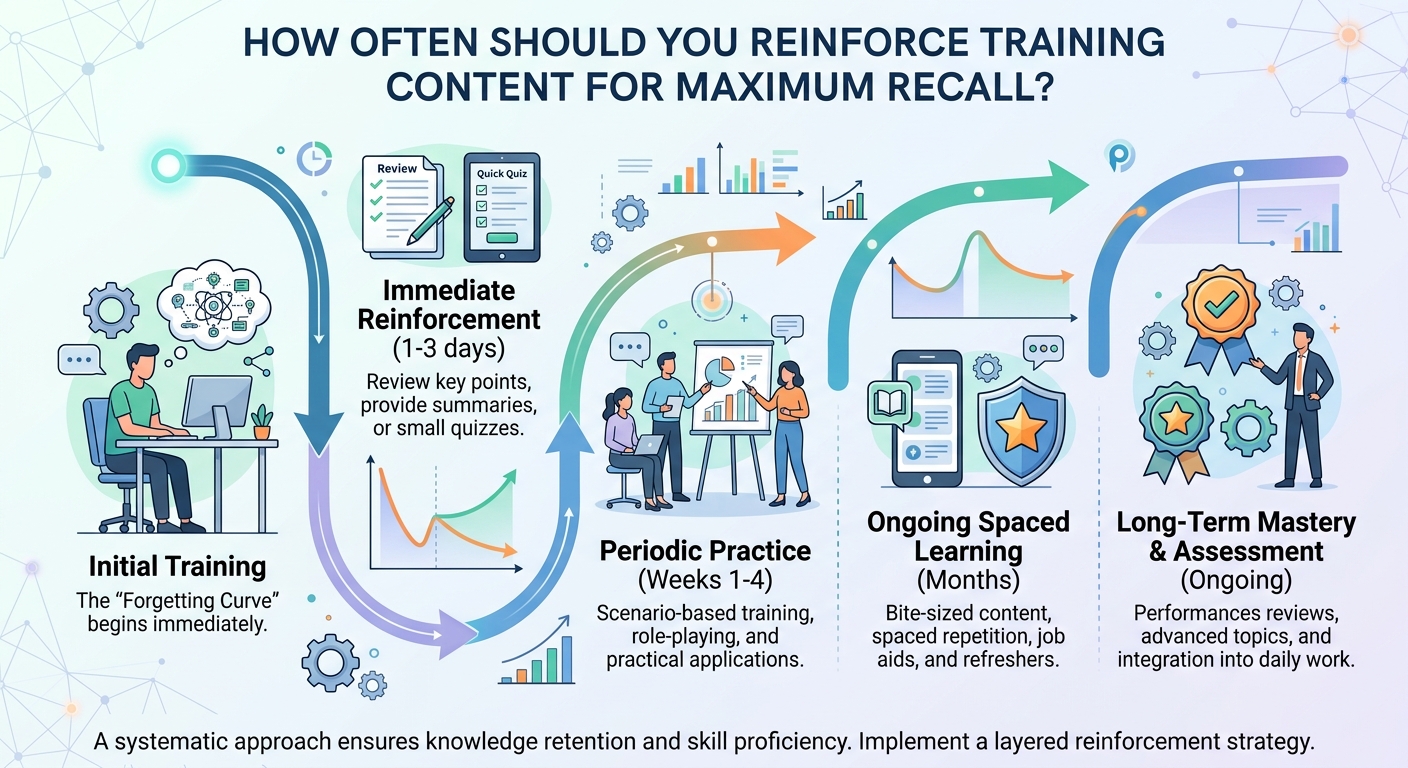
Hermann Ebbinghaus’s “Forgetting Curve” famously illustrates that within just an hour, people forget about 50% of newly learned information, and within a week, that number can climb to 90%. For L&D professionals, this isn't just a psychological curiosity; it's a strategic impediment. Whether it's complex compliance regulations, new sales techniques, or critical safety procedures, forgotten knowledge represents lost potential and increased risk.
Effective reinforcement isn't merely about repeating information; it’s about strategically re-engaging learners at optimal intervals to transfer knowledge from short-term to long-term memory. This is particularly vital in industries like finance, healthcare, and manufacturing, where precision and retention directly impact operational excellence and regulatory adherence.
The Science Behind Recall: Spaced Repetition
The answer to "How often?" largely lies in the principle of spaced repetition. Instead of cramming, spaced repetition involves reviewing information at increasing intervals over time. This method actively combats the forgetting curve, strengthening memory traces with each successive retrieval. An optimal Microlearning LMS can be instrumental in automating these schedules.
Many L&D leaders often ask, "What is the optimal frequency for training refreshers to truly stick?" The precise interval can vary based on several factors:
- Content Complexity: More complex or nuanced information (e.g., advanced financial models, detailed pharmaceutical protocols) typically requires more frequent early reinforcement.
- Learner Prior Knowledge: Learners with a weaker foundation may need quicker follow-ups.
- Consequences of Forgetting: For high-stakes training, such as Risk-focused Training in banking or oil and gas, reinforcement should be more aggressive.
- Employee Engagement: How engaged is the learner? More engaging content can extend intervals between reviews.
Generally, initial reinforcement should occur within 24-48 hours, followed by reviews at 1 week, 2 weeks, 1 month, 3 months, and 6 months. Advanced LMS platforms can automate this intricate scheduling, tailoring it to individual progress.
Leveraging Modern eLearning for Continuous Reinforcement
The digital age has gifted L&D professionals powerful tools to implement sophisticated reinforcement strategies. A robust learning content management system (LCMS) or a comprehensive learning management software (LMS) is no longer just for initial course delivery; it's the engine for ongoing learning and recall.
Microlearning: The Power of Bitesize Reinforcement
Long, exhaustive training sessions are often counterproductive for reinforcement. Microlearning LMS excels here by delivering short, focused bursts of information. These can be:
- Quick quizzes or flashcards on a key concept.
- Short video explainers for complex procedures.
- Interactive scenarios that test decision-making.
- Infographics summarizing crucial data.
Microlearning modules are perfect for spaced repetition, easily consumed during natural breaks, and are highly effective for high-volume content, such as product knowledge in retail or compliance updates in finance. A Adaptive Learning approach, often facilitated by microlearning, ensures content relevance for each individual.
Gamification: Making Reinforcement Engaging
Monotonous repetition can lead to disengagement. Gamified LMS features transform reinforcement into an enjoyable challenge. Points, badges, leaderboards, and friendly competitions motivate employees to revisit content. When asking, "How can we make recurring training less of a chore?", gamification provides a compelling answer, especially for industries like sales, where competition is a natural motivator.
- Challenges: Short, daily challenges related to recent training.
- Quests: Sequential tasks that build upon previous learning.
- Rewards: Tangible or intangible recognition for consistent engagement.
An effective learning management system that incorporates gamification can dramatically boost participation in reinforcement activities.
AI-Powered and Adaptive Learning: Personalized Reinforcement
The cutting edge of learning technology offers truly personalized reinforcement. Adaptive Learning systems analyze a learner's performance, identifying knowledge gaps and areas of strength. They then dynamically adjust the reinforcement schedule and content, delivering precisely what an individual needs, when they need it.
For example, if an employee consistently struggles with a particular module on data privacy, an enterprise learning management system powered by AI can automatically serve up additional microlearning modules, quizzes, or even contextual job aids related to that topic. This moves beyond a one-size-fits-all approach to highly efficient, targeted interventions.
Many L&D teams ponder, "Can technology predict when an employee needs a knowledge refresh, even for complex topics?" Absolutely. An AI Powered Authoring Tool, integrated with a sophisticated lms learning management system, can analyze performance data and even help create relevant, personalized reinforcement content on the fly, significantly reducing the manual effort involved in content updates and scheduling for ongoing training.
Implementing a Robust Reinforcement Strategy
Developing a successful reinforcement strategy requires careful planning and the right tools. Here’s how L&D leaders can approach it:
- Audit Existing Content: Identify which training modules are high-priority for recall and where knowledge gaps are most detrimental.
- Segment Content for Microlearning: Break down larger topics into digestible micro-modules suitable for quick review. An LCMS can help organize this.
- Design Diverse Reinforcement Activities: Go beyond simple quizzes. Incorporate interactive scenarios, simulations, short videos, and peer discussions.
- Leverage a Modern LMS: Invest in a cloud based learning management system like MaxLearn LMS that supports spaced repetition, microlearning, gamification, and Adaptive Learning. These learning management solutions provide the infrastructure for a continuous learning culture.
- Involve Managers: Managers play a crucial role in reinforcing learning through coaching, discussions, and providing opportunities to apply new skills on the job.
- Set Clear Metrics: How will you measure the effectiveness of your reinforcement? Look at retention rates, performance improvements, compliance adherence, and reduction in errors.
Measuring the Impact of Reinforcement
The true measure of a reinforcement strategy lies in its impact on business outcomes. By utilizing the analytics capabilities of your learning management system, L&D teams can track:
- Knowledge Retention Scores: Quizzes and assessments post-reinforcement.
- Application of Skills: Observed changes in employee behavior or performance metrics (e.g., sales quotas met, compliance violations reduced).
- Engagement Rates: Participation in microlearning modules and gamified activities.
- Feedback: Direct input from employees and managers on the value of reinforcement.
These insights help refine your strategy, ensuring you are reinforcing the right content at the right intervals for maximum recall and impact.
Conclusion
The question of "How often should you reinforce training content for maximum recall?" is central to optimizing your organization's human capital. By embracing scientific principles like spaced repetition and leveraging modern eLearning technologies – specifically an advanced learning management software that offers Microlearning LMS capabilities, Gamified LMS features, and Adaptive Learning – L&D leaders can move beyond simply delivering training to truly embedding knowledge. This strategic approach ensures that valuable information not only reaches your employees but stays with them, driving continuous improvement, fostering compliance, and directly contributing to your organization's success.
Invest in continuous learning and smart reinforcement to turn transient knowledge into lasting expertise.
.jpg)


