

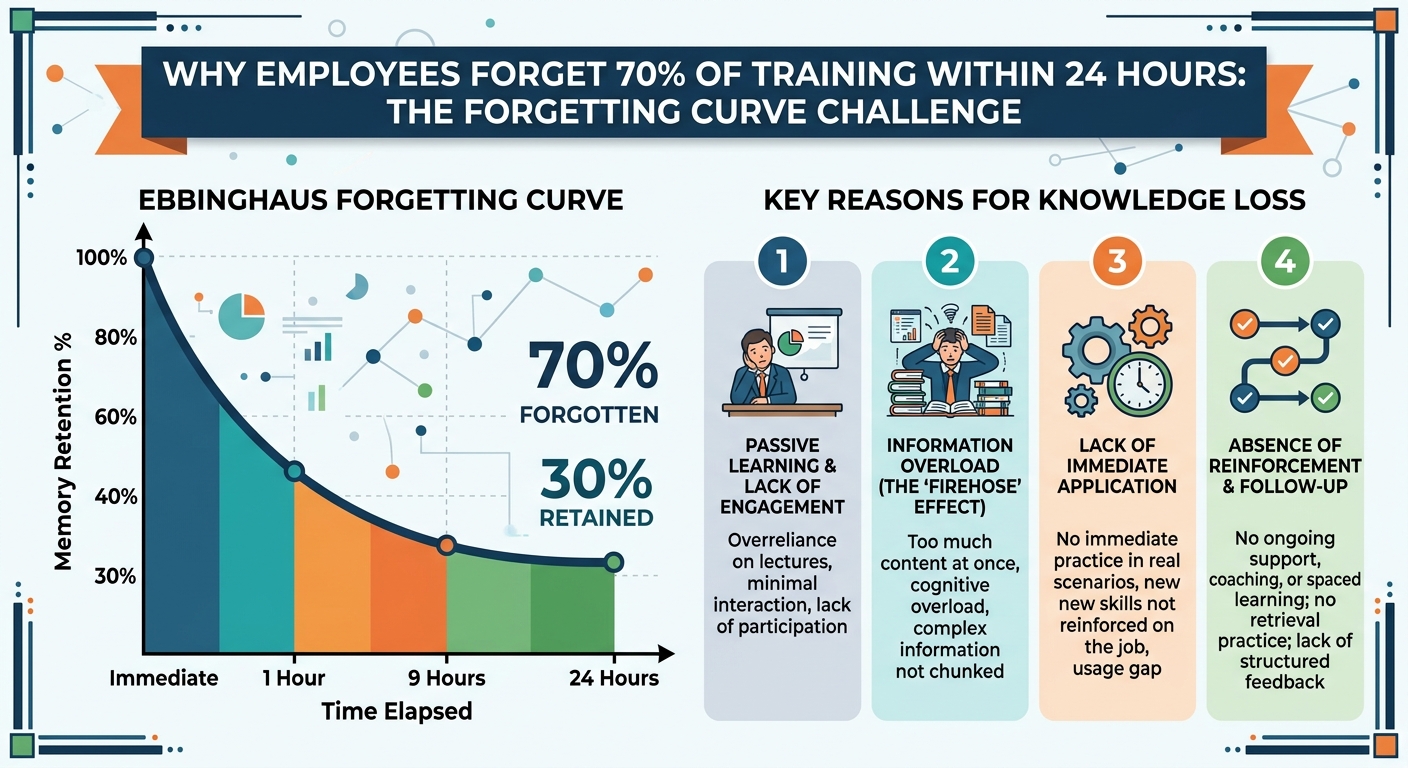
Why Do Employees Forget 70% of Training Within 24 Hours?
As Vice Presidents, Directors, and Senior Managers in Learning & Development, you know the scenario well: significant resources are poured into crafting comprehensive training programs, only for a disheartening percentage of that knowledge to vanish shortly after delivery. The statistics are stark—research indicates that employees can forget up to 70% of new information within just 24 hours. This isn't merely an inconvenience; it represents a substantial drain on your budget, a hurdle to compliance, and a significant impediment to workforce performance across industries like Banking, Finance, Insurance, Retail, Pharma, Healthcare, Hospitality, Oil and Gas, and Mining.
The problem isn't necessarily with your employees' intelligence or commitment. It's often rooted in the fundamental design and delivery of traditional training. Understanding why this rapid knowledge decay occurs is the first step toward building more effective, enduring learning experiences that truly stick.
The Science Behind the Swift Forgetting
The concept of rapid knowledge loss isn't new; it's a well-documented psychological phenomenon. Hermann Ebbinghaus’s "Forgetting Curve," developed over a century ago, illustrates how quickly information is forgotten if there's no attempt to retain it. Without reinforcement, engagement, or practical application, newly acquired knowledge rapidly fades from memory. For L&D professionals, this curve isn't just an academic concept; it's a critical challenge impacting every aspect of employee development, from onboarding to complex compliance and sales training.
Traditional Training: A Recipe for Forgetting
Many conventional training methods inadvertently contribute to this steep decline in retention:
- Information Overload: Long, dense sessions overwhelm learners, making it difficult for their brains to process and store new data effectively. Imagine a full-day seminar on new regulatory compliance; the sheer volume of data makes recall challenging.
- Passive Learning: Lectures, lengthy presentations, and extensive reading materials often promote passive reception rather than active engagement. Without interaction, practice, or problem-solving, information enters one ear and quickly exits the other.
- Lack of Relevance and Context: If training content doesn't immediately connect to an employee's daily tasks or future career goals, its perceived value diminishes, reducing the motivation to retain it. This is particularly critical in specialized fields like Pharma or Oil and Gas, where practical application is paramount.
- Infrequent Reinforcement: Training events are often isolated occurrences with little to no follow-up. Without spaced repetition or opportunities to apply what's learned, knowledge pathways in the brain weaken and eventually disappear.
- Poor Delivery and Engagement: Monotonous delivery, uninspired content, and a lack of interactive elements can disengage learners, leading to mind-wandering and reduced absorption of critical material.
The Tangible Business Impact of Forgotten Training
When training doesn't stick, the consequences ripple throughout an organization:
- Wasted Resources: Every dollar spent on ineffective training is a dollar lost. This includes direct costs of trainers, materials, and facilities, as well as the indirect cost of employee time away from productive work.
- Increased Risk and Compliance Breaches: In industries like Banking, Finance, Healthcare, and Pharma, forgotten Risk-focused Training can lead to costly errors, regulatory fines, and reputational damage.
- Reduced Productivity and Performance: Employees who haven't retained key skills or knowledge perform less efficiently, make more mistakes, and take longer to complete tasks. This impacts sales quotas, customer service quality in Retail and Hospitality, and operational efficiency in Mining.
- Lack of Skill Development: The inability to retain new skills hinders professional growth and organizational agility, making it harder to adapt to market changes or technological advancements.
- Low Morale and Disengagement: Employees who feel their training is ineffective may become frustrated, leading to decreased motivation and job satisfaction.
Revolutionizing Learning: Solutions for Lasting Retention
Combating the forgetting curve requires a strategic shift in how we approach enterprise learning. Modern LMS solutions, like a robust MaxLearn LMS, offer powerful tools to transform your training efficacy.
Embracing Modern Learning Methodologies
To ensure knowledge retention, L&D leaders must prioritize methodologies that actively engage learners, provide relevant content, and reinforce learning over time:
- Bite-sized Learning for Enhanced Recall: Instead of long sessions, break down complex topics into short, focused modules. Microlearning LMS platforms deliver information in digestible chunks, making it easier for employees to absorb, retain, and apply knowledge immediately. This is particularly effective for just-in-time learning and performance support.
- Engaging the Modern Learner with Interactivity: Passive learning is out; active participation is in. Implement interactive elements, quizzes, simulations, and real-world scenarios. A Gamified LMS injects fun and competition into learning, significantly boosting engagement and motivation, which are critical for retention.
- Personalization for Deeper Impact: One-size-fits-all training rarely works. Leverage data and technology to tailor content to individual needs, roles, and learning styles. Adaptive Learning paths adjust to a learner's progress, focusing on areas where they need more support and skipping what they already know, optimizing learning efficiency and effectiveness.
- Leveraging Artificial Intelligence for Smarter Content: AI isn't just a buzzword; it's a game-changer for content creation and delivery. An AI Powered Authoring Tool can help generate, update, and personalize learning content at scale, ensuring relevance and reducing the burden on L&D teams. This allows for dynamic updates essential in fast-changing regulatory environments.
The Imperative of Reinforcement and Continuous Learning
Even the best initial training won't withstand the forgetting curve without strategic follow-up. Incorporate:
- Spaced Repetition: Schedule short refreshers, quizzes, or challenges at increasing intervals after initial training. This strengthens memory traces over time.
- Performance Support Tools: Provide easy access to job aids, checklists, and quick reference guides that employees can consult at the point of need.
- Social Learning: Foster communities where employees can share knowledge, ask questions, and learn from peers.
- Feedback and Coaching: Regular feedback on performance related to training reinforces learning and identifies areas for further development.
Common Questions L&D Leaders Ask
As you navigate the complexities of enterprise learning, several questions often arise concerning optimization and universal applicability:
What strategies are most effective in boosting long-term knowledge retention from corporate training?
The most effective strategies involve a blend of modern methodologies delivered via a robust learning management system. This includes microlearning for digestible content, gamification for engagement, adaptive learning for personalization, and continuous reinforcement through spaced repetition and performance support. Utilizing an advanced cloud based learning management system allows for global deployment and consistent access to these vital tools. A comprehensive LCMS (Learning Content Management System) ensures your content is always relevant and easy to manage.
Do learning retention challenges vary significantly across diverse industries and international workforces?
While the fundamental principles of the forgetting curve apply universally, the *manifestation* of learning retention challenges and the *urgency* of effective training can vary significantly. In highly regulated sectors like Pharma, Finance, or Healthcare, compliance training with high retention is non-negotiable due to legal and safety implications. In Sales or Retail, applied knowledge directly impacts revenue. For international workforces, cultural nuances, language barriers, and access to technology must be considered, making a flexible enterprise learning management solution crucial. However, the core need for engaging, relevant, and reinforced learning remains constant across all segments.
How can AI-driven platforms revolutionize the way we combat the forgetting curve in employee development?
Artificial intelligence is transforming learning by enabling unprecedented levels of personalization, efficiency, and intelligence. AI can analyze learner data to identify knowledge gaps, recommend tailored content, and predict when reinforcement is needed. An AI Powered Authoring Tool streamlines content creation, making it faster to produce engaging, relevant materials. AI-powered chatbots can provide instant answers and support. This dynamic, responsive approach helps learning management software adapt to the individual, ensuring that training isn't a one-time event but an ongoing, intelligent journey designed to counteract the natural tendency to forget.
Conclusion
The alarming statistic that employees forget 70% of training within 24 hours is a call to action for every L&D leader. It's an indictment of outdated methods and a clear signal to embrace innovative solutions. By understanding the psychology of forgetting and strategically implementing modern eLearning approaches—such as microlearning, gamification, adaptive learning, and AI-powered content creation—we can transform employee training from a fleeting event into a lasting investment. A robust LMS learning management system is no longer just a delivery platform; it's a strategic partner in building a knowledgeable, compliant, and high-performing workforce ready to tackle the challenges of today and tomorrow. The future of learning management solutions lies in making learning unforgettable.
.jpg)


