

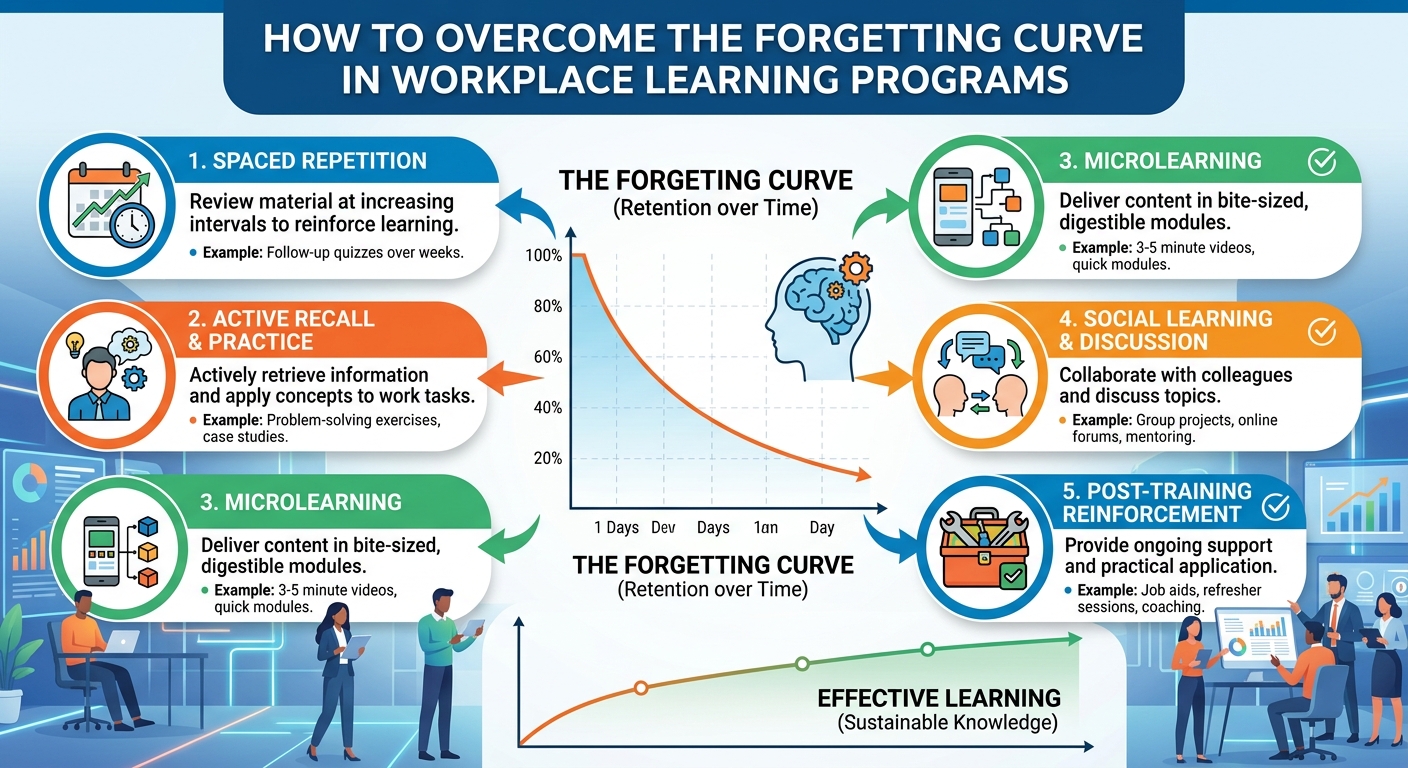
How to Overcome the Forgetting Curve in Workplace Learning Programs
As leaders in Learning & Development, you understand the critical role continuous learning plays in driving organizational success. Yet, there’s a formidable adversary quietly undermining your best efforts: the forgetting curve. Hermann Ebbinghaus’s groundbreaking research revealed that within just an hour, people forget about 50% of new information, and within a month, close to 90%. This stark reality isn't just a psychological phenomenon; it's a significant drain on your training budgets, a hurdle to compliance, and a barrier to employee performance across industries like Compliance, Sales, Banking, Finance, Insurance, Retail, Pharma, Health care, Hospitality, Oil and Gas, and Mining.
For L&D Vice Presidents, Directors, and Senior Managers, the challenge isn't just delivering content; it's ensuring that knowledge sticks. This article will explore proactive strategies and modern eLearning solutions to flatten the forgetting curve, maximizing the ROI of your workplace learning programs and fostering a culture of lasting knowledge retention.
Understanding the Forgetting Curve in Corporate Training
The forgetting curve illustrates the rate at which newly acquired information is lost over time when there is no attempt to retain it. In the context of corporate training, this translates to employees attending workshops, completing online modules, or participating in simulations, only to find a significant portion of that learning fading away shortly after. Traditional "event-based" training, characterized by one-off sessions, is particularly vulnerable to this effect, leading to a frustrating cycle of retraining and underperformance.
The High Cost of Forgetting
The implications of the forgetting curve are far-reaching and costly for any organization. Consider these impacts:
- Compliance Risks: In heavily regulated industries such as Banking, Finance, Pharma, and Health care, forgotten compliance protocols can lead to severe penalties, legal liabilities, and reputational damage.
- Reduced Sales Performance: For sales teams, forgetting product features, sales techniques, or customer relationship management (CRM) processes directly translates to lost deals and missed revenue targets.
- Operational Inefficiencies: Across Retail, Hospitality, Oil and Gas, and Mining, forgotten operational procedures can cause errors, delays, safety hazards, and decreased productivity.
- Wasted Training Investment: Every dollar spent on training that isn't retained is a dollar lost. This impacts budget allocation and the perceived value of the L&D department.
- Stifled Innovation: When foundational knowledge isn't solid, employees struggle to build upon it, hindering problem-solving and innovation.
Strategies to Combat the Forgetting Curve Effectively
Overcoming the forgetting curve requires a strategic shift from one-off training events to continuous, reinforced learning journeys. Here's how L&D leaders can make that happen:
Microlearning: Small Doses, Big Impact
Break down complex topics into bite-sized, easily digestible modules. Microlearning LMS platforms deliver short videos, infographics, quizzes, or interactive scenarios, making learning less intimidating and more accessible. These small bursts of information are perfect for just-in-time learning and frequent reinforcement, making them ideal for busy professionals.
Spaced Repetition: Reinforcing Knowledge Over Time
Based on Ebbinghaus's own findings, spaced repetition involves re-exposing learners to content at increasing intervals. This method leverages the brain's natural way of consolidating memories, moving information from short-term to long-term storage. A sophisticated LMS can automate this process, scheduling timely reminders and reviews based on a learner's performance.
Interactive and Gamified Learning
Engagement is key to retention. Integrating game-like elements such as points, badges, leaderboards, and challenges into your training significantly boosts learner motivation and participation. A Gamified LMS transforms learning into an enjoyable experience, where employees actively participate and apply their knowledge in a low-stakes environment, leading to deeper understanding and better recall.
Personalized and Adaptive Learning Paths
One-size-fits-all training rarely works. Adaptive Learning tailors content and pace to individual learner needs, strengths, and weaknesses. By dynamically adjusting the learning path, these systems ensure that employees spend more time on topics where they need help and less on what they already know, optimizing efficiency and engagement. This approach is invaluable for complex roles in industries like Pharma or Oil and Gas.
Leveraging Advanced Technologies for Smarter Learning
Modern learning solutions, often leveraging artificial intelligence, offer unprecedented capabilities to combat the forgetting curve.
-
In our increasingly global and specialized industries, how can we efficiently develop highly relevant and culturally appropriate training content that resonates with diverse teams?
An AI Powered Authoring Tool can streamline content creation, localization, and customization, ensuring learning experiences are contextually perfect and engaging for various regional and functional groups.
-
With vast amounts of learning data available, what advanced tools can truly analyze individual learner strengths and weaknesses, then dynamically adapt future learning pathways for optimal skill development?
AI-driven analytics within a sophisticated learning management system can provide deep insights into learner performance, predict areas of struggle, and automatically tailor content recommendations, ensuring a truly personalized and effective learning journey.
-
Especially in highly regulated sectors like banking or healthcare, how can we proactively identify and address knowledge gaps that pose significant compliance or operational risks, ensuring critical information is not just learned, but durably retained?
Implementing Risk-focused Training, often powered by AI to identify high-risk knowledge areas, ensures continuous reinforcement of crucial information, significantly mitigating compliance breaches and operational errors.
Practical Application and Real-World Scenarios
Learning by doing vastly improves retention. Incorporate simulations, case studies, role-playing, and hands-on exercises that allow employees to apply their knowledge in realistic scenarios. This method is particularly effective for developing critical skills in Sales, Hospitality, and technical fields like Mining.
Continuous Feedback and Assessment
Regular, low-stakes assessments and immediate feedback help learners identify knowledge gaps and reinforce correct understanding. This continuous loop of learning, application, and feedback is crucial for solidifying new skills and information.
The Role of a Modern Learning Platform
Implementing these strategies effectively requires a robust and intelligent learning management system (LMS). A modern LMS acts as the central hub for all your learning initiatives, integrating microlearning, spaced repetition, gamification, and adaptive learning capabilities. An enterprise learning management solution provides the infrastructure to deploy, manage, and track diverse training programs across your organization.
When selecting a learning management software, look for a cloud based learning management system that offers comprehensive features such as a powerful learning content management system (LCMS), advanced analytics, and seamless integration with existing HR systems. A true lms learning management system should not only deliver content but also provide insights into learner engagement and knowledge retention, allowing L&D leaders to continuously refine their strategies. For example, a MaxLearn LMS offers the tools necessary to tackle the forgetting curve head-on, ensuring your organization's learning efforts yield lasting results.
Conclusion
The forgetting curve is an inherent challenge in workplace learning, but it is not an insurmountable one. By embracing a holistic approach that combines intelligent instructional design with cutting-edge learning technology, L&D leaders can transform how their organizations learn and retain knowledge. Implementing strategies like microlearning, spaced repetition, gamification, and adaptive learning, all powered by a sophisticated LMS, creates a dynamic learning ecosystem that actively combats knowledge decay.
The time to move beyond traditional training paradigms is now. Invest in a strategic, data-driven learning approach that not only delivers information but ensures it sticks, empowering your workforce, mitigating risks, and driving sustained growth across all industries. Your organization’s future depends on it.
.jpg)


