

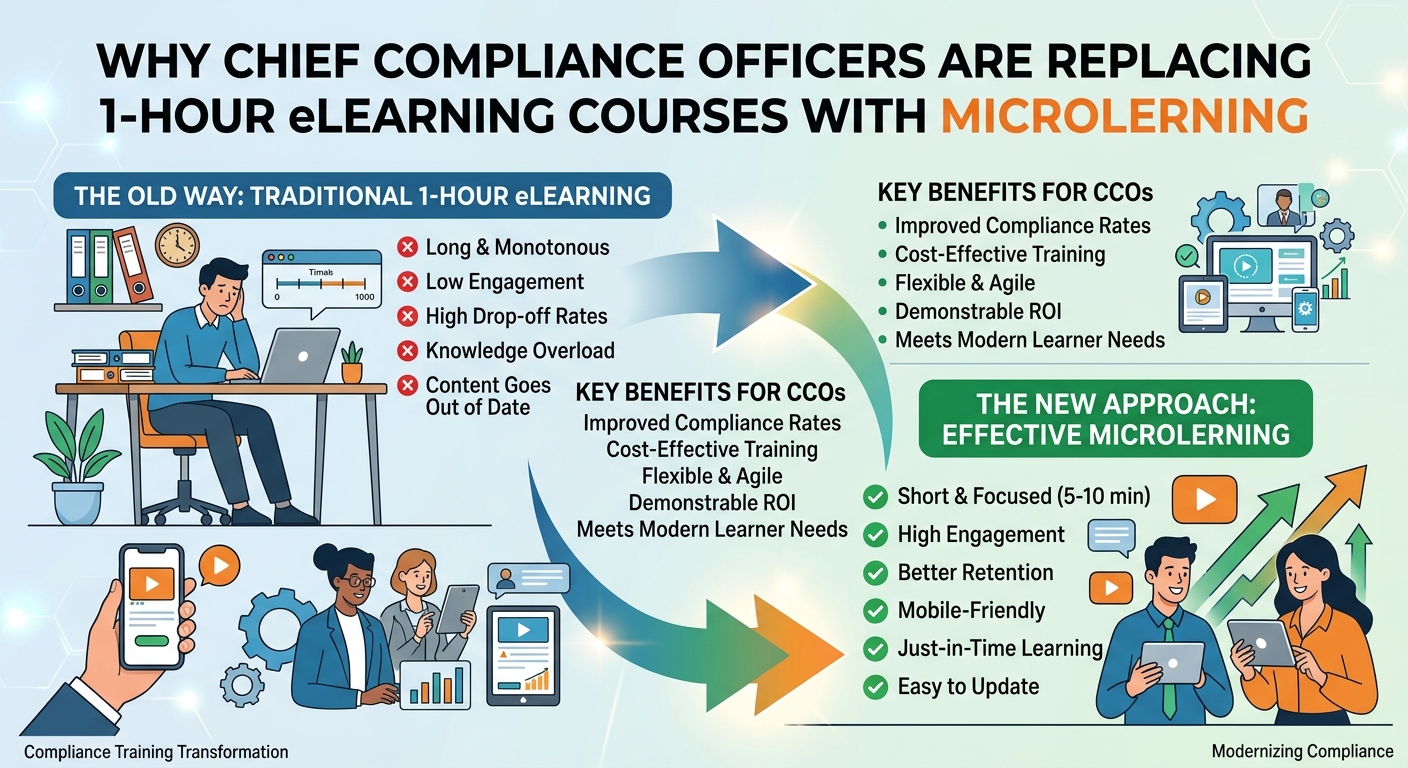
Why Chief Compliance Officers Are Replacing 1-Hour eLearning Courses with Microlearning
In the dynamic landscape of corporate governance, compliance is not just a buzzword; it's the bedrock of an organization's integrity, reputation, and financial stability. For Chief Compliance Officers (CCOs), ensuring every employee understands and adheres to intricate regulations is a monumental task. Historically, this has often meant mandatory, hour-long eLearning courses – often dreaded, frequently skimmed, and rarely effective in fostering lasting knowledge or behavioral change.
However, a seismic shift is underway. Forward-thinking CCOs, in collaboration with L&D leaders, are increasingly abandoning the traditional "one-and-done" annual training model in favor of a more agile, engaging, and demonstrably effective approach: microlearning. This isn't merely a trend; it's a strategic evolution driven by the pressing need for real-time relevance, improved retention, and measurable impact in a world of ever-evolving risks.
The Compliance Conundrum: Why 1-Hour eLearning Falls Short
The limitations of conventional compliance eLearning are well-documented and deeply felt across industries from Banking and Finance to Pharma and Oil and Gas. These include:
- Information Overload: Cramming extensive legal and regulatory information into a single, long module overwhelms learners, leading to low retention and a superficial understanding.
- Waning Attention Spans: In an age of instant gratification and constant digital stimulation, maintaining focus for an hour on a dry, often text-heavy course is a significant challenge. Engagement plummets, and learners mentally check out.
- Lack of Contextual Relevance: Generic, broad-stroke courses often fail to address specific roles, departments, or geographical nuances, making the content feel irrelevant to individual employees.
- Inefficient Time Commitment: Requiring employees to block out an hour (or more) for training disrupts workflows, especially in fast-paced environments like Retail or Healthcare, leading to resistance and resentment.
- Difficulty in Updates: When regulations change, updating a lengthy, monolithic course is a time-consuming and costly endeavor, often resulting in outdated training materials.
- Passive Learning: Traditional eLearning often promotes passive consumption rather than active engagement, limiting the application of knowledge in real-world scenarios.
For CCOs, these shortcomings translate directly into heightened risk, potential penalties, and a workforce that is not adequately prepared to navigate complex compliance challenges. The stakes are simply too high for ineffective training.
Enter Microlearning: The Agile Solution
Microlearning offers a compelling antidote to the traditional eLearning malaise. Defined as short, focused bursts of learning content designed to achieve a specific learning outcome, microlearning modules typically last from 2 to 10 minutes. They can take various forms: short videos, interactive quizzes, infographics, quick simulations, or brief scenario-based challenges.
This approach aligns perfectly with modern learning behaviors and the demanding schedules of today's professionals. When integrated into a robust Microlearning LMS, it transforms compliance training from a dreaded chore into an accessible, digestible, and continuous learning journey.
Key Advantages Driving the Shift for CCOs
Enhanced Engagement and Retention
Short, punchy modules are inherently more engaging. They respect learners' time and cater to natural attention spans. By focusing on one key concept per module, microlearning facilitates deeper understanding and significantly improves knowledge retention. The use of varied formats and interactive elements, often found in a Gamified LMS, further boosts learner motivation and recall, ensuring critical compliance information sticks.
Real-time Relevance and Application
Microlearning enables "just-in-time" learning, meaning employees can access specific information precisely when they need it – perhaps before a client meeting in Finance, prior to handling sensitive data in Healthcare, or when encountering a new procedure in Oil and Gas. This immediate applicability reinforces learning and embeds compliance practices directly into daily workflows. It empowers CCOs to implement targeted, Risk-focused Training that addresses emerging threats or specific departmental vulnerabilities.
Scalability and Cost-Effectiveness
Creating and updating microlearning modules is far less resource-intensive than overhauling lengthy courses. This agility allows organizations to respond swiftly to new regulations or internal policy changes. For large enterprises with global footprints, a cloud based learning management system supporting microlearning offers unparalleled scalability, delivering consistent training across diverse teams and geographies without prohibitive costs.
Personalization and Adaptive Learning
One of the most powerful aspects of microlearning, especially when powered by advanced learning platforms, is its capacity for personalization. Instead of a one-size-fits-all approach, Adaptive Learning paths can be created, tailoring content to an individual's role, prior knowledge, performance data, and even preferred learning style. This ensures that every employee receives precisely the training they need, maximizing relevance and minimizing wasted time.
Improved Reporting and Compliance Metrics
A sophisticated learning management system (LMS) designed for microlearning provides CCOs with granular data. They can track completion rates, performance on specific modules, areas of common struggle, and even time-to-completion for individual pieces of content. This detailed insight allows for continuous improvement of training programs and provides concrete evidence of compliance efforts, essential for audits and regulatory bodies. This comprehensive data makes a modern lms learning management system an invaluable asset.
The Role of Technology: Powering the Microlearning Revolution
The successful pivot to microlearning for compliance is underpinned by powerful learning technologies. A robust learning content management system (LCMS) or learning management software is crucial. These platforms provide the framework for creating, delivering, managing, and tracking microlearning assets efficiently. Features like an AI Powered Authoring Tool can dramatically accelerate the content creation process, allowing L&D teams to generate interactive modules faster and with greater consistency.
For enterprise learning management, integrating microlearning with a modern LMS ensures seamless delivery across all departments, whether it's for Sales, Hospitality, or Mining. The ability to push targeted content to specific employee groups means compliance training becomes an integrated, proactive element of operational excellence, rather than a periodic interruption.
Addressing Key Inquiries from L&D Leaders
"How can we ensure our compliance training stays relevant and impactful for every employee, no matter their role or location?"
Leveraging sophisticated learning platforms allows for dynamic content updates and personalized pathways. Intelligent algorithms can analyze an individual's specific job functions, prior knowledge, and regional requirements to deliver precisely the modules they need, eliminating redundant or irrelevant information. This ensures a focused, high-impact learning experience across all departments and geographical boundaries.
"What's the best approach to rapidly create and deploy engaging, compliant content that adapts to evolving regulations and diverse global workforces?"
The answer lies in advanced authoring capabilities integrated within a robust learning management system. Tools that incorporate intelligent content generation and localization features can dramatically reduce development time. They empower L&D teams to quickly adapt existing materials or create new ones, automatically tailoring language, cultural context, and legal nuances for different regions, ensuring swift and accurate compliance training rollout worldwide.
"How can we measure the true effectiveness of our compliance training beyond completion rates, demonstrating genuine behavioral change and risk mitigation?"
Modern learning solutions offer deep analytics that go far beyond simple course completions. By tracking engagement patterns, assessment performance, and correlating training data with incident reports or audit outcomes, organizations can gain actionable insights. This data-driven approach, often augmented by machine learning, helps identify knowledge gaps, predict potential risks, and prove the tangible impact of Risk-focused Training on reducing organizational exposure. It allows CCOs to demonstrate a measurable return on investment for their learning initiatives.
The MaxLearn Advantage
Platforms like MaxLearn LMS are at the forefront of this transformation, offering a comprehensive suite of tools designed to facilitate effective microlearning for compliance. From intuitive content creation to advanced analytics and adaptive pathways, MaxLearn empowers CCOs and L&D teams to build resilient, compliant workforces ready for the challenges of today and tomorrow.
Conclusion
The era of the tedious, ineffective 1-hour compliance eLearning course is drawing to a close. Chief Compliance Officers are no longer content with merely checking a box; they demand demonstrable competence, reduced risk, and a culture of continuous compliance. Microlearning, supported by intelligent learning technologies, provides the strategic solution. For L&D Vice Presidents, Directors, and Managers, this shift represents an opportunity to partner with CCOs to implement innovative, impactful training programs that protect the organization, engage employees, and drive sustainable growth across all industries.
.jpg)


