

How to Prove Compliance Training Effectiveness to Your Board of Directors
In today's complex regulatory landscape, compliance training isn't just a checkbox activity; it's a critical shield protecting your organization from reputational damage, financial penalties, and legal repercussions. For Vice Presidents, Directors, and Managers of Learning & Development, the challenge often isn't just delivering effective training, but demonstrating its tangible impact to the Board of Directors. The board seeks assurance that investments in training translate into concrete risk mitigation and improved organizational performance, moving far beyond mere completion rates.
Convincing the board requires a data-driven narrative that connects learning outcomes to business objectives. It's about showing how your compliance training program isn't just 'good to have,' but essential for the organization's strategic resilience and success.
Understanding the Board's Perspective: What Matters Most?
Your Board of Directors operates at a strategic level, focused on governance, risk management, and long-term organizational value. When it comes to compliance training, their primary concerns typically revolve around:
- **Risk Mitigation:** Is the organization adequately protected against compliance breaches? Are potential legal and financial exposures being proactively addressed?
- **Return on Investment (ROI):** Is the training budget being used efficiently, and what tangible benefits are being realized from the investment?
- **Organizational Culture:** Does the training foster a culture of ethics and compliance throughout the enterprise?
- **Strategic Alignment:** How does compliance training support the company's broader strategic goals and market positioning?
To truly speak their language, L&D leaders must shift from reporting activity metrics to demonstrating business impact.
Beyond Completion Rates: The True Indicators of Effectiveness
While completion rates indicate reach, they reveal little about actual learning or behavioral change. A critical question for modern L&D professionals is: 'How can cutting-edge learning platforms provide tangible data to substantiate compliance training's value?' Modern learning management software (LMS) solutions provide the tools to go deeper.
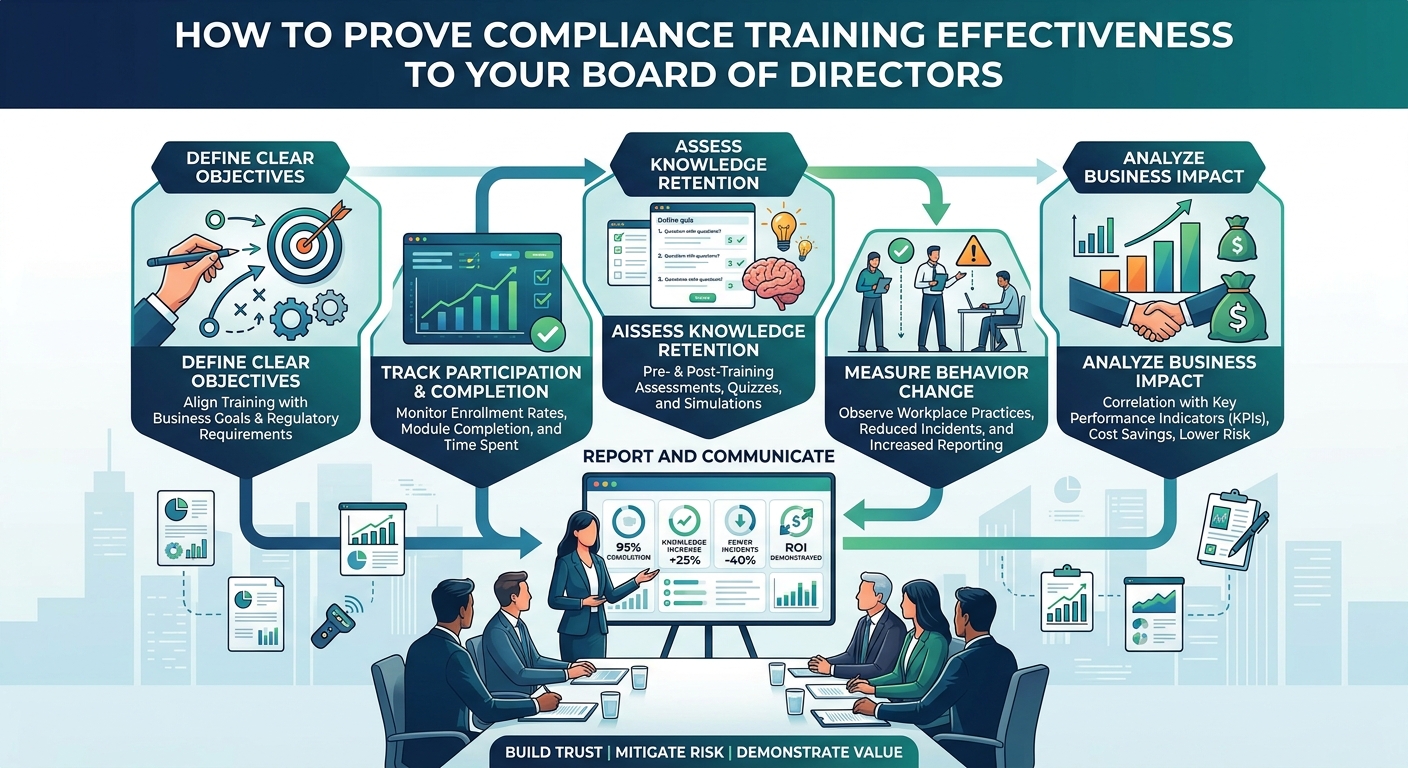
1. Knowledge Acquisition and Retention
Did learners grasp the material, and more importantly, do they retain it over time? This is the foundation of compliance. To prove this:
- Pre- and Post-Assessments: Demonstrate an increase in knowledge scores.
- Knowledge Checks and Quizzes: Integrate regular, short assessments within the training (especially effective with a Microlearning LMS).
- Retention Quizzes: Administer assessments weeks or months after initial training to measure long-term recall.
- Scenario-Based Evaluations: Test employees' ability to apply knowledge in realistic situations, proving understanding beyond rote memorization.
2. Behavioral Change and Application
Knowledge is inert without application. The ultimate goal of compliance training is to influence employee behavior. This is where the rubber meets the road. Senior leadership often asks: 'What truly moves the needle when presenting compliance training's impact?' The answer lies in observable behavioral shifts:
- Reduced Incident Reports: A decrease in non-compliance incidents, policy violations, or audit flags.
- Managerial Observation: Direct feedback from managers on changes in employee behavior related to compliance protocols.
- Simulations and Role-Playing: Evaluate performance in controlled environments that mimic real-world compliance challenges.
- Audit Findings: Positive results from internal and external compliance audits directly reflect effective training.
3. Risk Mitigation and Financial Impact
This is arguably the most compelling metric for the board. Connecting training directly to reduced risk and financial savings makes a powerful case.
- Avoided Fines and Penalties: Quantify the potential cost of non-compliance (fines, legal fees, settlements) that the training helped avert.
- Reduced Legal Costs: Show a decrease in litigation or investigative expenses related to compliance issues.
- Insurance Premium Reductions: Some insurers offer lower premiums for organizations with robust, proven compliance programs.
- Reputational Value Protection: While harder to quantify, maintaining a strong reputation avoids significant long-term costs.
4. Operational Efficiency and Productivity
Effective compliance training can also streamline operations and boost productivity by reducing errors, clarifying processes, and fostering a confident workforce.
- Streamlined Workflows: Employees who understand compliance requirements make fewer mistakes, reducing rework and delays.
- Faster Decision-Making: Clear compliance guidelines empower employees to make quick, informed decisions.
- Employee Confidence: A well-trained workforce is more confident in their ability to perform tasks compliantly, leading to greater efficiency.
Leveraging Modern Learning Technology for Data-Driven Proof
To gather and present these diverse metrics effectively, a robust learning management system (LMS) is indispensable. A modern learning management system (LMS) provides the analytics and reporting capabilities needed to track, measure, and analyze performance across your entire compliance program.
Consider the benefits of advanced learning platforms:
- Analytics Dashboards: A sophisticated learning content management system (LCMS) offers real-time data on learner progress, assessment scores, and engagement.
- Skill Gap Analysis: Identify areas where employees struggle, allowing for targeted remediation and demonstrating where training is most needed.
- Adaptive Learning Paths: Platforms employing Adaptive Learning can tailor content to individual needs, improving efficiency and retention while providing granular data on specific knowledge mastery.
- Engagement Data: A Gamified LMS can track not just completion but also participation, quiz attempts, and interaction with content, providing insights into course effectiveness.
- Content Effectiveness: An AI Powered Authoring Tool can analyze content performance, helping L&D refine courses for maximum impact and pinpointing areas for improvement.
- Targeted Training Reports: Especially with Risk-focused Training, advanced reporting can show how specific training modules directly address identified organizational risks.
When considering diverse operations, a key query arises: 'Are there universal benchmarks for compliance training effectiveness, or must it be tailored across different regions and sectors?' While foundational principles of effectiveness apply, specific benchmarks and reporting requirements often vary significantly by industry (e.g., finance, healthcare, pharma, oil and gas) and geographic region, necessitating flexible and configurable learning management solutions (MaxLearn LMS offers such adaptability). A cloud based learning management system is particularly adept at handling such diverse requirements for enterprise learning management.
Presenting Your Case to the Board
Once you've gathered your data, the presentation is key. Frame your report with the board's perspective in mind:
- Start with the "Why": Reiterate the strategic importance of compliance and how your training program supports it.
- Tell a Story with Data: Don't just present raw numbers. Show trends, connect cause and effect, and highlight successes. Use clear visuals like graphs and charts.
- Focus on Risk Reduction and ROI: Quantify the financial benefits and mitigated risks. Use clear dollar figures where possible.
- Highlight Key Achievements: Showcase examples of improved employee performance, reduced incidents, or positive audit outcomes.
- Address Challenges and Future Plans: Acknowledge areas for improvement and outline how future initiatives will address them, demonstrating continuous improvement.
- Be Prepared for Questions: Understand your data inside and out and be ready to elaborate on methodologies and findings.
Conclusion
Proving compliance training effectiveness to your Board of Directors is more than a reporting exercise; it's an opportunity to underscore L&D's strategic value and solidify its role as a critical business driver. By moving beyond simple completion rates and focusing on measurable outcomes like knowledge retention, behavioral change, and quantifiable risk reduction, you can build a compelling case. Leveraging advanced learning management solutions, such as a comprehensive learning management system (LMS), empowers L&D professionals to collect, analyze, and present the robust data needed to gain board confidence and ensure that your organization remains compliant, resilient, and ready for future challenges. Investing in the right learning management solutions is not just about delivering training, it's about securing your organization's future.
.jpg)


